Eagles-Chiefs film: Spying Mahomes, handling exotic blitzes, and other keys in the Super Bowl rematch
Set to meet for the second time in seven months, the Eagles and Chiefs enter Week 2 with two major areas in need of improvement. Here’s what to watch on both sides of the ball Sunday.

The Eagles and the Kansas City Chiefs meet on Sunday for the second time in seven months after the Birds trounced Patrick Mahomes in Super Bowl LIX. The biggest storylines coming out of that game? The Eagles’ dominant pass rush and Kansas City’s inability to sustain drives.
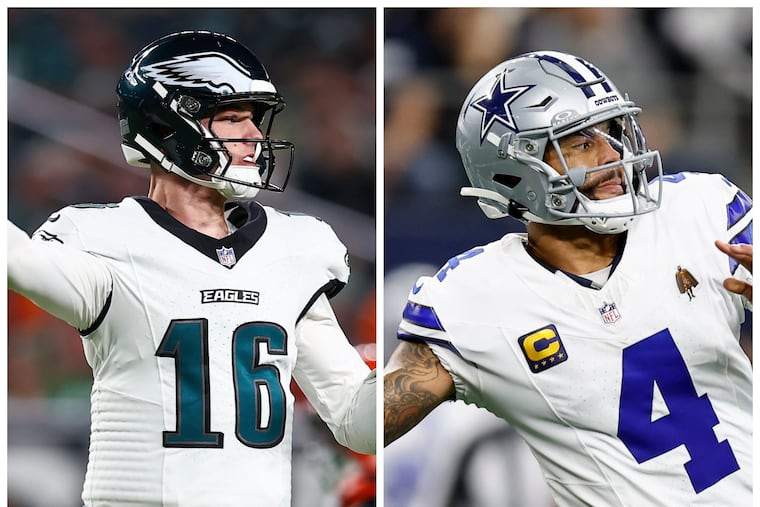
That pass rush is no more for the Eagles, who generated only 12 quarterback pressures and recorded zero sacks in Week 1 against Dallas — the Eagles were one of three teams that didn’t record a sack in the opening week of the NFL season. Kansas City, meanwhile, is down receivers Xavier Worthy and Jalen Royals and the offensive line has two new starters in rookie left tackle Josh Simmons and left guard Kingsley Suamataia.
» READ MORE: The Eagles are lucky Jalen Carter will play Sunday. They’ll be luckier if Patrick Mahomes doesn’t bait him, too.
After a slow start, Mahomes was the main driver of Kansas City’s offense, accounting for 306 of the team’s 347 offensive yards in a loss to the Los Angeles Chargers in São Paulo, Brazil.
The Eagles held him to six points through three quarters in February. Can they do it again Sunday?
Here are some keys to the matchup (4:25 p.m., Fox) and points of emphasis for the Eagles on both sides of the ball:
Containing Mahomes
Mahomes picked up 57 yards on six scrambles outside the pocket against the Chargers, but there were a few times Los Angeles was prepared to stop him. Linebacker Dayian Henley was a quarterback spy on third-and-9 from the Chargers’ 9-yard line. The other stops on Mahomes were a product of maintaining rushing lane integrity or retracing their pass-rush stem.
Could linebacker Jihaad Campbell be deployed in a quarterback spy role? At Alabama, he showed the ability to close on ballcarriers from well off the line of scrimmage and occasionally spy the quarterback when he wasn’t sent on a blitz or pass rush. But against the Cowboys, Campbell, especially on third downs, spent more time dropping into coverage to man the middle of the field than rush the passer.
That could change this week against the Chiefs for an offense that will rely even more on Mahomes’ playmaking with Kansas City down two potential impact receivers.
While Mahomes scrambled for first downs multiple times in the opener, he was especially effective on three throws that went for big yardage: a sidearm throw on a first-and-20 in the first half, a flip to Juju Smith-Schuster for a crucial third down in the third quarter, and a cross-body 49-yard heave to Marquise Brown, keeping the game alive late in the fourth quarter.
Limiting those explosive plays will be important, but so will a strong pass rush. The Eagles obviously struggled in that aspect against the Cowboys without Jalen Carter, although defensive tackle Jordan Davis and edge rusher Jalyx Hunt got close to bringing down Dak Prescott.
The Eagles replicating their 38.1% quarterback pressure rate from the Super Bowl, according to Next Gen Stats, seems unlikely. But generating more than 12 pressures will be important against a Kansas City offense that struggles running the ball on early downs.
Dealing with Spagnuolo’s blitz packages
The Cowboys sat back in zone coverage on every Jalen Hurts dropback during the season opener, and the Chiefs did something similar to the Chargers in the first half of their matchup. According to Next Gen Stats, the Chiefs deployed zone coverage on 85.7% of Justin Herbert’s first-half dropbacks, tied for the highest rate in a first half under Kansas City defensive coordinator Steve Spagnuolo.
» READ MORE: Eagles vs. Chiefs in Week 2: Here are the numbers that matter
That number dipped to 35% in the second half, and when the Chiefs played man coverage, they sent an extra pass rusher on almost 70% of the snaps. Across 16 dropbacks, Herbert carved up the Chiefs when they blitzed, completing 11 of 14 passes for 173 yards and one touchdown. On six of those dropbacks, though, Herbert was pressured and he was sacked three times. His average time to throw was 2.58 seconds.
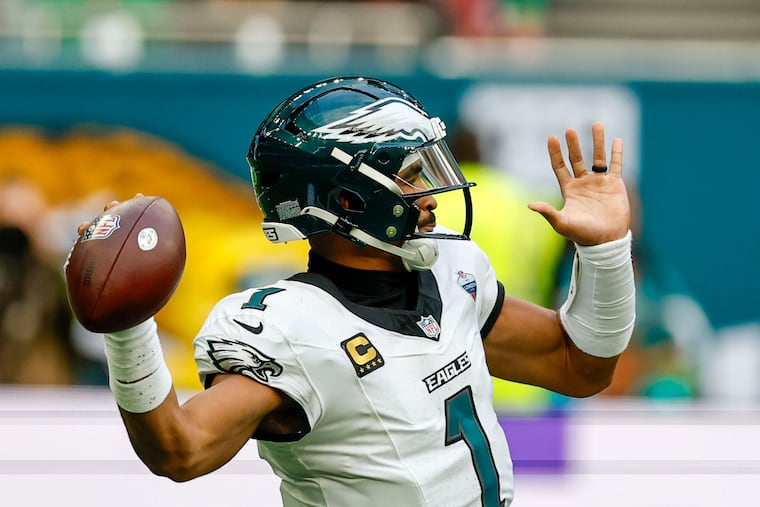
Handling the blitz was an area of strength for Hurts last season. Between the playoffs and postseason, according to Next Gen Stats, Hurts completed 64.5% of his passes with five or more rushers bearing down on him. He also had a 10-2 touchdown-to-interception ratio, with an average time to throw of 2.84 seconds, meaning he got the ball out quickly.
In the opener, Dallas blitzed six times in the second half, and found some success doing so. Hurts completed 3 of 4 passes for 17 yards but was pressured on five of the dropbacks and sacked one time. His average time to throw on such plays was 3.31 seconds, 0.17 seconds slower than when he wasn’t blitzed and nearly a half second slower than last year.
Both of Drue Tranquill’s sacks against the Chargers came on blitzes, when he disguised himself pre-snap aligned as a slot defender. The sack of Hurts came from Dallas’ DaRon Bland having a similar alignment pre-snap, forcing the Eagles quarterback to drop his eyes and eventually be taken down by Marshawn Kneeland.
Expect the Chiefs to blitz more often than Dallas did, especially on second downs to put the Eagles behind the sticks. For reference, the Chiefs sent blitzes on eight of Hurts’ 29 dropbacks in the Super Bowl — he was pressured twice, sacked once, and had one interception.
Getting the running game back on track
In Saquon Barkley’s last two games, Super Bowl LIX and the season opener, he managed 57 and 60 yards, respectively, averaging just 2.7 yards per carry over his last 43 attempts.
» READ MORE: Forget all the Week 1 questions: The Eagles are still better than the Chiefs
Dallas stacked the box with eight or more defenders on 12 of Barkley’s 18 runs, nearly three times more than the average last year (20.7%) and the Eagles star finished with just 33 yards on those attempts, according to Next Gen Stats.
The Cowboys stacked the box as frequently as they did because the Eagles used 13 personnel (one running back, three tight ends) at a 17.4% rate, the highest in the NFL in Week 1, according to Sumer Sports. The league average in that formation was only 3.61% across the NFL.
While the Eagles led the NFL in 13 personnel last year, one reason the running game struggled last week was because their tight ends missed or failed to sustain blocks at the line of scrimmage. Barkley’s longest run was a 16-yard carry in the first quarter, which came on an outside toss play to the opposite side of Dallas Goedert, Grant Calcaterra, and Kyle Granson in 13 personnel.
» READ MORE: What we know (and don’t) about the Eagles entering Week 2 vs. the Chiefs
The Eagles had their best success running from 11 personnel (one running back, one tight end). Sumer Sports had the Eagles with the second-best expected points added (EPA) on running plays from that formation. That is noteworthy because the Chiefs struggled to stop the run against the Chargers out of that formation, finishing with a -0.03 EPA against the run in 11 personnel. Barkley broke off runs of 12 and 10 yards against Dallas, plus Will Shipley’s screen pass, counted as a run, went for 20 yards, all out of 11 personnel.
The Eagles have a clear advantage they can exploit against the Chiefs by utilizing it in their running game in 11 personnel. Outside and inside zone runs, allowing Barkley to get downhill quickly, can set up play-action passes for Hurts as well.
Kansas City’s defense faced just 18 runs (without scrambles from Herbert) in Week 1 and allowed just 3.2 yards per carry. But the Chargers found success utilizing the pin-and-pull run game scheme, which gets two pulling linemen leading the way on an outside run. Running back Omarion Hampton popped runs for 10 and 8 yards, and each run was out of 11 personnel.
With Hurts’ running ability keeping the defense honest, Barkley could find more success against a Chiefs front seven that looks less effective than it did a year ago. Reestablishing the line of scrimmage will be a big key for the Eagles offense to look as dynamic as it did a year ago.

Even with all the injuries and ineffectiveness through six games, Sean Mannion is still a believer in the Eagles’ offense, saying the problems are “totally fixable.” The Inquirer’s Jeff McLane and Marcus Hayes have some thoughts on the state of Mannion’s group, as well as a defensive unit that’s also been underwhelming this season. Listen here.
Listen to all episodes here or wherever you get your podcasts.