Howie Season begins today. It’s his toughest one yet, for three big reasons.
The questions that will actually define the Eagles' offseason and shape their strategy are complicated to answer.
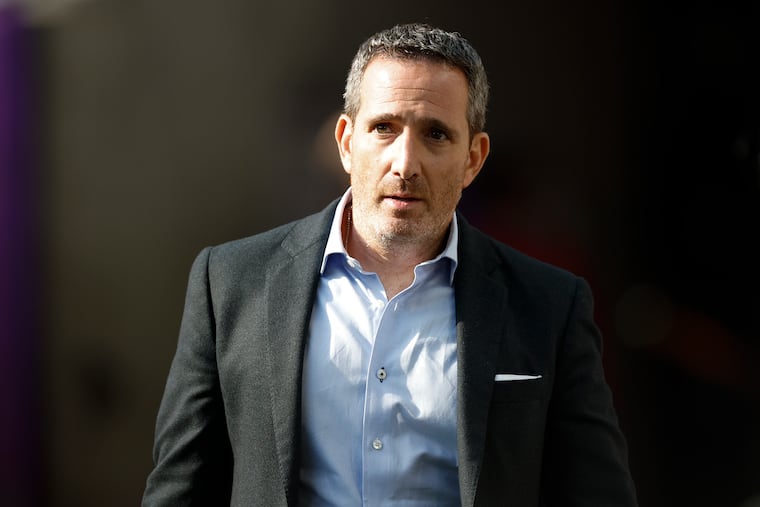
This is the most fascinating free agency period of the Howie Roseman era. Sure, it has something to do with A.J. Brown. But not primarily. If anything, the ongoing trade chatter about the star wideout is a symptom of that which lies down the road.
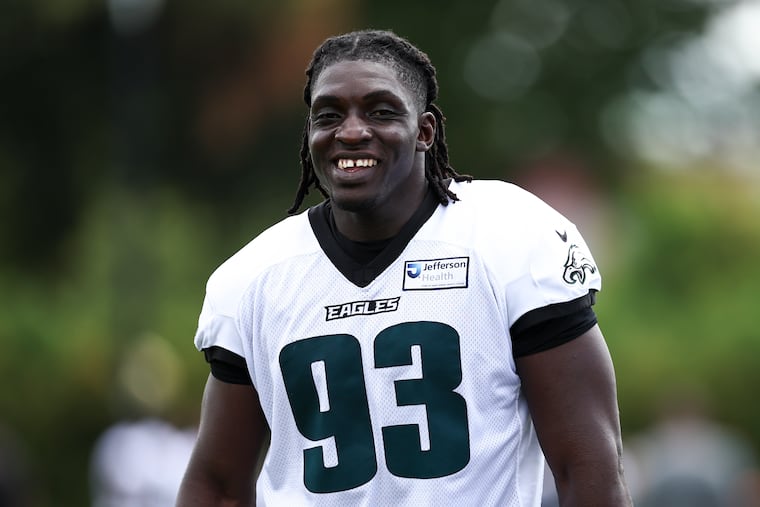
We saw a preview of it this weekend. Everyone knew Jordan Davis was going to get paid, and most of us agreed that the Eagles would be right to do it. Yet there is something about seeing the numbers on paper that drives home the magnitude of the challenge that Roseman faces. Three years and a reported $78 million is a lot of money for a player most would rank a distant fourth in importance among the young defensive stars the Eagles have drafted over the last four years.
» READ MORE: Jordan Davis: A feel-good story about a gentle giant who will continue with the Eagles through 2029
As of Sunday night, the structure of Davis’ deal had not yet been reported. Until that happens, we won’t know how much more cap room the Eagles have given themselves this season. What we do know is that the last year of Davis’ deal will run headlong into a four-way intersection of looming extensions for defensive tackle Jalen Carter and cornerbacks Quinyon Mitchell and Cooper DeJean. The meat of the cap hits on those extensions likely will not coincide until 2029, when the three latter players all figure to be in at least the second year of any big money deal. That doesn’t make the present-day implications any less acute.
Those implications make it awfully difficult to forecast or opine upon the Eagles’ optimal strategy in the free agent signing period, which effectively begins today with the opening of the NFL’s so-called legal-tampering window. Moving forward, every spending decision the Eagles make will either impact or be impacted by their motivation to retain Carter, Mitchell, and DeJean alongside Davis. And let’s not forget, in a hard-capped environment such as the one that constrains NFL GMs, every roster move is a spending decision.
The further you are from the official spreadsheets, the easier it is to say that the Eagles should heap mega money upon Isaiah Likely, or present Jake Tonges with an offer sheet the 49ers can’t match, even if it costs significant draft capital, or re-sign Jaelan Phillips regardless of his market. The questions that will actually define the Eagles offseason and shape their strategy are much more complicated to answer.
1. How confident are the Eagles that Carter will be here long term?
A year ago, you might’ve snickered at any answer less than 95%. Maybe that’s still the case. Elite talent is the ultimate arbiter in pro sports, and Carter has more of it than almost any other defender in the NFL. He is a game-wrecker, the antidote for any offensive scheme. The defensive tackle position has exploded in value because it is the one position that can’t be schemed around. An elite cornerback takes away half the field, but that still leaves the other half. There are some strategies to counteract elite edge rushers. You can chip, misdirect, move a pocket, etc. There is no easy solution for a man who can knock a double-team backward or flatten any interior lineman who attempts to handle him one-on-one. Aaron Donald showed everybody this during his prime with the Rams. That’s the level of dominance that Carter has flashed during his first three years with the Eagles. I mean, the guy single-handedly makes a statistically significant impact on the make percentage of field goals.
» READ MORE: The Eagles whiffed on Maxx Crosby. It should remind them of what they stand to lose with A.J. Brown.
Even the least risky of players creates a unique level of risk when he has the potential to set a new ceiling on the pay at a position. We saw that with Myles Garrett and the Browns over the last year-plus. It is difficult to value a player who has no comps. That’s especially true for a team that must budget for two other unique talents, which the Eagles have in Mitchell and DeJean.
With Carter, the uncertainty is compounded by his health and his volatility. He is coming off a season that began with him spitting in the face of an opposing player on the first play from scrimmage, earning an ejection that the NFL treated as a de facto one-game suspension. He then missed time to address a shoulder injury that sapped his strength. He looked much better after he returned. But how close to his old self was he?
Carter is extension-eligible now, but the Eagles would need to feel awfully comfortable with the price tag in order to be willing to commit three or four years of cap inflexibility to him. That’s true however modest one deems the aforementioned question marks. At a certain price point, there can be no question marks.
The obvious path forward is to play out the year on Carter’s existing deal and see where things stand. The risk is that Carter plays 17 games like a Defensive Player of the Year and eliminates whatever discount the Eagles might have gotten had they signed him now. Again, though, we’re assuming such a discount is negligible. In which case, the Eagles would be in a position to pay him what he is worth, or trade him to a team that is comfortable doing so. There would be no shortage of suitors.
2. How much will DeJean make if he maintains his current role in the slot?
Neither cornerback is nearly as likely as Carter to be in a position to pick a number, any number. But both play a position where even the very good are so far beyond replacement level, and, thus, are very richly rewarded. DeJean brings the added uncertainty of his positional fungibility. Is his value closer to an elite outside cornerback or an elite safety? It’s not a question we need to dive into right now. The uncertainty is the point.
» READ MORE: Eagles free agency roundtable: Who are some realistic targets — and bigger targets — for the Birds?
What Mitchell and DeJean are doing is basically unprecedented. The Eagles are the only team in the last 40 years to have two of their own draft picks earn All-Pro honors at cornerback in the same season. Mitchell and DeJean just happened to be drafted in the same year. Good luck finding comps for Roseman’s looming financial decisions. The Cowboys had Trevon Diggs and DaRon Bland both make an All-Pro team in a three-year span before either was extension-eligible. But Diggs’ star faded pretty quickly after his 2021 nod. The Cowboys signed him to a sizable but less-than-elite-money extension after the 2022 season and released him this year, when the first year of Bland’s extension kicked in.
The most comparable situation for the Eagles is probably the Texans, who have managed to retain Derek Stingley Jr. and super slot Jalen Pitre, even with a monster extension looming for edge rusher Will Anderson. But then, the Texans still have quarterback C.J. Stroud playing on his rookie contract.
3. How confident are the Eagles that they can add what they need for 2026 in the draft and free agency?
The tight end position is one that I keep coming back to, whether Brown is on the team or not. It is one of the most difficult positions to find a player who actually makes a positive impact in his rookie season. It is even more difficult to do when a team’s first pick is No. 23 overall. If Brown returns, the Eagles need to find an upgrade over second tight end Grant Calcaterra, plus an upgrade over Jahan Dotson as WR3. If Brown is traded, they need to find significant upgrades over Darius Cooper at WR2, plus upgrades over what they had last year at TE1 and TE2, dependent on the extent of their upgrade at WR2.
Even if the solution exists, is it feasible to execute while also retaining Phillips or finding a replacement edge rusher? Or would it be wiser to take their medicine this season by trading Brown, bidding adieu to Dallas Goedert, and eating their cap hits? Is that even feasible?
The calculus is convoluted, and that makes it fascinating. They call it Howie Season for a reason. We will all be witnesses.

The Eagles’ regular season roster is set - for now. How ready is the team for the new year, and will the talent be enough for the Eagles to get back to Super Bowl contention? The Philadelphia Inquirer’s Jeff McLane and Mike Sielski examine general manager Howie Roseman’s final roster decisions in the aftermath of cutdown day. Listen here.
Listen to all episodes here or wherever you get your podcasts.