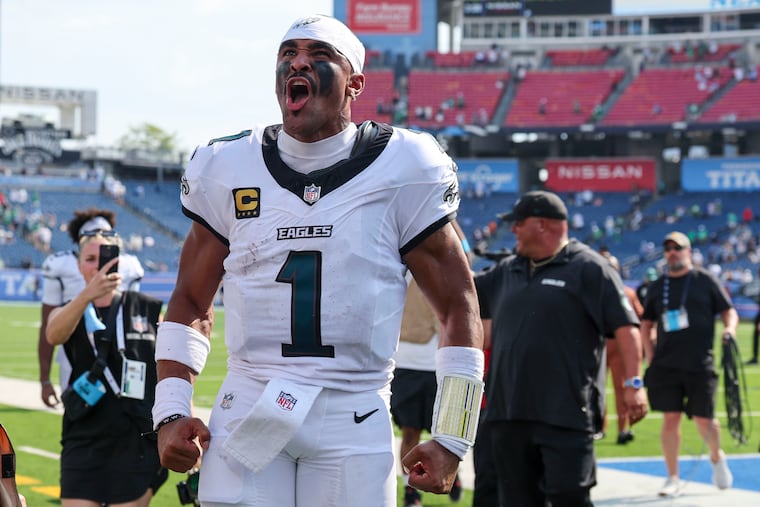
The Eagles have utilized Jalen Hurts heavily in the run game. Is it sustainable?
The quarterback turns 27 today. Could his role in the run game change this season?

The first week of training camp was winding down. Right before the Eagles took the field at the NovaCare Complex for a morning practice, Nick Sirianni made his way to the media tent. A few minutes into the press conference, I asked him a question.
He didn’t seem to have much patience for the premise.
“I think this is the same question you ask me every year,” Sirianni told unCovering the Birds with a smile.
Probably a slight exaggeration, although I had asked him about this topic before. I wanted to get Sirianni’s thoughts about Jalen Hurts’ role in the run game and whether it might change this season. Is it sustainable?
“It has been so far, and we’ll continue to do the things that we need to do to win the games,” Sirianni said.
A little dismissive at first, but then, in the same breath, he acknowledged the obvious.
Just like Saquon Barkley, Sirianni said, the Eagles must be mindful of preserving one of their most important players.
“We’ll rest them Monday through Saturday, we’ll get ’em ready for the game, we’ll get ’em ready for practices, and then do what we need to do to win football games,” he said.
Sirianni might not have thought much of the initial question, but there was a reason I brought it up. It wasn’t arbitrary or a chance to put him on the spot less than a week into training camp about a topic that could generate buzz.
My question had everything to do with the timing of where Hurts is at this moment of his career.
The 2025 season is going to be his sixth year in the NFL, his fifth as a starter. You know how many notable quarterbacks have run as much as he has through 75 career starts?
One.
So, yeah, given how much the Eagles need Hurts on the field if they have any hopes of running it back for another championship, I thought asking Sirianni about Hurts’ workload on the ground was fair game.
“We’re always thinking first and foremost when he carries the football, ‘How do we keep that scheme safe to keep him out of harm’s way?’” Sirianni said.
So about that stat. When it comes to running the ball, there has been only one quarterback who has had more carries in the first 75 starts of his career than Hurts in the history of the NFL — Lamar Jackson.
Jackson has averaged 11.3 rushes per game. Hurts is second at 9.8. That’s a lot of carries and opportunities for opponents to knock him out of the game. For the most part, Hurts has done a decent job of avoiding injury when running. But he’s also had a couple of late-season injuries that resulted in missed time.
Year 5 is around the time when dual-threat quarterbacks often begin the process of running less and working more from the pocket. Take Jackson, for example. He’s already begun a downward trajectory in terms of his carries per game.
I asked Hurts about running the ball at training camp earlier.
“It’s not about maintaining a pace, it’s about doing whatever it takes to win, and that’s something that evolves year to year,” he said. “So I’ll continue to have that approach.”
I didn’t expect Hurts to reveal the Eagles’ plans for him this season nor do I think there will be a concerted effort to not run him as much. It likely will be an organic thing over time that could be dependent upon any number of variables — mostly, how teams defend Hurts and the Eagles specifically in the designed runs that involve the quarterback.
» READ MORE: Jalen Hurts can’t be labeled as a quarterback. It’s what makes him and the Eagles great together.
But many of Hurts’ runs come on scrambles. There are times to take off and times when he should hang in there and go through his reads. But the Eagles don’t want to strip Hurts of a dynamic that makes him special — his ability to pick up yards on the ground.
In Super Bowl LIX, for instance, he set a record for quarterbacks with 72 yards rushing, breaking his own record by 2 yards set two years earlier. Hurts’ long touchdown pass to DeVonta Smith might have been the final dagger, but he kept knifing the Chiefs with backbreaking scrambles throughout the Super Bowl.
New coordinator Kevin Patullo isn’t expected to change much about the Eagles offense. He’ll add tweaks and likely put his stamp on the passing game. But in the running game, there’s only so much with which to tinker. And why would he, with Barkley coming off a 2,000-yard season in which he partly benefited from the threat of Hurts as a runner?
Patullo said as much when I asked him if Hurts running as much as he has is sustainable.
“I think it’s all situational,” the offensive coordinator said. “So when he wants the ball in his hands, he’s going to do it, and he’s going to let us know. And then, really, it just comes down to if he needs to make a play and he knows he wants to, he’s going to do it. So whether it’s just dropping back and scrambling and making a play with his legs or if he feels like now’s the time that I want to start running the ball, we will give him that opportunity.”
» READ MORE: The Bengals will play their starters in the preseason opener. Don’t expect the Eagles to do the same.
But there is risk — short-term and long-term. The Eagles obviously can’t afford to lose Hurts for an extended period of the season. But they also have to think about his future and longevity. The game has evolved. We’re seeing more dual-threat quarterbacks in the NFL than ever before. More teams are incorporating that element into their offenses.
And quarterbacks like Hurts, Jackson, Josh Allen, and next-generation talents like Jayden Daniels are doing a better job of protecting themselves or avoiding splatter hits when they are in the open field.
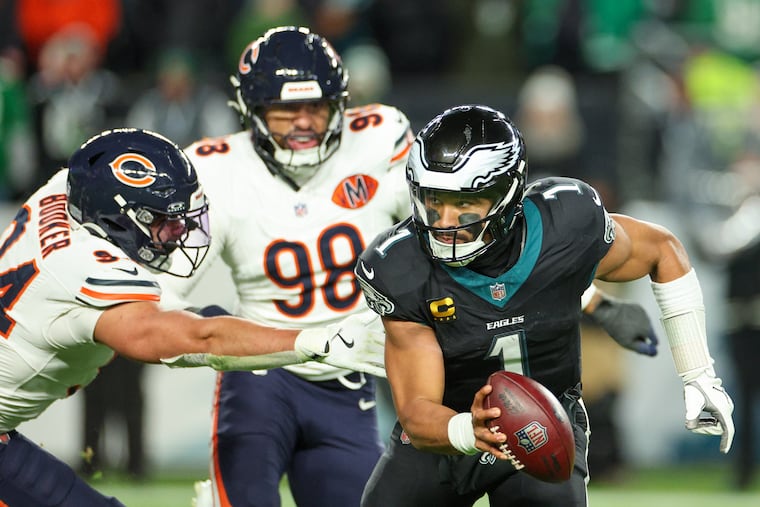
There also are myriad ways to get hurt in the pocket. Some of Hurts’ injuries have been unavoidable. But he’s missed three starts and most of another game because of injuries that occurred on designed runs — three seasons ago at Chicago and last season at Washington when he suffered a concussion on a draw play.
Hurts, for the most part, has been adept at evading contact. He’ll go to the ground or run out of bounds if necessary. There are times when he may throw caution to the wind, but typically it’s based upon situations when it’s third down or near the goal line.
He could improve as a slider, giving himself up so that defenders can’t tackle him. But the best way he can protect himself on non-designed quarterback runs is to simply execute the pass play as drawn up. Yeah, sure, there are going to be plenty of times when no one is open and scrambling is the best course. But Hurts has been known to leave the pocket too early on occasion.
Jackson was a repeat offender early in his career, but he turned so many scrambles into long gains that it was hard to be overly critical of his habit. The same can apply to Hurts just as it did for groundbreaking dual-threat quarterbacks like Randall Cunningham and Michael Vick.
But even though the former Eagles didn’t run nearly as much as Hurts and Jackson, Cunningham averaged 6.6 carries per game in his first 75 starts, while Vick averaged 7.3 carries. Cunningham became more of a pocket passer later in his career, while Vick kept running at only a slightly lower number in the final stage of his career.
Maybe the best dual-threat quarterback at avoiding hits — Russell Wilson — averaged 6.1 carries in his first 75 starts and he didn’t miss a game in his first 9½ seasons. But Wilson also ran less as he got older. It just wasn’t as drastic and it didn’t happen overnight, like it did for Donovan McNabb.
McNabb wasn’t as much of a runner as the other quarterbacks mentioned here. He averaged 5.3 carries a game in his first 75 starts. But he made a concerted effort, starting in his sixth season, of executing the passing offense and running less, and in his final 83 starts with the Eagles, he averaged only 2.9 carries a game.
He still got injured and missed games, and it’s unclear how much the decision extended McNabb’s career. But Vick — or, more glaringly, Cam Newton — showed how running at a continued high volume post-75 starts could wear down mobile quarterbacks.
Newton averaged 7.7 carries in his first 75 starts. He was only marginally below that at 7.5 carries in the next 51 starts of his career, and he started breaking down in his late 20s. Newton was a physical specimen and played with physicality, but once he started to slip as a runner, he couldn’t offset it with passing acumen and was out of the league by age 32.
» READ MORE: Cam Newton doubles down on his Jalen Hurts criticism
Hurts’ two closest contemporaries seemingly have taken an opposite approach to running. Jackson still runs a lot. But in the Ravens quarterback’s last 27 starts, he has averaged only 8.7 carries per game. That’s 2.6 fewer rushes per game than in his first 75 starts.
Allen has Newton-like physical traits, but he can throw the ball just as well as he can run it. And the Bills quarterback still wants to run it. In his first 75 starts, Allen averaged 6.1 carries. In the next 48, there was an uptick to 6.7.
Are the sample sizes enough to definitely say that Jackson is on a downward trajectory, while Allen’s is steady as she goes? Maybe not. There also are many outside factors that could have impacted the numbers.
But it will be interesting to see how their careers progress. Allen is 29, and Jackson is 28. And Hurts turns 27 today.
There are many reasons to believe that Hurts can keep playing as he has. He, too, has considerable physical traits. He seems to work as hard as anyone in the weight room. And the Eagles aren’t likely to cut back on the Tush Push — the controversial quarterback sneak play that the NFL tried to banish during the offseason. The Tush Push may pad Hurts’ number of carries, but it’s still a play that exposes him to potential injury.
As for the earliest indication that he may run less this season, we’re seeing some signs in training camp. Whether it’s by design or simply organic, Hurts hasn’t been scrambling as much as he was even a year ago. He’s executing the passing offense, and few of his throws are hitting the ground.
Sirianni has been pleased.
“Jalen just is a guy that continues to improve,” the coach said. “I think he’s continuing to do a good job of going through his progressions and getting to the right guy with the football and getting to his third, fourth reads. The ball doesn’t hit the ground very often in practice, and that’s the way you want to see it.”
It’s early. Camp has a ways to go. The Eagles have joint practices with the Cleveland Browns next week. And of course, there are the actual games in which the best-laid plans may go to waste.
Even so, Hurts running — and running a lot — has been a winning formula for the Eagles. They can’t allow the potential for injury to affect their thinking. But for those of us on the outside, there’s reason to ask the question.