Jalen Hurts running more might be the best thing for the Eagles. Is it also hazardous to his career?
Hurts isn't the first quarterback to confront how running the football might impact his career. But what if more running equals more winning?
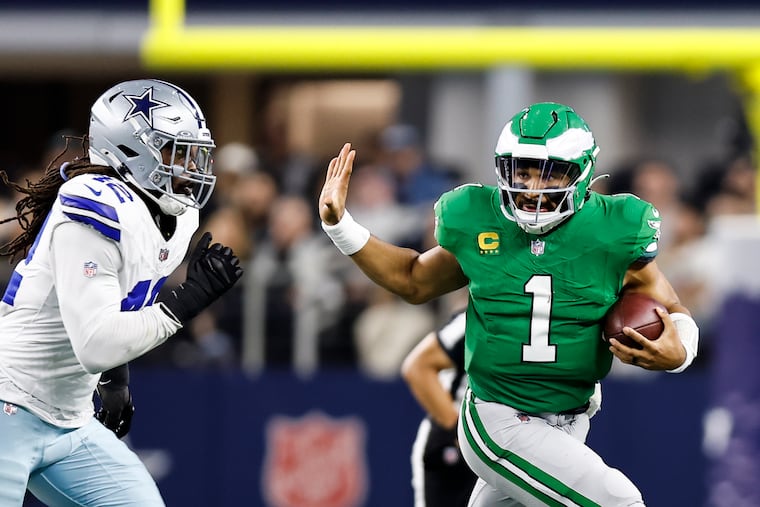
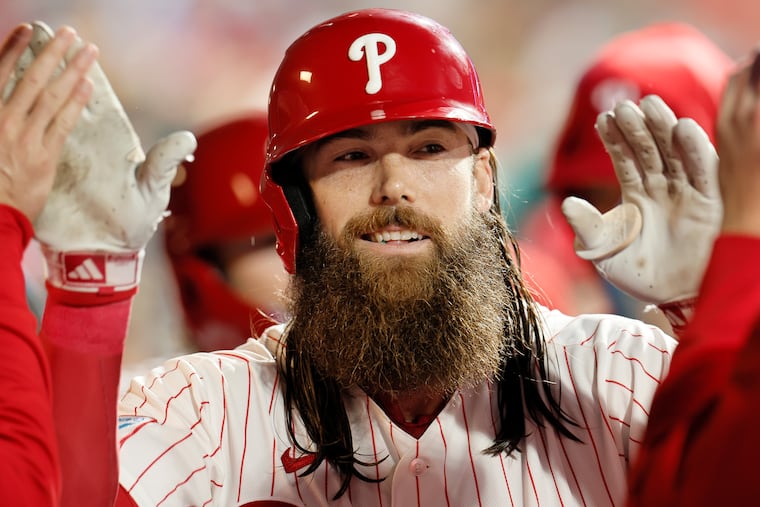
For one play during an otherwise dismal Black Friday loss to the Chicago Bears, Jalen Hurts gave the Eagles offense a jolt. The ball never even left his control.
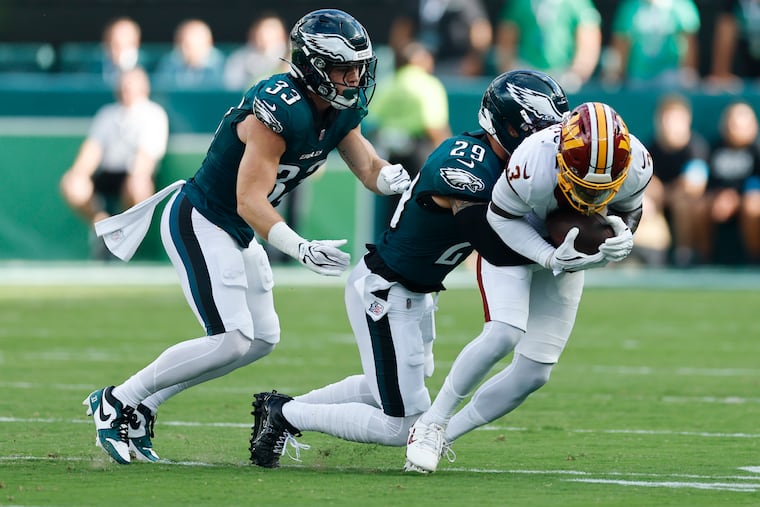
Rather, he tucked it into the crook of his left arm and dashed through a lane created on the left side of the offensive line by a pulling Cam Jurgens and Jordan Mailata. With neither linebacker in the picture — one was picked up by Jurgens on a blitz and the other ran with Saquon Barkley as he motioned out wide before the snap — Hurts dashed upfield unabated for 23 yards, the Eagles’ most explosive rushing play of the day.
» READ MORE: What we know (and don’t) about the Eagles entering Week 14 vs. the Chargers
It set up A.J. Brown’s 33-yard touchdown reception on the ensuing play, capping off the Eagles’ longest drive of the afternoon: 92 yards.
It was also like seeing a unicorn.
Designed runs have become rarities for Hurts in his fifth season as the Eagles’ starting quarterback. After averaging 3.6 designed runs per game in his first four seasons as the starter, Hurts has dropped to 1.1 designed runs per game in 2025, according to Pro Football Focus. Hurts has gone without a single designed run in six of this season’s 12 games.
On one hand, that drop-off should come as a surprise, seeing as Hurts once proclaimed himself a “triple threat” capable of dissecting defenses with his arm, his legs, and his mind. Among quarterbacks from 2021-25, only Lamar Jackson boasts more rushing yards (3,531) than Hurts (3,108).
On the other, though, there is plenty of precedent for quarterbacks who rush less as they progress in their careers, either by choice or by physical limitation. Those examples include Hurts’ contemporaries such as Jackson (6.6 designed attempts per game before Year 5; 4.0 after) and Josh Allen (2.0; 1.6).
As evidenced by that 23-yard run on Friday, the 27-year-old Hurts can still burn defenders on the ground. His ability to serve as a run threat has historically forced opponents to defend all 11 players on the field, creating more opportunities in the run game as a whole.
» READ MORE: Numbers and trends that could impact Monday’s Eagles-Chargers game in Los Angeles
Could the Eagles lean into the quarterback run game as one fix to help revitalize Kevin Patullo’s floundering offense that is running out of time to achieve consistency?
Hurts was asked after the Bears loss whether he would do anything different during the extended break before the Chargers game to help improve the offense. He was then asked whether he needed to use his legs more to fuel that improvement.
Flashing a slight smile, Hurts offered the same three-word answer to both questions.
“I’ll be working,” he said.
Why is Hurts rushing less?
Hurts is a full-time quarterback, part-time philosopher. His penchant for dropping philosophical sayings at the podium has become part of his brand, according to Mailata.
One of the sayings that Hurts helped popularize, “Keep the main thing the main thing,” offers a window into his approach. Winning, regardless of how it looks, is the most important facet of the game. Everything else is secondary.
So, when asked the week before the Bears game if he was open to more designed runs, Hurts emphasized that he is “open to doing whatever it takes to win.” Similarly, days later after the loss, Nick Sirianni seemed to refute the notion that Hurts wanted to run less this season by suggesting self-preservation is a factor in the decision to call fewer designed runs.
“We’re always thinking about how to protect Jalen and make sure that he is healthy for the long haul,” Sirianni explained.
It isn’t hard to fathom why the Eagles would want to protect their investment. Hurts is the highest-paid player on the team at $51 million on an average annual basis. As the offensive player with the ball in his hands on every down, he’s arguably the team’s most important player, too.
But Hurts has injured himself both in and out of the pocket throughout his NFL career, which has caused him to miss games. In 2021, he sprained his ankle when he was sacked in the Week 12 loss to the New York Giants. The injury forced him to sit out the following week’s game against the New York Jets and required offseason surgery.
» READ MORE: Nick Sirianni reiterates Eagles are ‘evaluating everything,’ but Kevin Patullo will still call plays
His other two serious injuries occurred on designed runs. Hurts sprained his throwing shoulder in 2022 after getting tackled on a 3-yard zone-read keeper in Week 15 against the Chicago Bears. Hurts had plenty of wear-and-tear in that game, running the ball on 17 occasions on a frigid day at Soldier Field. While he finished (and won) that contest, he missed the next two.
Hurts also suffered a concussion in Week 16 in 2024 against the Washington Commanders on a play very similar to his 23-yard gain on Black Friday. After Hurts exited in the first quarter, the Eagles went on to lose their first game in roughly three months. He missed the final two games of the regular season in concussion protocol, though he likely wouldn’t have played in the season finale against the Giants anyway.
But the lack of carries for Hurts isn’t always in the Eagles’ control. Sometimes, that can be dictated by the defense.
While the Eagles run fewer run-pass options (7.4 per game, according to Pro Football Reference) than they did in the past — especially compared to 2022, when they led the league with 10.9 — it was a substantial part of the game plan in the Week 5 loss to the Denver Broncos. More often than not, though, Hurts opted to throw. Sirianni explained in the aftermath that on those plays, “when you have that ability to get that to a playmaker in the flat, you take it.”
At the time, that game marked Hurts’ lowest rushing total of his career as the starter (one scramble, one kneel-down for a total of 3 yards).
“Sometimes when you’re calling those plays, he can run it, Saquon can run it, or we can throw it, so it’s kind of a three-way monster right there,” Patullo said. “It’s kind of a dealer’s choice, so it is just kind of a different kind of style, and it worked in that moment.”
Hurts isn’t alone
Hurts is far from the only quarterback who has experienced a dip in runs as he has progressed in his career. Jackson is perhaps the best case study among active quarterbacks this season in his seventh full year as the Baltimore Ravens’ starting quarterback.
Jackson, 28, is averaging 4.7 carries per game, according to PFF (2.1 designed runs, 2.6 scrambles). He had already been on a downward trajectory after his first few seasons in the league, but this year is a new low for the two-time MVP quarterback.
Injuries have held Jackson back this year. He missed three games from Weeks 5-8 with a hamstring issue. He’s been active since Week 9, but over the past month, he has dealt with injuries to his knee, toe, and now his ankle. He has not participated in a full week of practice in a month.
Carson Wentz, the Eagles’ starter from 2016-20, was heralded for his athleticism, especially in 2017 when he was briefly the Eagles’ leading rusher through the first two weeks of the season. His asset became an issue, though, when he scrambled his way into an ACL tear later that season, marking the beginning of the end of his Eagles tenure. While his play style didn’t change upon his return in 2018, his efficacy deteriorated.
But injuries — and the threat of incurring them — aren’t the only factors at hand when it comes to the frequency of the quarterback run game. Donovan McNabb experienced a shift in his playing style throughout his 11-year tenure with the Eagles from 1999-2009. After posting 5.2 carries per game in his first four years as the full-time starter, McNabb averaged 2.9 over his final six in Philadelphia.
McNabb came up in an era when the “dual-threat” label on Black quarterbacks often came with racist undertones. Regardless of his detractors, McNabb’s emphasis on the passing game seemed to be more of a personal preference.
Even early in his career, before he leaned more into the passing game with the arrival of Terrell Owens in 2004, McNabb responded “no” when asked whether he enjoys running.
» READ MORE: Yes, Jalen Hurts is the ‘problem’ for the Eagles, not Kevin Patullo: So what?
“When I hear ‘running quarterback,’ that sort of upsets me,” McNabb said in 2000. “That takes away from my drop-back ability, my play-action ability and my ability to get the ball downfield. Any time that you talk about how athletic a quarterback is, and you continue to talk about his running ability, you sort of forget about him passing the ball.”
McNabb and Hurts aren’t one-for-one comparisons from a rushing perspective. McNabb was more of a scrambler, while Hurts has demonstrated a proficiency both in scrambles and designed runs. As passers, McNabb is arguably the best in franchise history. Hurts has had excellent games — including both Super Bowl performances — but is still working to find a sense of consistency in the passing game this season.
Uptick on the way?
Can the Eagles achieve some sort of middle ground, aiming to protect their quarterback while also injecting life into a listless offense, specifically the run game?
It’s been a tough season for Barkley and the Eagles’ rushing attack as a whole. The 2024 offensive player of the year has averaged 3.7 yards per attempt, a decrease of more than two full yards per carry from last season. His run blockers haven’t been doing him any favors, leaving him with 2.3 yards before contact per attempt (down from 3.8 last year).
Hurts could help through the use of his legs, according to Dan Orlovsky, the former NFL quarterback and ESPN analyst. Orlovsky said he expects to see more designed runs for Hurts in the last five games of the season. That increase is imperative if the offense wants to continue to live out of the shotgun, he explained.
According to Next Gen Stats, approximately 70% of the Eagles’ offensive plays occur when Hurts is lined up in the shotgun. That alignment can make a run game too predictable if the quarterback isn’t a threat on the ground, too.
“If you don’t, there’s really no reason for you to be in the shotgun, because the defense can see constantly what’s going on in the run,” Orlovsky said. “So their lack of running the quarterback this year … defenses fly to Saquon a lot more. They’re much less disciplined. They can constantly see the football. Those giveaways with Saquon’s alignment of what kind of run and when they’re running. And a lot of times, there’s 3 yards that aren’t taken advantage of from the quarterback run. So it’s had a negative impact on their ability to run the football.”
» READ MORE: Jalen Hurts is at the root of the Eagles’ offensive problems, but that doesn’t excuse ‘Siritullo’
The Eagles broke that tendency briefly against the Bears. Hurts opted to keep the ball on a zone-read play that gained 3 yards. He read the unblocked defensive end who began to crash down hard on Barkley before pulling the ball and turning upfield. Instead of a handoff to Barkley for likely no gain or negative yards, Hurts created a positive play.
According to Smael Mondon, the Eagles’ fifth-round linebacker out of Georgia, an offense that runs out of the shotgun and boasts a quarterback who poses a threat on the ground “opens up the menu a lot.”
“If you don’t really have a running quarterback, like he’s not really a threat in the run game, then the menu kind of simplifies for what set you see in the backfield for what runs you could get,” Mondon said. “But if you got a quarterback that can run, then that menu of options of plays they could run kind of opens up even more. So it’s more things you’ve got to potentially have to defend. So it’s more stuff for a defense to think about.”
A quarterback run threat can also help with the offense’s “numbers disadvantage,” as backup Tanner McKee puts it. On a typical run play in which the quarterback hands the ball off to the running back, the offense has nine players that can block for the ballcarrier. The defense has 11 who can tackle, putting the offense at a mathematical disadvantage.
There are different ways for quarterbacks to “get your block,” according to McKee, and keep defenses honest, including the use of play action and bootlegs. But a quarterback who keeps the ball for himself gains an actual blocker in the running back, minimizing the numbers disadvantage and, in theory, giving the offense a chance to rack up extra yardage.
An extra blocker means two extra gaps — the space between each blocker — for a linebacker like Mondon to fill.
“It just kind of makes it harder,” Mondon said. “Everybody has to fit perfect with QB designed runs, just ’cause they’ve got that extra hat and extra two gaps in the game.”
Time is running out for the offense to hit its stride before heading into the playoffs. Still, Sirianni expressed an understanding that there’s a fine balance between keeping Hurts healthy and doing what it takes to win.
“You’re always thinking first about what the players do well, especially with your quarterback, how do you make sure that you’re keeping them safe on those?” Sirianni said. “Even when you think about those, there are quarterback runs you can run that are a little [safer] than another quarterback run. But it’s still football and you still [face] a risk with every snap that you take, and that’s on a drop back, too.
“But again, you look at the defenses, how you want to attack, you look at what you do well, how to protect the guys, and you’re just looking for the best way to go about that. I don’t think anybody wants to come out of a game with Jalen having 15 carries, designed carries. But again, we’re looking at everything, and we’ll see how that looks going forward.”

The Eagles survived -- again. This time, instead of holding on for dear life as they did in their opener against Washington, the Eagles came from behind in the final minutes to pull out a gutsy win at Tennessee, with their quarterback leading the way. With the Eagles 2-0, The Philadelphia Inquirer’s Jeff McLane and Mike Sielski examine Jalen Hurts’ promising performance through two games, and dig into the uneven play of the defense. Listen here.
Listen to all episodes here or wherever you get your podcasts.