Joe Banner reveals Howie Roseman’s greatest hit on Philly guy Cliff Stein’s new podcast
“Negotiation Warriors,” created by North Philly native Cliff Stein, is a good listen where expertise on an interesting subject gives the audience a worthy alternative to “hat-backward bro-chat.”
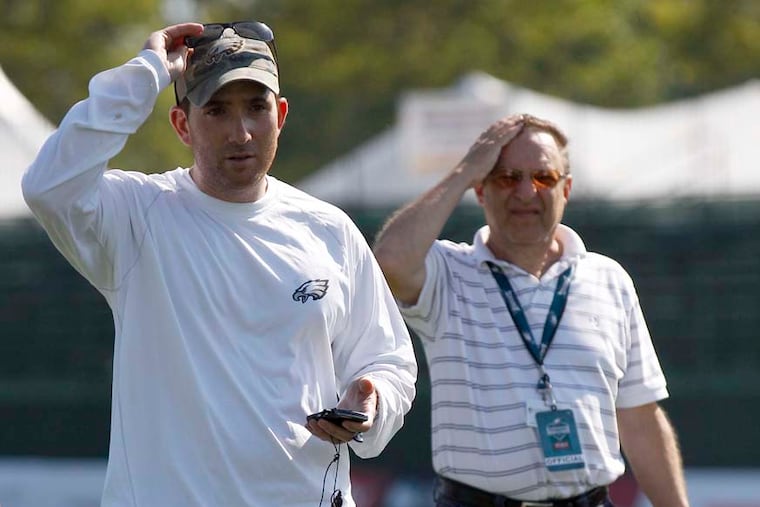
In a world full of blowhard self-promoters who lack expertise in anything outside hat-backward bro-chat, it’s refreshing to hear smart guys talk about interesting stuff in plain words.
That’s what you’ll get when you find Episode 12 of the Negotiation Warriors podcast on YouTube. On the podcast, former Chicago Bears executive Cliff Stein spends 75 minutes discussing the evolution of NFL front-office practices with a certain former Eagles and Cleveland Browns executive.
The episode is titled “The Salary Cap Godfather with Joe Banner.”
This is not hyperbole.
Banner entered the NFL in 1994 as the salary cap and free agency became the league’s most important drivers of roster construction. Banner was, simply, smarter and braver than almost everybody else making those decisions. It was he who designed the template for salary-cap management, free-agent pursuit, and, to a degree, the maximization of early- and late-round draft pick evaluation.
Banner (with an assist from his then-administrative assistant, Lee Ann Hartley, who gets name-dropped in the episode), also invented Howie Roseman, who since has led the Eagles to three Super Bowls, two championships, and today generally is considered the NFL’s top executive.
But everybody has a godfather.
Banner served a similar role to Stein, a North Philly kid who played receiver for Ron Cohen at George Washington High School and rose from fringe-player agent to the role of senior vice president for 22 years with the Bears, until regime change in 2023 ended his tenure.
» READ MORE: Flyers see their Stanley Cup window open as they offer Leo Carlsson the richest salary in NHL history | Marcus Hayes
Stein, 59, then became a consultant for college programs dealing with NIL challenges, helped develop software called Front Office 360 to help schools manage their salary caps, and, of course, started the pod. He’s already hosted super-agents Drew Rosenhaus and Peter Schaffer, and he has about 30 more in the bank. None, he said, was as rewarding as the Banner pod.
“He’s not known as a very tall man, but he is a giant when it comes to negotiations,” Stein says, introducing Banner in anatomically and metaphorically appropriate terms.
Why Banner? Why now?
Because the business of the NFL was uncharted territory in the mid-’90s. Banner was Magellan. Now semiretired and semiforgotten by a generation that uses his methods but has no appreciation of their origins, it is important to Stein to shine light on Banner’s massive contribution, from negotiating stadium deals to navigating the cap to assigning values to players on the front and back ends of their careers.
“My biggest takeaway was the value of a negotiator in the role of a GM, and to show that’s what he was doing,” Stein said.
Banner’s one of the most respected sports executives, one of the most brilliant minds and canniest negotiators the NFL has ever seen. Some would even call him the Godfather.
From North Philly to the South Side
Stein got his business and law degrees at Temple, then began work as a union lawyer in 1994 when he also got his NFL agent’s license. Three years later he partnered with Jerrold Colton, continued his law practice, and acted as agent for a few low-level players such as former Eagles offensive lineman Jerry Crafts and kick returner Michael “Beer Man” Lewis, the 29-year-old Arena Football League speedster who delivered Budweiser but did not play college football. The Eagles cut Lewis in 2000, but he eventually reached the Pro Bowl with the Saints.
In 2002, the Bears solicited Stein’s application to be their contract negotiator. He spent much of the next 22 years in that role and several others as senior vice president and general counsel, a vital adviser for Bears executives and ownership, until Kevin Warren was hired as president in 2023 and dismissed him.
Banner was instrumental in nurturing Stein’s development.
The podcast is 75 minutes of two of the deepest sorts of sports insiders discussing not only the inner workings of the NFL’s well-cloaked business models and practices but also the origins of those practices in the salary-cap, free-agency world, the very creation of which they played a crucial role.
Detail-oriented pod
That’s the word that keeps popping up: detail. Banner’s philosophy in preparing to negotiate: be detailed. The key trait in every hire Banner makes or recommends: obsession with detail.
Stein learned from Banner, and the stories in the podcast episode are clinically detailed.
They discuss how, under Banner, the Eagles used principals of analytics years before the Moneyball revolution coalesced in the later 2000s.
The most poignant anecdote involves Roseman’s biggest hit. In 2004, as a low-level assistant — director of football administration — Roseman, in his fifth year with the organization, was eager to add a kid named Jason Peters. At that time, Peters not only was a rookie tight end, but he was on the Buffalo Bills’ practice squad. It would have cost the Eagles nothing to acquire him except a minimum salary. Coach Andy Reid didn’t want to use the roster spot for Peters.
» READ MORE: Who is Julian Lurie?
Four years later, again at the insistence of Roseman, who now was vice president of player personnel, Banner traded three picks for Peters, gave him a six-year, $60 million contract, and watched him go to seven of the next eight Pro Bowls.
Banner had more stories Sunday afternoon, stories that didn’t make the pod. Such as:
Lurie bought the Birds in 1994, the same year Stein got into the agent game. As newcomers, Banner thought it would be wise to introduce himself and Lurie by entertaining the adversaries.
In October 1994, at the owners’ meetings in Chicago, Banner and Lurie hosted a cocktail hour for the Eagles’ agents at the time. This was tantamount to Abraham Lincoln, in 1863, inviting Jefferson Davis and his generals to Thanksgiving dinner. The other owners and league office were furious.
Banner claimed ignorance.
“We were flagrantly breaking the ‘rules,’” Banner said, “But we honestly didn’t realize how bad a line we were crossing.”
When Stein was with the Bears, they regularly crossed that line.
Later in the podcast, in addressing the number of front-office executives who began their careers under Banner, Stein recalled his introduction to Roseman.
For months, Hartley had received and rebuffed Roseman’s daily letters pleading to join the Eagles — a plea he sent to virtually every other team, too — in any capacity. Roseman’s persistence impressed her, which, Stein said, was key: “I knew that if someone like Lee Ann likes you, you’re going to get the respect of Joe Banner and Jeffrey Lurie.”
In 2000, after Jets GM Mike Tannenbaum met and vetted Roseman — a Fordham Law graduate, just like Stein — Banner finally relented and gave Howie an interview.
“I think I saw a little of me in him,” Banner said.
Banner then fired his current numbers guy and hired Roseman, who took up residency on the corner of Hartley’s desk outside of Banner’s office on the fourth floor of Veterans Stadium. And the rest, as they say, is history.
Fast forward
Stein says he’s content to continue his life in Chicago to be near his two grown children, unless some team comes at him with an offer he can’t refuse. For now, he’s eager to plumb the podcast depths. He says he’s gotten a commitment from an executive who said he’d never do a podcast but changed his mind after seeing the Rosenhaus pod.
Until then, Stein is positively giddy at the chance that the Eagles might make Hartley available for an episode. She now is the vice president and senior adviser to Lurie; essentially, the job she used to do for the president she now does for the owner.
Imagine the stories she could tell.
“I’m going to do a behind-the-scenes on someone who knows everything about the business, part of the NFL population that never gets credit,” Stein said. “To have her as a potential guest? I mean, she’s half the reason Howie got hired!”

Marcus Hayes alerts
As for Banner, he left the Eagles in 2012 to become Cleveland’s CEO, but he was out by 2014. He’s been an adjunct professor at Villanova, a role in which Stein, still in Illinois, now serves at Northwestern. Banner has acted as a consultant on dozens of NFL coach and executive searches; cofounded the 33rd Team group of football consultants with Tannenbaum; acted as an adviser during the 2021 NFL CBA negotiations; and has sat on the board of Patricof Co, a venture capital firm that caters to pro athletes.
In his dotage, Banner, like so many, splits time between Maine and Florida, enjoys his grandchildren, and hopes to stay relevant and appreciated.
The pod, and maybe this column, will serve that end.
“I gotta say, I feel like that 45-year-old golfer who’s leading the Masters after the first round,” Banner said with a chuckle.
Well, Jack Nicklaus won it at the age of 46. Banner might not be the Nicklaus of the NFL, but he’s at least the Fred Couples of the boardrooms.
He deserves this moment, and many, many more.