This week’s NFL scouting combine is a massive event that could end up outgrowing Indianapolis
The NFL convenes to evaluate players, and increasingly, to put on an offseason show for fans. The event has become so popular, it might end up moving to somewhere like Los Angeles.
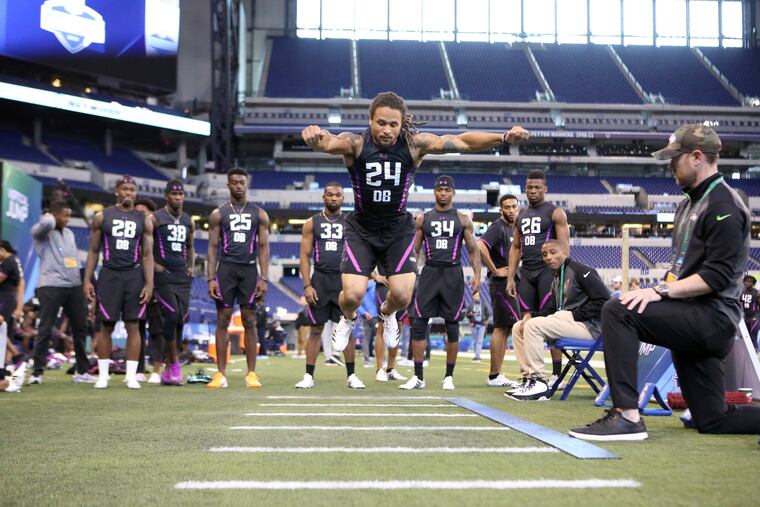
Pretty much the entire National Football League is wending its way to Indianapolis for the annual scouting combine, which began Tuesday and runs through Monday. The event started in a simpler, less scouting-intense time as a way to evaluate draft-eligible players, but has mushroomed into something much more elaborate.
The 337 college players coming in to be tested and interviewed, the 60 to 65 people from each of the 32 NFL teams who will take part in the testing and interviewing, the 2,500 or so fans journeying to watch, and the 1,000 or so media members on hand to chronicle it all will more or less take for granted that the combine machinery will chug along efficiently, as it has since three separate player evaluation events were combined, giving the event its name, and the entity moved to Indianapolis in 1987.
Jeff Foster, the Indianapolis-based president of National Football Scouting, who works all year long to put the event together, will take nothing for granted. He’ll be watching the weather reports from cities with major airline hubs, from whence the players will connect through to Indianapolis, in staggered tiers – a group a day for four days. Some players stay three nights, some four, and some five, depending on position group.
A small delay can have a domino effect on such a tightly scheduled event; for instance, Foster has learned the hard way to fly players coming in from west of Denver a day earlier than they need to be there.
“On Friday, March 1, at some point, our internal staff will receive a text. All it will say is ‘337.’ What that means is that the 337th player has arrived,” Foster said Monday. “Once they arrive, the greatest challenge for us is over. The event has a tendency to operate itself, with the help of all the great [team personnel] that support us. The one thing we can’t combat is Mother Nature. When that 337th player arrives, it bears a sense of relief for us.”
The combine has become the league’s second-largest media event of the year behind the Super Bowl, which is good for Foster and for Indianapolis. But he knows this also means that if there is a hitch, it gets wall-to-wall coverage.
Two years ago, star Alabama linebacker Reuben Foster (no relation to Jeff) was sent home from the combine after a confrontation with hospital personnel over how long he had to wait for a required test. (Foster ended up being drafted 31st overall in the first round by the 49ers, then being released by them this past season after a domestic violence charge. He was picked up by Washington but was placed on the commissioner’s exempt list and has not been allowed to play since.)
When he banished one of the top prospects in the 2017 draft, Jeff Foster suddenly found himself being as widely quoted as the top network draft analysts.
“If people know who I am, that means something is happening incorrectly,” Foster said. He said the combine has since added a group of liaisons to wait with players when there is a medical testing backlog and deal with medical personnel on their behalf.
“Probably the greatest logistical challenge of the event is the medical scheduling,” said Foster, who expects 350 to 400 MRIs to be performed this week on the record 337 participants, most by the four imaging machines inside Lucas Oil Stadium, some at hospitals in the Indiana University Health system.
In the NFL of 2019, the agility drills and whatnot you watch on TV rarely produce revelatory information to teams who have scouted these players for years. The interviews and medical exams take precedence.
Each team brings its doctors, and they convene in groups of five or six teams in a room, for players whose injury histories might have raised questions. Each doctor can take his or her own look, though everybody doesn’t get to take their own MRI studies.
Even so, Foster said the MRI machines are running continuously from 7 a.m. to 11 p.m.
The interviews are just as tightly scheduled. Foster said each player, on arrival, gets a laminated card with the times and locations of his scheduled interviews. Foster relies on a network of 45 team area scouts to shepherd groups of players through the various steps.
Perhaps to lessen the frequency of episodes such as the Reuben Foster banishment, the combine now also has access to a group of “NFL Legends,” former players who have been through the process.
“The NFL assigns a couple to each group. That’s been outstanding for us,” Foster said. “It helps put the players at ease; it gives them someone to kind of relate to and talk to” about such subjects as what to wear to interviews.
Who gets to attend?
Every year, much is made of combine invite snubs. Logistically, Foster can’t invite everybody. He said this year’s record 337 players will be a challenge to the event’s infrastructure.
A few years ago, National Football Scouting tinkered with its process, vexed a little by the fact that every year, it seemed 40 or so players were drafted who hadn’t been invited to the combine.
Instead of continuing to rely on a committee with representatives of 12 to 15 teams for nominations, it opened the process to all 32 teams, and gave them a way to notify combine personnel online of players they thought were worthy. The timing of the evaluation process also changed.
“We found that we were doing it a little too early,” Foster said. Now he tries to identify the top 150 early, then holds off on the rest, in part to consider underclassmen who declare, which is an ever-growing part of the draft process.
Foster was sure he was on to something with the new procedures, when non-invited draftees plummeted to 23 in 2017. But then came 2018.
“We did the process exactly the same last year, and we were back up to 44,” Foster said.
The fact is, the cutoff will always be subjective. What you really don’t want is first- or second-day draftees who weren’t invited. If you didn’t get all the third day fifth-, sixth- and seventh-rounders, so be it.
“Let’s say we invite 325 [players],” Foster said. “Well, Nos. 326 to 350 are going to be very similar. We try to let the talent pool dictate the number of players by position.”
The steady rise of underclassmen declaring has skewed things a bit, Foster said. Teams want to see and talk to these guys, because they haven’t seen and spoken with them as much as they have the seniors. Maybe a junior who ends up not getting drafted takes a combine spot that could have gone to a senior who does get drafted, but was more of a known quantity. This year, a record 135 players are forgoing remaining eligibility to enter the draft.
Why Indy, and for how long?
Indianapolis emerged as a centrally located host for the event back when, as Visit Indy senior vice president of marketing and communications Chris Gahl noted last week, “no one was allowed in – no media, no fans.” And nothing was televised.
The host city has upped its game as the combine has grown – Lucas Oil Stadium opened in 2008 with a dozen meeting rooms, an exhibition hall and four locker rooms, all tailored toward the combine and the NCAA men’s basketball Final Four – but as TV has helped make the combine into a huge national fan event, there has been talk of holding it elsewhere, the way the league now rotates its annual entry draft. The $5 billion stadium complex in Los Angeles, scheduled to open next year, has featured prominently in such talk.
Indianapolis has a contract with the league for just one more year, but Gahl and Foster said there have been talks about an extension, and they soon expect to have a sense of where things are headed.
“It’s become a very sought-after event that other cities want and other franchises want,” Gahl said. He said there is always a post-event wrapup, where improvements are discussed. “We would suspect that in that post-event conversation, we’ll learn more about where the NFL is, where their appetite is for continuing in Indianapolis, and we feel confident, again, that there’s no better city.”
Whether that is true depends on how you see the event. Foster and Gahl, in laying out their case for keeping it in Indianapolis, often refer to “the true purpose of the combine” – for the teams to efficiently evaluate players. But the league has a broader vision, as it attempts to engage fans throughout the offseason.
The NFL Network’s coverage starts Wednesday with news conferences from general managers and coaches, and continues through the weekend with the various drills. For the first time, ABC will televise two hours of quarterbacks and receivers working, from 1 to 3 p.m. Saturday.
It’s unlikely any other city can match Indianapolis’ compact, efficient infrastructure, where you don’t need a car if you’re staying in virtually any of the 7,200 downtown hotel rooms, and you rarely need to go outdoors, if you know how to navigate the endless convention center hallways with their hotel connectors.
But for fans who come to the NFL Experience, or those watching on TV, links between buildings might not be a paramount concern. The L.A. stadium complex is supposed to have shops, hotels, and restaurants; it’s said to be 3½ times the size of Disneyland. The NFL Network is headquartered in L.A. The spectacle could be bigger there. “And now let’s go to Andrew Siciliano in Venice Beach for the bench press …”
For Foster, trying to recreate everything involved in the combine in a new city would be a massive undertaking, one he would just as soon avoid. One of the reasons it runs smoothly is repetition; everyone involved except the prospects has been there and done that.
“We certainly don’t want to try to move it. Indianapolis has been a great home for 33 years,” Foster said. “What the future looks like, I hope it looks like what’s right outside my window right now.”
NFL scouting combine numbers:
Dates: Feb. 26 - March 4.
Site: Indianapolis, where the event has been held since 1987.
Players invited in 2019: 337
NFL personnel: Each of the 32 teams brings 60 to 65 people.
Estimated number of visitors to Indianapolis for the combine: 7,500
Projected economic impact: $8.4 million.
Hotel rooms occupied: nearly 7,200
Number of MRI tests expected to be performed: 350-400.
Player interviews: Each team can interview up to 60 players, each for 15 minutes. Teams are limited to 20 interviews per day.