With Eagles in the forefront, NFL is quietly entering a new age of analysis using player-tracking data
In 2019, it seems analytics have gone mainstream, and Doug Pederson and Howie Roseman are using data to determine how to maximize a player's effectiveness.
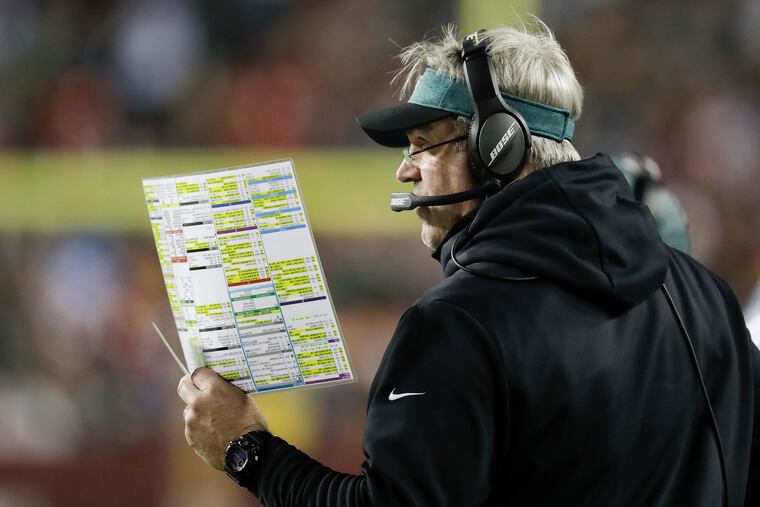
Jeffrey Lurie’s chip has come in.
Almost three years ago, at the NFL meetings, the Eagles owner gushed to reporters about how crucial it soon would be for teams to accurately utilize RFID data from practices and games.
“That’s going to revolutionize the sport, in the long run,” Lurie said.
“If you study the batting averages in free agency and the draft, it’s not real good in the NFL. It’s just not. And I think we’re about to enter a phase where there’s an opportunity to really up that.”
At the time, the reporters barely knew what Lurie was talking about. Didn’t RFD have something to do with delivering mail in the boondocks? No, this was different: radio frequency identification. But what exactly did that mean, in this context? Attempts to follow up with Eagles coach Doug Pederson and executive vice president Howie Roseman were met with generic, opaque answers.
Eventually, it became clear that despite Lurie’s evangelizing about the data being collected from chips placed inside players’ pads and the football, the organization wasn’t real interested in explaining or highlighting its use of such data. Maybe not every team fully understood the benefits. Why lay it all out for competitors?
The Eagles declined to provide anyone to discuss their use of RFID when contacted for this story. They have a vice president of football operations and strategy, Alec Halaby, who is understood to be in charge of analytics, but it has been years since Halaby was available to be interviewed. Ditto their director of high performance, Shaun Huls.
In 2019, RFID seems to be part of the NFL mainstream. Zebra Technologies, the company with which the league contracts, this past season gave all NFL teams access to data from each game, for the first time. About a third of the teams, including the Eagles, also use Zebra for their practices.
NFL.com’s popular “Next Gen” stats are compiled using RFID data. Last week, Zebra tracked the prospects preparing for and competing in the Senior Bowl in Mobile, Ala. NFL scouts received data on players they hadn’t yet drafted.
“It gives them an enriched set of information, which they’re now familiar with” because it has become common in the NFL, said John Pollard, Zebra Sports’ vice president of business development, during the week in Mobile. He said teams mostly wanted to know when Zebra could sign deals to provide data from bowl games, as well.
Zebra installs receiver boxes around a stadium or practice field. Then the electronic chips in the ball and the equipment transmit such information as how fast a guy is running, how long it took him to reach top speed, how active he was during practice, how fast a ball was being thrown and with how much rotation, how high it was being punted, and so on.
Pollard said the chips in the pads are the size of a nickel, and as thick as two nickels stacked. They can be washed with the equipment; they don’t have to be taken out and reinserted. Batteries last a year, but two-year batteries are on the horizon. The chips in the ball are implanted in the rubber bladder during manufacturing, under the spot where the NFL logo sits.
Pollard said one of Zebra’s handful of college clients sometimes posts the speed data on the scoreboard during practice, goading players to compete against one another, or their own best numbers.
“The Eagles have been a practice client of ours for some time,” Pollard said. “Also, speaking generally, the Eagles are looked at as an organization amongst the 32 clubs … that looks at innovation, usage of technologies, looking for efficiencies through technologies. They’re typically on the front end of innovation.”
» FROM APRIL: How the Phillies use analytics to steal more bases
An NFC personnel source said “there’s so much information” generated by RFID that his team’s analytics group and the strength and conditioning staff spend a lot of time parsing it, day to day. “Seeing what data is the most useful, what data is maybe not as useful, making sure we’re looking at the right things,” he said.
One of the most practical uses of the practice data is for injury prevention and monitoring, which seems interesting, given the cascade of soft-tissue injuries the Eagles suffered in 2018. Pollard said a strength and conditioning coach could “look at the workload and participation of each player during practice. They can tailor the types of things they’re looking for to each independent player and position group.
“For instance, they can set certain sprint ranges and distance traveled, workload ranges for each player. Say they’re coming off of injury, or rehabbing an injury. Maybe a player who’s more tenured in the league, or even a younger player, toward the tail end of the year they can start to titrate and balance the workload, to be sure that they’re being prepared in the most beneficial way.”
Over a period of weeks, Pollard said, “you start to develop a performance profile for these players.”
» READ MORE: How the Sixers rode the analytics wave all the way to the playoffs
In press conferences, Pederson sometimes refers to a player’s “load” during practice — an oblique reference to the RFID data.
Among the things discovered by the use of such data is that limiting a tired player’s reps in practice might not always be the best way to go, if the player is going to be active on game day, Pollard said.
“In some cases … special-teams players, who have only a very finite number of sprints during a game, if they practice only at a certain reduced level throughout the week, and then they’re accelerating through explosive movement during a game, is the potential for injury higher?” he said. Monitoring data “allows strength and conditioning coaches to be sure, during the week, [such players] get enough work to ready their muscles for explosive work during the game.”
Given the controversies that have enveloped NFL officiating recently, it is tempting to think how such monitoring might be used in making officials’ jobs easier.
“The technology has aspects to it that will allow for placement of the ball, measurement of the ball. … It certainly could be an ingredient of consideration when they figure out if they want to expand the usage of this type of technology, or use it in conjunction with some other technologies that will allow for efficiency in the game,” Pollard said. “We do have chips in the pylons and the sticks. It’s not something we collect and distribute to the teams.”
He added that the league does not, either. But surely, that is coming, and more.
Get insights on the Eagles delivered straight to your inbox with Early Birds, beat writer Zach Berman’s newsletter for Eagles fans. Click here to sign up.