The Sean Mannion offense was a major focus of the Eagles’ pre-combine news conference. Here are 10 things we learned about the new scheme.
Nick Sirianni and Howie Roseman each talked at length about the search that ended in Mannion's selection as offensive coordinator — and the scheme he'll run in Philly.
Nick Sirianni sat back in a chair with his feet up in UGG slippers. The Eagles coach looked as relaxed as he has in over a year, and certainly since a tumultuous 2025 season ended with him having to oust consigliere Kevin Patullo as offensive coordinator last month.
Sirianni met with reporters at the newly named Jefferson Health Training Complex on the Friday before the scouting combine. He and general manager Howie Roseman normally answer questions with locals in Indianapolis before they hit the combine podium. But with so much change already — and more to come — the Eagles opted for the more familiar setting of their draft room to address pertinent matters about the team.
Sirianni and the more upright Roseman spoke separately, each for around 40 minutes. They tackled subjects ranging from wide receiver A.J. Brown’s uncertain future to longtime offensive line coach Jeff Stoutland’s departure. But a significant portion of their availability — especially the coach’s — was spent on new offensive coordinator Sean Mannion.
Why did Sirianni hire the inexperienced former Packers quarterbacks coach? Why was the search drawn out? How much did wanting the Shanahan-McVay offense factor into the decision? What did Sirianni like about the scheme? How much autonomy will Mannion have? How will quarterback Jalen Hurts and other returning players adapt to the new system? And how will the changes affect evaluations of Brown and future Eagles?
Sirianni was light on details — how could he not be with so many unknowns? — but he and Roseman did provide enough information to allow for informed perspective on Mannion, the new scheme, and what could be an inflection point for the coach, his quarterback, and the Eagles overall. Here are 10 takeaways about the offense from Friday’s interviews:
1. The Eagles pivoted in their approach to the OC search after it became obvious that Mike McDaniel and Brian Daboll wanted to explore other opportunities.
Sirianni didn’t confirm Inquirer reporting that McDaniel and Daboll were leading candidates, but he said he entered the offensive coordinator search looking for a veteran play-caller.
“I went into it … like I’d like for somebody to have some of the experience that’s done this,” Sirianni said. “Obviously, Sean has not had experience calling the plays. That, to me, was [secondary]. Like, we got into it and that kind of changed. I’m like, ‘No, this is the best guy for the job.’”
Sirianni also said he went into the process most interested in the Shanahan-McVay scheme, which would suggest that McDaniel was the primary target. Daboll comes from another system of offense, but he worked previously with Hurts at Alabama and would have checked other boxes. McDaniel went to the Chargers, while Daboll was hired by the Titans.
We’ll never know if the Eagles would have offered either McDaniel or Daboll the position, but clearly the search shifted into another phase. Sirianni said he interviewed a total of 17 candidates and that seven reached the second round. Only four of the final seven names — Josh Grizzard, Jim Bob Cooter, Jerrod Johnson, and Mannion — became public.
Mannion’s first interview was virtual, while the second was in person. Sirianni said that once he got him in the building, it confirmed his initial impression that the 33-year-old former quarterback was the guy for the job even though he had never called plays.
“What I was really looking for was the detail in which everything was explained to me, because the detail is so critical, conviction on what they believed and why they believed in it, and the vision and conviction of that how they went about it,” Sirianni said. “Like, OK, you haven’t called plays, but how do you go about thinking about calling plays in this particular area, like the vision for the offense, the vision and the conviction for how you would call it?”
2. Sirianni led the search and made the final decision — a fact that was made abundantly clear.
Roseman, who touted Sirianni’s credentials as a CEO-type coach last month, made light of outside perception that he and owner Jeffrey Lurie hold strings over a powerless Sirianni when asked why he made those unprompted comments.
“Hold the strings, like during the games?” Roseman said. “Am I in his ear?”
Roseman, of course, remains one of the more entrenched figures in his position after two Super Bowl titles and 10 playoff appearances in 16 seasons as GM. He has final say over both the 90- and 53-man rosters and his influence with Lurie also can’t be overstated.
Roseman is also one of the most resourceful executives in the NFL. He helped Sirianni identify Mannion as a budding prospect.
“As you talk to people around the league, and they described him and his future, it became somebody that we really felt like we needed to talk to,” Roseman said. “It’s just his name kept coming up as we were doing things and as we were talking about the way that we were kind of moving from an offensive perspective.”
Sirianni, who spoke before Roseman, talked about a collaborative approach but identified himself as the “point man” in the search.
“The coaches that we bring in here always going to fall on me, right?” Sirianni said. “And I have to make those final decisions.”
Were the Eagles powers-that-be trying to empower their coach in giving him ownership over the coaching changes, or were they distancing themselves from the moves? Maybe only Lurie and Roseman can answer that question.
3. The Eagles are hoping Mannion will be the offensive coordinator version of Sirianni.
The Eagles have had unprecedented success under Sirianni. They have a Super Bowl MVP in Hurts. They have Pro Bowl-caliber offensive players at multiple spots. And yet, there were rumblings that some OC candidates didn’t consider the job as desirable as other vacancies.
While previous coordinators Shane Steichen and Kellen Moore parlayed winning into promotions, Brian Johnson and Patullo were out after just one season at the helm. The position comes with both internal and external pressures. There’s also a question of Sirianni’s permanence in Philly and how Hurts has factored into coordinator turnover.
The Bears’ Declan Doyle, for instance, declined an interview request and reportedly told the Eagles he was staying in Chicago, even though he doesn’t call plays. Not long after, he took the offensive coordinator job with the Ravens, although it should be noted that he will work under defensive-minded coach Jesse Minter in Baltimore.
“All that really matters,” Sirianni said, “is the guy that you end up picking for the job and his excitement and willingness to be there.”
Sirianni might feel some kinship with Mannion, who didn’t interview for any of the other 14 coordinator openings this offseason. Sirianni, too, was an under-the-radar choice who surfaced late in the process when the Eagles tabbed him to be coach.
While Mannion had no other bites this offseason, like Sirianni five years ago, it doesn’t mean he won’t pan out.
4. It was the Shanahan-McVay scheme that led the Eagles to Mannion.
Sirianni interviewed coaches with backgrounds and experience in various offenses, but one scheme stood out more than others.
“It was in my forefront of my mind to say, ‘I’m interested in this,’” Sirianni said of the Kyle Shanahan-Sean McVay scheme. “But I didn’t necessarily say, ‘I have to have this.’ And then as the process went forward that’s where I kind of got to with that.”
The Shanahan-McVay system is often run-based that utilizes a wide-zone blocking scheme. It often marries the run with the pass through under-center play action. It features motion and misdirection. And it uses all the above to create space in the passing game for easy reads, yards after the catch, and explosive plays downfield.
While there were some commonalities between Sirianni’s and Moore’s schemes which allowed for a relatively easy transition, and maybe prevented the latter from fully implementing his offense, the Shanahan-McVay system is significantly different than Sirianni’s on early downs.
“Third down, red zone, backed up, four-minute [offenses] — a lot of those things are pretty similar in the thought process of people,” Sirianni said. “It’s the first- and second-down run, play action where people are a lot different and have different philosophies. And … that’s where I see just it’s going to be a little bit of a change there, but we’ve got good players.”
5. Improving the run game was paramount in choosing the new coordinator and scheme.
There’s no question the Eagles’ passing offense was substandard and there needs to be more sophistication in the operation. But when Sirianni’s teams have had their greatest successes, it’s been behind a dominant running attack.
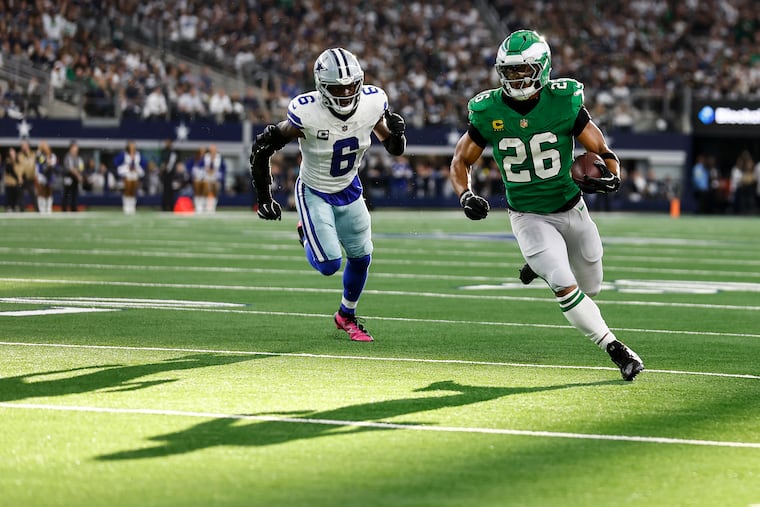
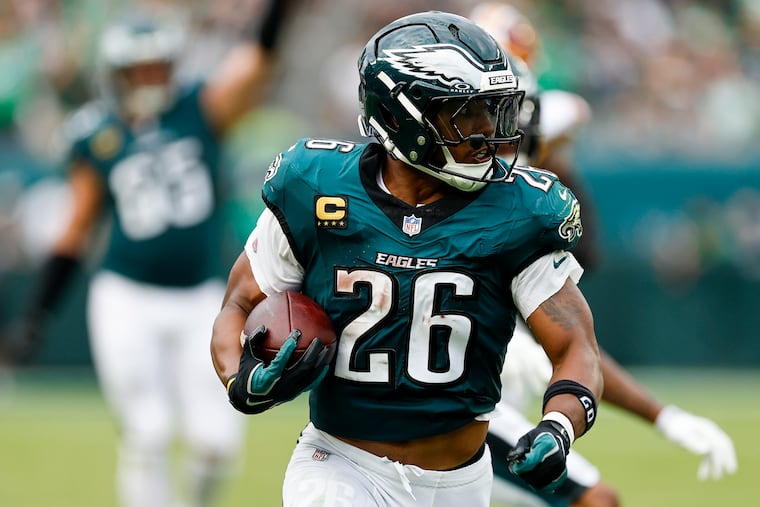
The Eagles were bound to face challenges after Saquon Barkley’s historic campaign in 2024. Injuries on the offensive line didn’t help matters. But when opponents devoted their efforts to stopping the run with increased numbers in the box, the Eagles struggled to adjust and make defenses pay through the air.
Sirianni equated how the Shanahan-McVay rushing offense handles defensive intricacies with how some passing offenses have adapted to modern coverages.
“You’ve seen a lot of teams that have done things where they’re reading pure progressions to handle all the junk that is being thrown at you by the defense,” he said. “This version of the run game is kind of in that mix, as well. It’s the run-game version of it.
“There’s a lot of junk that’s being thrown at you. This handles a lot of it.”
6. The run-blocking scheme changes were probably the chief reason Stoutland resigned.
The most significant change in the running game will come with the offensive line. The preferred wide-zone blocking scheme of the Shanahan-McVay offense is much different than the mid-zone scheme Jeff Stoutland employed with the Eagles for 13 seasons.
Stoutland was also the run game coordinator since 2018, but the alteration meant that he wouldn’t have returned in that role. Sirianni confirmed that he wanted Stoutland back, although the 64-year-old assistant would have had to teach his O-linemen a new run-blocking technique.
At its most elemental, wide-zone blocking has offensive linemen fire off the ball and block at an angle to create cutback running lanes. Mid-zone blocking has O-linemen more under control, perhaps required to win more at the point of attack and shuffle in their assignments.
One is not better than the other, they’re just different. The Eagles think their returning O-lineman can block in any scheme, but there will be an adjustment. The change could benefit an athletic center like Cam Jurgens, or it could hinder a cinder block like left guard Landon Dickerson.
“Will there be maybe a little bit more emphasis on movement and athleticism?” Roseman said. “Maybe a click. Maybe.”
Roseman was talking about how the new scheme may affect his evaluations in the upcoming draft. Right tackle Lane Johnson is returning for a 14th season, but the Eagles could be searching for his successor.
Stoutland was as involved as any coach in the pre-draft process and through his prioritization of “critical factors” helped the Eagles land Johnson, Dickerson, Jurgens, and left tackle Jordan Mailata, a former rugby player.
“We’re looking for a lot of the same things,” Roseman said, “with a lot of the same — a shout-out to Stout — critical factors that we’ve always been looking for.”
7. Hurts may actually run even less in the new offense.
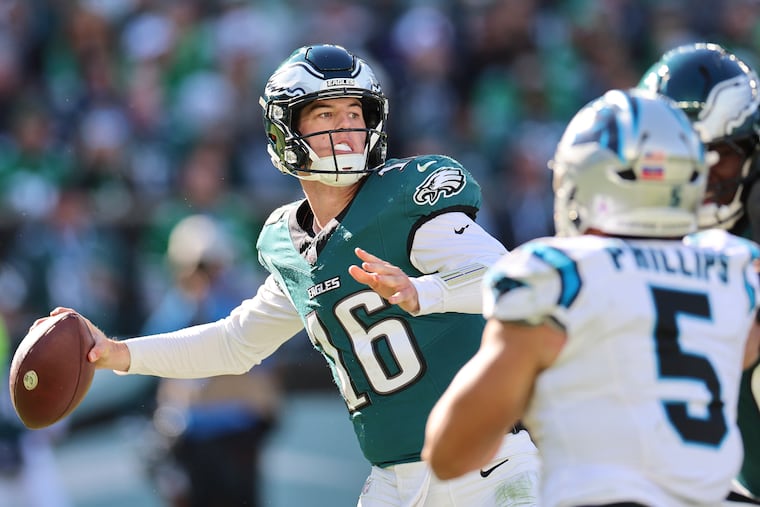
Hurts’ history with different offensive coordinators and play callers dating back to college is a fact that has been repeated so frequently at this point it’s almost not worth mentioning, especially for a quarterback entering his seventh NFL season.
He has admitted that having first-year success with Moore should give the discourse less meaning. The scheme has also been relatively similar during the Sirianni-Hurts partnership. There has been a natural progression with his coaches asking him to do a little more under center, off play action, and with motion.
“He’s shown that he can do all these things,” Sirianni said. “I think what’s awesome about Jalen is he’s shown he can do a lot of things really well. … The great thing about great players is they can usually fit to any scheme.”
And yet, the Eagles have never majored in any of the above. Was that on Sirianni and his coordinators, or was it on Hurts? How much did Stoutland’s preferred run scheme prevent the offense from evolving? All of the above were likely factors.
Whatever the answer, change is coming. Hurts should be on board, especially if he wants to run less and desires more schemed-up layups in the passing game. With less shotgun, there won’t be as many designed quarterback run opportunities.
It remains to be seen whether less of Hurts on the ground is a good thing. It wasn’t last season. There are ways to incorporate some quarterback runs into the Shanahan-McVay scheme, but there will likely be fewer zone reads and run-pass option plays.
8. Sirianni left plenty of wiggle room for carryover from the previous offense.
While some Sirianni critics may have short attention spans, he has presided over an offense that has often been among the best in the league. And in winning a Super Bowl last year he was able to retain some of the better parts of his scheme and incorporate it with Moore’s.
He said the same will happen with Mannion.
“I think that some of the things that you can sprinkle in from the things that we’ve done, it’ll just be a good mesh of different things,” Sirianni said. “You want to have something that you can [hang] your hat, which I think that we’ve always had, but then adapt that to different things that your players do well.”
The best coaches scheme to their players’ skill sets. In 2021 and 2024, the Eagles installed pass-based offenses before switching at midseason to feature the run. Some of that had to do with Hurts’ limitations as a dropback passer, but also to emphasize his mobility, a dominant O-line, and Barkley.
It would be foolish for Sirianni to commit to anything, although the Shanahan-McVay offense will initially be the scheme the Eagles hang their hats on. But there won’t be a complete whitewash.
“Its ever-evolving,” Sirianni said. “Shoot, you might end up saying, ‘Hey, I wanted to be an outside zone team, but it looks like we’re going to be a little bit more of a gap team, or vice versa, right?’ And it could be the same with, ‘Hey, I wanted to be a little bit more play action, but it looks like we’re going to be a little bit more naked and move the pocket and stuff like that.’”
Mannion won’t have autonomy like defensive coordinator Vic Fangio. How could he with no experience? The offensive-minded Sirianni will obviously be involved at some level. But he wants Mannion to ultimately be responsible for running the offense.
“I know that the most important thing that I need to do is be the head football coach of the football team, not the offensive coordinator for the Philadelphia Eagles,” Sirianni said. “I need to be the head football coach in charge of everything. It’s setting that vision, all the different things that go into it.
“But I’ve had a lot of experience in putting together an offense, so I’m here as a resource for him in that aspect.”
9. Mannion will work closely with Hurts.
Mannion’s pedigree as a quarterback played some role in his hiring. Hurts had his best seasons under former quarterbacks in Steichen and Moore. Mannion has been credited with assisting the development of Packers starter Jordan Love and the reclamation of backup Malik Willis.
Hurts has a strong personality, so it’s no guarantee that Mannion’s playing experience or his relative youth will translate to a harmonious relationship. That could go in any direction. But Mannion’s former teammates and coaches have been unanimous in their praise of how he comports himself.
As for Hurts’ actual position coach, the Eagles opted to move pass game coordinator Parks Frazier to quarterbacks coach and let Scot Loeffler go. Sirianni said he wanted some continuity, but also pointed to Frazier’s one season working in the Shanahan-McVay scheme with the Dolphins under McDaniel.
Grizzard offered Sirianni the chance to keep a runner-up for the job who also has experience in the system and one year of play-calling under his belt. While he could be viewed as a backup if Mannion struggles, the Eagles were likely more focused on having an in-house replacement to guard against what happened after Steichen and Moore left.
New tight ends coach/run game coordinator Ryan Mahaffey and offensive line coach Chris Kuper were Mannion hires and will be instrumental in installing the new wide zone blocking scheme.
10. The new scheme probably won’t increase the likelihood that Brown wants to stay in Philly.
Roseman will ultimately do what’s best for the team even if Brown no longer wants to be an Eagle. Brown has expressed his love for Philly, but that doesn’t necessarily mean he wants to return if the passing game is going to remain secondary.
Brown could envision a scenario in which the Shanahan-McVay scheme improves Hurts as a thrower and gives the receiver opportunities to use his skills after the catch. But if the running game remains the focus, he may not get the targets he desires.
Replacing Brown wouldn’t be easy, even if receiver DeVonta Smith has a more prominent role. The free-agent market is light at the position. And while the draft is said to be deep, there are few Day 1 starters at receiver. The Eagles also have other needs.
Roseman may need to replace all three of his top tight ends with Dallas Goedert, Grant Calcaterra and Kylen Granson slated for free agency. The Shanahan-McVay scheme favors hybrid tight ends who can run-block.
“I would say that the tight-end position starts with me in evolving,” Roseman said. “I think that from my perspective, I’ve always had an affinity for kind of the receiving tight ends. I think that that’s shown in my work.”
It certainly showed this past season. Goedert, Calcaterra, and Granson were detrimental to the running game. They weren’t the only ones.