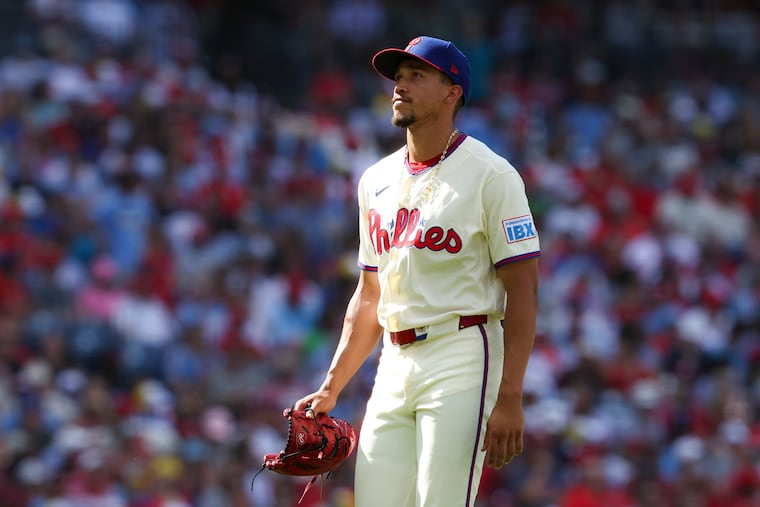
Pro sports teams and athletes are shining a light on local artists. But there’s a flip side.
Seeing a professional athlete or sports team share their work can be a rush for artists. But what happens when it’s shared without credit?
After Kyle Schwarber went deep on all three swings in the All-Star Game’s tiebreaking home run derby to win the game for the National League, his family joined him on the field to take part in the festivities.
A lot of Philly fans will look back on that moment with excitement, but perhaps none as strongly as local artist Olivia Smith. When Schwarber’s two sons joined him to take a photo with his All-Star MVP award, they were wearing T-shirts that she’d designed.
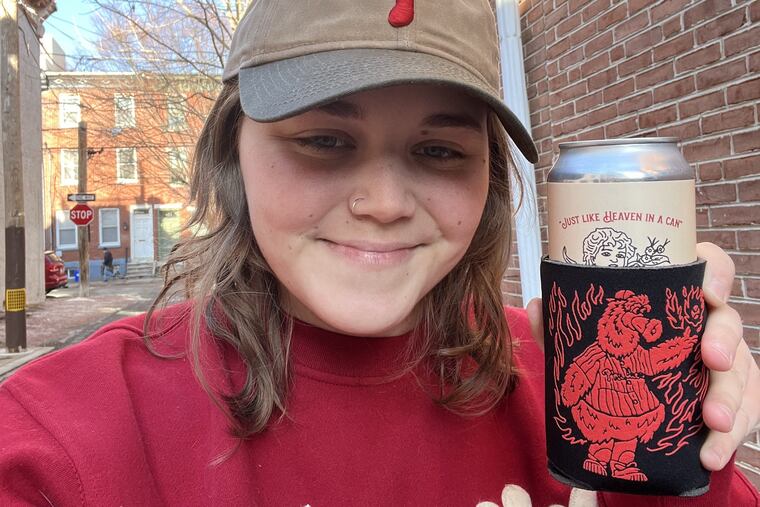
Smith, a 26-year-old artist from the city’s Bella Vista neighborhood, has been drawing since she “could hold a pencil,” and graduated from the Tyler School of Art at Temple. She grew up a Phillies fan in Harrisburg, and was inspired by old-school baseball cards to draw her favorite Phillies players, like Ryan Howard and Jimmy Rollins, in vintage uniforms and style.
After posting a few on social media, she started to gain traction from fellow Philly fans online and opened an Etsy store to sell prints. She has since branched out into apparel, including the Eagles-themed Phillie Phanatic T-shirts she sent to the Schwarbers.
Smith reached out to Paige Schwarber, Kyle’s wife, and offered to send her a custom shirt, and to her surprise, Schwarber messaged back and asked for two for their sons. But even though she knew Schwarber had the shirts, Smith was still stunned to see her work on display in such a big moment.
“It was so hard to grasp. I didn’t know what I was looking at at first, and then I just absolutely freaked out,” Smith said. “It was at like 12 in the morning, too, when I saw it. I first saw it on Twitter, a friend posted it, and I was jumping up and down, freaking out. It was a very special moment.”
Since Schwarber’s kids wore her design, Smith has seen her T-shirt sales spike.
Smith is one of a growing group of online Philly sports artists who’ve built a vibrant community celebrating local teams and players. As the community has grown, so have the artists’ relationships with franchises.
Artists like Dhwani Saraiya have collaborated extensively with local teams, including a mural at Citizens Bank Park and a Nick Foles retirement tribute. Eric Kenney, better known as Heavyslime, collaborated with Jason Kelce’s Underdog Apparel and designed a T-shirt for Grant Calcaterra’s Portland fundraiser. Jimmy McMenamin (the artist behind Glossblack) has done work for the 76ers and Red Bull and was commissioned for a Jason Kelce mural in the former Eagle’s adopted hometown of Havertown. The list goes on.
Collaborating with local artists has helped teams build stronger connections with their fans and community, but there have been speed bumps.
In July, 16-year-old Jamie Whitlock woke up to see that one of her favorite hockey players, Trevor Zegras, had reposted art she made of him shortly after he was traded to the Flyers.
But Zegras hadn’t credited her. Whitlock still was excited that he’d seen her work and liked it enough to repost it. She “really freaked out, in a good way,” after friends started tagging her in Zegras’ post.
“I am getting exposure,” Whitlock said. “I went from, I think, 450 followers to around 630 overnight. It definitely got me something, but it is still a little disappointing, because 50,000 people can see his post on Instagram and like it and see my art and have no idea that it was me. I wouldn’t say I’m upset that he posted it, just mildly disappointed that my name isn’t anywhere there for people to find.”
She sent a few direct messages to the Flyers jokingly requesting a T-shirt or jersey since he’d failed to credit her, but Whitlock didn’t expect to hear anything back. “I definitely sent those thinking, ‘No one’s going to see them. It’s just me screwing around and having fun.’”
After hearing about the situation from the Flyers, Zegras felt terrible and said he hoped to get in touch with Whitlock.
In the lead-up to Super Bowl LVII, the Eagles cracked down on local artists and independent merchandise sellers. They and the NFL had Instagram accounts disabled or deactivated for alleged trademark infringement, including that of Heavyslime, who since has collaborated with the Sixers and multiple Eagles players.
Sports teams can be “incredibly protective” over their intellectual property, Villanova law professor Waseem Moorad said, and sports artists often skirt the line of what’s allowed by copyright, including depictions and variations of team mascots, wordmarks, and logos. Compared to the resources at the disposal of the major sports teams, local artists have minimal recourse to defend themselves if a team were to step in to protect their copyright.
To avoid potential pitfalls, Smith said she draws Phillies players with “Phillie” on their jerseys instead of Phillies, for example. She even once had a beverage holder she designed struck from Etsy after she used “koozie” to describe it — Koozie is a registered trademark.
But what about when teams borrow from artists?
In June, the Eagles used artist Ruth Speer’s self-portrait and edited it for their own social media channels, without contacting or crediting her, she said. Speer posted the comparison photos to Instagram after she claimed she received no response from the team via DM.
“The Philadelphia Eagles have used my original painting and edited an eagle over part of it to create a marketing image for their social media channels, without compensation or even contacting me for use of my work,” Speer said in a message to The Inquirer.
The Eagles declined to comment.
Speer wrote that she posted the comparison on social media in an effort to educate young artists about the rights they have regarding their work and to call out what she said was a “grossly negligent and unethical” decision by the Eagles media team to use the painting without crediting or contacting her. The Eagles later deleted the image from their social media channels.
The Eagles hardly are the only team to have issues with independent artists. The New Orleans Pelicans recently were sued by an artist known for his deflated basketball work for posting content on the team’s Instagram account that the artist claims was “substantially similar” to his own work. A Mets fan artist who has collaborated with multiple athletes on the team found his work, including his logo, being sold by a New Era dealer, allegedly because the team sent along his work as its own.
Still, local artists like Smith have managed to carve out a niche in the merchandise market and earn recognition from their favorite athletes.
“I think that people appreciate a small creator, as opposed to buying from a larger corporation, or buying something at the ballpark,” Smith said. “Maybe just because a lot of thought and consideration and quality of craft goes into what I personally do, and I think that people are really starting to appreciate that a lot more. From the printing job that I do to the T-shirt blanks to how they’re shipped out, I really make sure that things are up to standard for myself, and I think that people really appreciate that.”