Saquon Barkley has been dominant in December and January during his career. Can he heat up the Eagles offense?
Barkley has had a frustrating year, but there's historical precedent that says the floodgates could soon open.
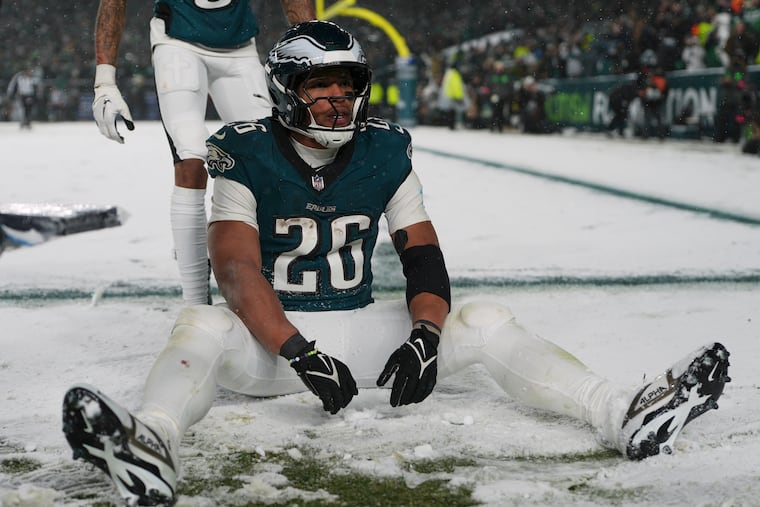
For a few moments on Monday night, Saquon Barkley looked as if he had stepped into a time machine and returned to his 2024 offensive player of the year form.
His success on the ground against the Los Angeles Chargers reached its pinnacle early in the fourth quarter. On a Tush Push fake on third-and-1, an under-center Jalen Hurts pitched the ball to Barkley, who hurried to his left and accelerated through a hole opened by Dallas Goedert, Darius Cooper, Fred Johnson, and Jordan Mailata. Flawless blocking — a rare sight in 2025 — ensured that Barkley could run unhindered to the end zone.
» READ MORE: Brandon Graham unretired to help the Eagles. Now he’s featuring at a new position at age 37.
The trick play turned into a 52-yard touchdown run, Barkley’s second-longest carry of the season. On an otherwise dismal day underscored by Hurts’ four interceptions in the Eagles’ 22-19 overtime loss to the Chargers, Barkley’s 122 rushing yards and his explosive play offered a glimmer of hope for the offense’s future.
“We just need more of that,” Barkley said after the game.
That has been evading the Eagles for most of the season. The explosive runs that once seemed routine for Barkley have been difficult to attain in his second year with the team. The TD run on Monday was just his third carry of 20 or more yards, a feat he achieved 17 times in the regular season last year.
For select moments, Barkley’s performance on Monday served as a reminder of what’s possible. The Eagles may need more from him going forward. The 28-year-old running back has averaged just 14.3 carries over his last three games (17.5 before the losing streak).
Meanwhile, Hurts has been called upon to pass more frequently at 37.7 attempts per game (26.9 before the losing streak). There have been some encouraging moments, including his third-and-16, middle-of-the-field, 28-yard throw to DeVonta Smith against the Chargers. But in that three-game span, Hurts has thrown three touchdown passes to five interceptions.
» READ MORE: Eagles vs. Raiders predictions: Our writers pick a winner for Week 15
Once upon a time, the Eagles’ identity was based in the run game. It fueled their Super Bowl run last season. In 2021, it took the Eagles from 2-5 to the playoffs. With Barkley showing signs of life and the upcoming wintry weather lending itself to the ground game, is it too late for Nick Sirianni and Kevin Patullo to strike a balance between the run and the pass?
At the very least, Barkley’s self-confidence hasn’t wavered.
“I know the type of ability that I have and the energy I can bring,” Barkley said. “Just got to keep my foot on the gas and keep going and hopefully be able to make some more like that. I know it’s going to start breaking off for us, ‘cause I trust, one, my work ethic and my preparation. I have trust in the coaches and most importantly, I have trust in the guys up front.”
Building off successes
Barkley’s performance on Monday was the second time he eclipsed 100 rushing yards this season. His season-best showing came against his former team in the Week 8 win over the Giants, in which he rushed for 150 yards and a 65-yard touchdown on 14 carries.
Both efforts featured a common thread. Barkley generated most of his output when Hurts was lined up under center — 116 yards and the touchdown on eight carries against the Giants and 102 yards and the touchdown on 10 carries against the Chargers. Explosive touchdown aside, Barkley had three additional runs for double-digit yardage from under-center handoffs on Monday.
Barkley’s success from under center has been a season-long trend. According to Next Gen Stats, he has averaged 4.9 yards per carry on those looks while posting 3.6 yards per carry from the shotgun. He’s had far more shotgun runs this season — 218 to 82 under center.
Still, in the aftermath of Monday’s game, Sirianni emphasized that explosives can be generated from any alignment.
“Many different ways that you can create explosives in the run game; under center, in the gun, there are screens that are like runs, there are shovels that are like runs, so there are many different ways to go about it,” Sirianni said Wednesday. “I think at the end of the day, there were good schemes introduced by the coaches, and then there was good execution by the players with really good fundamentals. On those particular ones, Saquon found some light and was able to get free and that was huge.”
But the Eagles’ success rushing from under center was undeniable on Monday. Barkley averaged 10.2 yards per carry on those runs including the touchdown and 5.6 yards per carry without it, which is more than a 1½-yard increase over his season average.
On his 10 handoffs from the shotgun, Barkley rushed for 20 total yards (2.0 yards per carry).
According to Mailata, some of the under center runs were more effective because of the element of uncertainty that is instilled within the defense on those plays.
“There’s so much more complementary stuff from under center than there is in gun or pistol, in my honest opinion,” Mailata said. “I think that’s why we execute better. I think for us up front, it gets us on our angles, because they truly have to read the defense. The defense truly has to read or play their gap first or play us, whatever their assignment is. It’s like a second delay before they can commit to it. Is it a run? Is it a pass? And that’s why I think our plays under center are a lot better than the guns.”
That second delay helps the run blockers time their combination blocks better, Mailata said. Additionally, one wrinkle that the Eagles added on some of the early under-center runs was keeping the receivers tight to the formation. That opened up the possibility for the Eagles to run a crack toss, adding yet another option that defenses must honor at the snap.
The under-center alignment doesn’t exclusively benefit the blockers, according to Mailata. He surmised that Barkley’s positioning in the backfield allows him to see a more complete picture of the defense, too.
» READ MORE: Benching Eagles quarterback Jalen Hurts would be short-sighted, but it isn’t ridiculous to wonder
“I think his vision, because he’s coming downhill, especially on outside zone, or even inside zone,” Mailata said. “He can see everything. If there’s leakage, he can bounce out and make a play. When we’re in gun, I feel like he has to come down here, but now his vision is there.”
Throughout the season, Barkley has been asked about the disparity in his output between the two alignments. He continues to downplay that discrepancy. While he acknowledged on Friday what the numbers show, Barkley stressed that he doesn’t have a personal preference between runs from the shotgun vs. under center.
“I feel like for me, personally, it doesn’t make a difference,” Barkley said. “It’s just running the football. Is there a difference? Yes. Outside zone is different. There is a difference of how you set it up, get your shoulders squared, what you’re seeing, what you’re reading. But to me — I’m not trying to brag here — I was drafted very high in this league from Penn State and the last two years in college, I never went under center. Then when you get into the NFL, you have to adapt and learn how to run under center.
“I feel comfortable in either, but I guess the numbers are showing that. Again, the player I want to be, it shouldn’t be that way. It shouldn’t be we’re having more success in one way, because ultimately the run game falls down on me. So, yes, we’re producing underneath, but I’ve got to find ways to help us produce from gun, too. Because it gives us a better balance, too, when you’re going against defenses.”
The shotgun runs aren’t going away. Certain concepts, like zone reads and run-pass options, are executed out of the shotgun. The Eagles must run the ball from the shotgun to set up those other plays throughout the game.
But would Mailata advocate for more under-center runs going forward?
“I’ll be honest,” Mailata said. “Depending on the flow of the game, we would advocate for more under center stuff. But in the mode that we’re in right now, just be a player. Let the coaches coach and let the players play.”
Later in the season, longer runs?
Aside from the backward hurdle, no image better defines Barkley’s historic 2024 than his 78-yard touchdown run in the NFC divisional-round win over the Los Angeles Rams in mid-January.
Late in the fourth quarter, Barkley became a human snowplow as he rattled off a touchdown run that tied the longest in his career. In the week leading up to the game, Barkley reminisced fondly about the snow games he played in his youth. The snow-globe-like environment at the Linc lived up to Barkley’s expectations in the aftermath.
“The atmosphere was crazy, man,” Barkley said after the game. “It was insane. Got a smile on my face thinking about it. This is what you dream about. This is why I came to Philly. Wanted to be a part of games like this. I’m just happy to be able to be a part of it.”
Barkley could be a part of more of those games, even before he reaches the playoffs. The Eagles are done playing in domes for the rest of the regular season. While the snow in Sunday’s forecast is limited to the morning, according to AccuWeather, the high in the afternoon is 28 degrees with 16 mph winds making the Real Feel temperature 15 degrees.
When the weather cools off, Barkley tends to thrive. In the months of December and January throughout his eight-year career, he has averaged 4.7 yards per carry in the regular season, which is a slightly better clip than each of the rates he managed in the preceding months.
He also tends to earn more carries in December and January, averaging 17.9 carries per game, which is also a greater rate than September, October, and November.
“Real football happens late in the season,” Barkley said in late November. “And that’s when you want to be at your best, especially when you get into that run to go into the playoffs and then getting into the playoffs.”
That trend isn’t limited to Barkley. Among a pool of running backs with at least 300 December carries per month since 2015, December and January is the most productive period compared to earlier in the regular season. Those high-volume backs averaged 4.5 yards per attempt and 14.7 carries per game in December and January.
Can Barkley continue that trend for the rest of the regular season, from Philly, to Landover, Md., to Buffalo, N.Y., and back to Philly? Mailata is optimistic that the Eagles can build off of the wrinkles they implemented in the run game on Monday, even though he said some of the concepts “got a little bit stale” in the second half.
Plus, the Eagles still need to improve at putting themselves in situations to run the ball. Barkley had eight carries for negative yardage or no gain on Monday night, which isn’t exactly a recipe for sticking with the run.
“That doesn’t put us in prime position to continue to get more runs called,” Barkley said. “It’s easier to run the ball when it’s second-and-6 and second-and-5 rather than second-and-11 or second-and-10.”
But Mailata was adamant that Barkley can’t do it alone. If the run game is going to breathe life back into the Eagles offense, it’s going to take the entire unit.
“The guy’s always looking for solutions,” Mailata said. “He’s always going to blame himself, which I hate that, because you can watch the film and we’re one block away up front. As tiring as that is, he’s going to take the blame for that, because he didn’t make a move. And I’m just like, ‘You can’t do everything. You’re not Superman.’”

Even with all the injuries and ineffectiveness through six games, Sean Mannion is still a believer in the Eagles’ offense, saying the problems are “totally fixable.” The Inquirer’s Jeff McLane and Marcus Hayes have some thoughts on the state of Mannion’s group, as well as a defensive unit that’s also been underwhelming this season. Listen here.
Listen to all episodes here or wherever you get your podcasts.