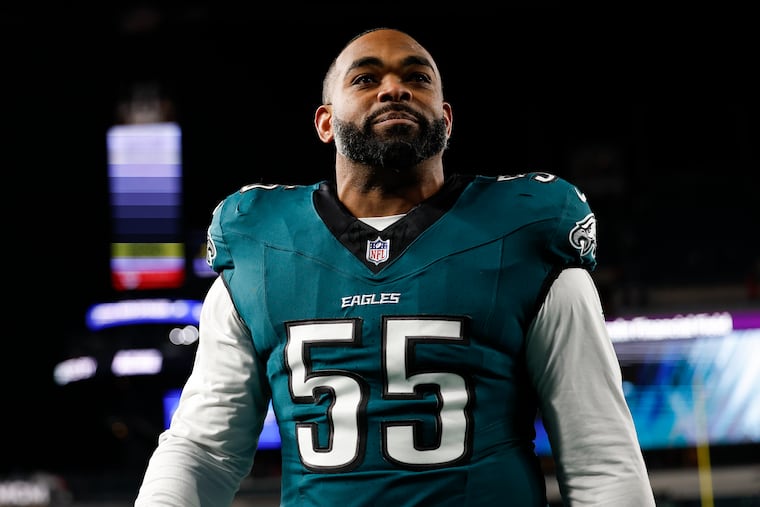
Almost a decade after his cancer scare, Eagles QB Tanner McKee champions the importance of early detection
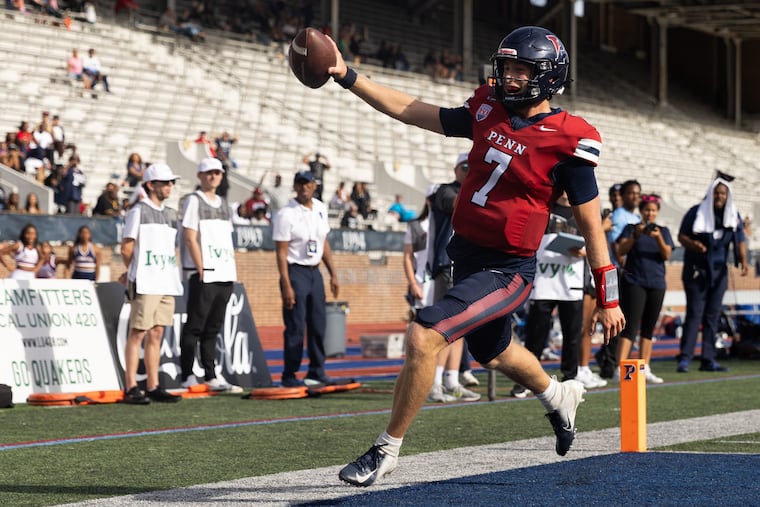
McKee is a proud member of the American Cancer Society’s Player Ambassador program and visited Southern Jersey Family Medical Centers' Hammonton location Tuesday.

Tanner McKee had a reputation around his hometown of Corona, Calif.
Sure, he was a budding football star, a tall and lanky quarterback who would go on to pass up offers from Alabama and Texas to serve a mission in Brazil before attending Stanford.
His football-throwing ability wasn’t all he was known for.
“Tanner McKee, he wears bucket hats,” said his wife, Lauren, who grew up in the same hometown. “That was always his signature thing.”
The Eagles’ backup quarterback wasn’t trying to be a trendsetter. He was protecting his skin from the sun, and hiding the scar on his forehead. McKee was 16 when his mother, Layna, a vigilant observer given the family’s history with melanoma (McKee’s great-grandfather died of the skin cancer), noticed a mole on her son’s head.
» READ MORE: Eagles vs. Vikings in Week 7: Here are the numbers that matter
McKee, now 25, had a half-dozen moles removed — including spots on his back and chest — and the mole on his forehead was positive for melanoma.
It was caught early and never required chemotherapy or radiation, but the ordeal could have impacted his football career and life. His medical team at UC Irvine Medical Center also removed two lymph nodes in his neck area that were near a nerve that could have affected the use of his right shoulder and, in turn, the throwing motion that would eventually help him earn a living.
McKee could still throw after the surgery, and the cancer was gone. A football career was saved, but the scar on his head and the lifestyle that followed are part of who McKee is. He wears a lot of sunscreen and often wears long sleeves, even during the dog days of training camp. The bucket hats are worn frequently, too.
McKee also carries with him a point of view.
“I think it gives you great perspective of kind of what’s important when something like that happens,” McKee said. “There are so many uncertainties that can happen in a split-second notice, so just leaning on your faith, leaning on your family, leaning on people you love kind of puts life in perspective.”
Perspective he shares with others. McKee, through his community work with the Eagles, has visited children in hospitals and in schools. On Tuesday night, he spent time at the Southern Jersey Family Medical Centers’ Hammonton location, where he toured the facility that serves a vulnerable population.
The topic of the night was early screening for colorectal cancer, and McKee knows firsthand how crucial catching cancer early can be.
“My case was very mild because I was able to catch it early, so if I can help someone just go in, get screened early, and maybe they have the best-case scenario happen, then that would be awesome,” he said.
» READ MORE: Adoree’ Jackson ‘probably’ will start at cornerback for Eagles; Quinyon Mitchell’s status in question
‘Having that platform is pretty cool’
McKee is one of 19 NFL players in the American Cancer Society’s Player Ambassador program, all of whom have a personal tie to cancer. These ambassadors help amplify the mission and vision of the league’s “Crucial Catch” program through appearances, fundraising campaigns, and raising awareness across social media.
That’s what brought McKee to Hammonton on Tuesday. Southern Jersey Family Medical Centers received a Crucial Catch CHANGE grant, which helps community health centers and systems in underresourced areas increase access to cancer screenings.
Through Crucial Catch, the ACS and the NFL have supportedmore than 840,000 cancer screenings and impacted more than 1.9 million lives since the program launched in 2012. Since then, the NFL has raised more than $35 million to support the program.
During McKee’s visit, Dr. Gregory Collins, Southern Jersey Family Medical Centers’ former chief medical officer, spoke about low screening rates in New Jersey for colorectal cancer and the disease’s rising incidence rates. Cancer patient Robyn Parker also shared her story with McKee and talked about the impact Southern Jersey Family Medical Centers has had on her care.
Collins said having people like McKee around is influential.
“People can relate to that because they read about it, they see advertisements, but when they’re up and close to a person that’s experienced it, it kind of sticks a little better,” he said.
McKee called his community work “more of an opportunity than a responsibility.”
“The Eagles do a great job of giving us opportunities to give back to the community, going to elementary schools and hospitals,” he said. “It’s cool. Especially in kids’ lives. Just showing up and making their day and getting them excited about whatever it is — school or a kid that’s going through a pretty tough time in the hospital and showing up at their door and they’re sitting up and the doctor says, ‘Wow. We haven’t seen him smile in a few days.’
“Just having that platform is pretty cool.”
McKee said he doesn’t have a standard set of advice he gives out when he participates in community visits. He just tries to have conversations with people, make them smile, and get their minds off whatever they’re going through. Most of the time, he’s answering questions about the previous game or what it’s like to be around Eagles stars like Saquon Barkley, A.J. Brown, and Jalen Hurts.
“It’s really amazing for me to watch Tanner interact with people,” Lauren McKee said. “He can have such a positive impact on so many different people, and so I love tagging along with him. I love seeing him interact with people and people getting excited. We’re really grateful we have opportunities to make someone’s day and maybe to change their life no matter what they’re going through.”
Hey, Tanner, sign my bucket hat
McKee doesn’t live every day worried about cancer, and understands well that his cancer scare was mild compared to many others, but the scar on his head is a daily reminder. The McKees are a spiritual family, and McKee said his father, Jeremie, once told him that the mirror in the morning is a daily reminder that God was and is looking out for him.
McKee leans on his faith, but he also takes a practical approach to caring for himself. Hence the bucket hats, the sleeves, the high SPF sunscreen. The Eagles have dermatologists available, too, McKee said.
The sleeves, the hats, and the SPF 70 have at times been a joke for teammates. Eagles kicker Jake Elliott, whose locker stall is near McKee’s, once ribbed McKee for the SPF count, only to have McKee explain: “Well, I‘m not trying to get a tan.”
“It’s me taking care of myself but also being able to spread awareness for other people.”
McKee’s wife was once no different from one of her husband’s football teammates — curious about the hat choice.
“Before I even knew he had cancer, I knew he wore the bucket hat, and I really didn’t understand why,” Lauren said.
“It’s become a fun little characteristic he has.”
A fun characteristic with a purpose and a story.
“I’ve had a lot of people ask me to sign bucket hats,” Tanner said.
He doesn’t mind. Just another person practicing good skin health and protecting their head from the sun.
“Exactly,” he said.

The Eagles are back from London, looking to leave the disappointment of a last-second defeat behind while choosing instead to focus on lessons they can learn from a third straight loss. And you know what? The Inquirer’s Jeff McLane actually thinks there were encouraging takeaways from the game, outcome aside. He and Mike Sielski discussed why the Eagles’ sky, despite being gray, isn’t falling just yet, and what the team can build on to if it hopes to reverse its fortunes during a key stretch of the schedule that begins Sunday. Listen here.
Listen to all episodes here or wherever you get your podcasts.