Two coaches in Nigeria — and an ex-New York Giant — helped Uar Bernard reach the NFL. Back then, he had a nickname: ‘Bigfoot’
Bernard's unlikely journey to the NFL began with a cross-country trip in his native Nigeria — and a helping hand from a player who was once an enemy to the Eagles.
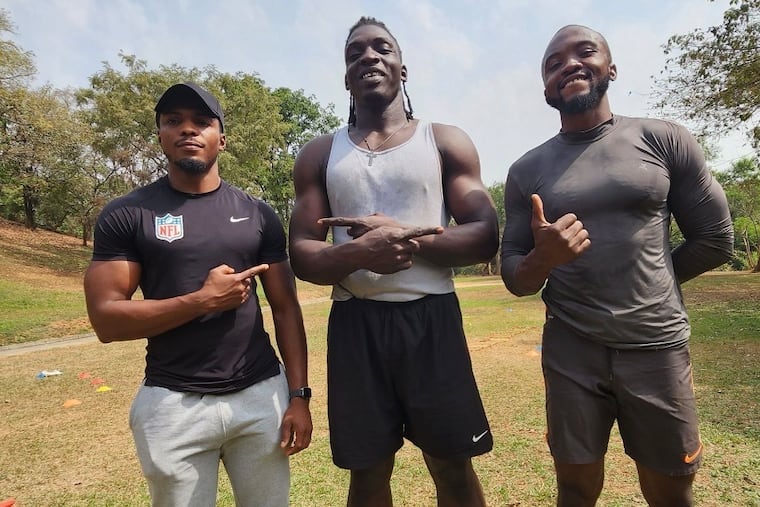
In the summer of 2022, a sheepish teenager with a backpack walked into Moshood Abiola National Stadium in Abuja, Nigeria. He was there for a basketball camp, but his physique looked like that of an edge rusher; lean and athletic with sculpted calves.
Two coaches told him as much. Mustapha Musa and Dike Christian of Pro Prospects Program were in the same building for a flag football event coordinated by former New York Giants defensive end Osi Umenyiora’s agency, The Uprise. Musa and Christian approached the teenager and asked if he’d ever played American football.
The teenager said no. They asked if he would give it a try. He explained that this would be logistically difficult; he had traveled six hours from Unguwa Uku, a suburb of Kano, in the northern part of the country.
But the coaches were insistent. They asked if the teenager would consider extending his trip.
“You know,” Musa said, “you look like a footballer, not a basketballer.”
The teenager let out a laugh. He decided to stay, and underwent a workout the following day. Ejike Ugboaja, a co-founder of The Uprise, sent Umenyiora some video.
He didn’t know the teenager’s name, but quickly came up with a moniker.
“[Ejike] just called him Bigfoot,” Umenyiora said. “And he was a freak athlete. I saw him running and moving around, and I was like, ‘OK, this kid, he’s got something.’”
By the time he showed up to the next flag football event, everyone knew him as Uar Bernard. But “Bigfoot” stuck, in part because the coaches couldn’t find cleats that fit him.
“He had like a size 18,” Umenyiora said. “It was ridiculous.”
At 17 years old, Bernard was too young to qualify for the NFL’s International Player Pathway (IPP) program but too old for the NFL Academy. He would have to wait until he was three years removed from high school to try again.
Over those three years, Bernard trained with Musa and Christian in Abuja. In 2024, he attended another NFL Africa Camp in Lagos, but failed again to make the IPP, this time because he was not considered mobile enough.
The Nigerian finally qualified in 2025. He entered a 12-week training program in Florida in January, and in April, he was drafted by the Eagles in the seventh round.
» READ MORE: Meet Uar Bernard, the athletic marvel and Eagles draft pick who has never played football
Bernard has never played a down of organized football. He didn’t spend his childhood on a Pop Warner team. But Musa and Christian have helped him prepare for this moment.
And Umenyiora is confident it is all going to work.
“I think one of the GMs for the Giants used to call it ‘planet theory,’” he said. “There are only so many people walking around the planet that have that type of physique and ability. And so whenever you get that, you have to take a chance on them, and give them an opportunity to develop.
“And hopefully, Philadelphia — who have been absolutely tremendous — will give him that opportunity.”
Training in ‘The Trenches’
Of the tens of thousands of players who have ever competed in the NFL, only 40 were born in Nigeria.
Twenty-one of those 40 hailed from Lagos, the country’s largest city; Umenyiora says most come from the southern and eastern regions.
None have come from Kano. According to the World Bank Group, the state has a poverty rate of 53.75%, more than double that of Abuja, and more than six times that of Lagos.
“It’s a dangerous place,” Musa said. “You only see a few kids that will grow up in that area, and be like, ‘I want to do sports.’ It’s very hard and very rare in that kind of environment.”
When Bernard moved to Abuja, Musa already had a handful of aspiring football players living with him. So Christian took the teenager in. Together, they’d work every day, from 8 a.m. to 11 a.m., at a local public park they called “The Trenches.”
This wasn’t an NFL training facility, but Musa and Christian saw potential. The park had a sand pit. Its hills were steep, perfect for mid-morning sprints, and its trees were as sturdy as a blocking sled.
The coaches purchased small pieces of equipment, like cones, ladders and mini hurdles, and set them up on the grass, sharpening the players’ skills under the blistering sun.
They’d also use the natural resources around them. Bamboo sticks were repurposed for cross-chop drills and honing inside shoulder drops. Bernard and his fellow athletes had occasional access to a gym, but due to limited funds, everyone had to get creative.
This was especially true for Bernard. One of his biggest early obstacles was mobility, and he didn’t have access to a physical therapist in Nigeria.
So, Musa and Christian came up with an idea.
“We had to push him into a dance class,” Musa said. “We’re like, ‘Yo, you need to go to a dance class.’ It was to help his flexibility. More aerobics than Afro dance.”
“He laughed about it,” Christian said, “but even if he laughs, he will never say no. He will do it. He’s humble.”
Bernard knew virtually nothing about American football when he started working with the coaches. But even from West Africa, Musa and Christian had learned quite a bit.
In 2011, a former University of Maryland linebacker, Ricardo Dickerson, co-founded the American Football Association of Nigeria, an organization focused on youth development. He started going on visits to high schools around the country, which is how Musa was introduced to the sport.
He and his classmates stayed in touch with Dickerson, who sent them YouTube tutorials and documentaries. Musa had hoped to attend an American university on a football scholarship, but the pandemic — and a lack of financial support — made that a nonstarter.
The coach wasn’t getting any younger, and as months turned into years, he conceded that his dream had passed him by. But he and Christian still felt a passion for the sport, and continued to follow it religiously.
They’d seek advice from high-profile coaches on Instagram, like defensive line trainer Javon Gopie. They’d study film of pass rushers including Umenyiora and Myles Garrett.
Before long, Musa and Christian could recite defensive drills and plays by heart. And the two coaches would break them down for the future Eagle, bit-by-bit.
If a move required three steps, Musa, Christian and Bernard would spend a week working on each one. Their pupil had many God-given gifts — explosiveness, quickness, strength — but the coaches wanted to refine the basics.
Bernard would know exactly where his size-18 feet would need to be planted before and after the snap. He’d know exactly how to get off for a cross chop play, and which direction to break in the following moments.
He would know the difference between bull rush and speed rush, and when to use each move.
“Small details,” Musa said, “that will make him outstanding.”
Like his coaches, Bernard was a voracious learner. After spending three hours at The Trenches, he’d put in extra work, calling Musa or Christian with follow-up questions.
At night, over the West African dish soup and swallow, Bernard and Christian would study more video, usually of Uar’s favorite player, Aaron Donald.
“He would show me tape, and then say, ‘What’s my take?’” Christian recalled. “And then we’d try to dissect and talk about it.”
Unlike other athletes his age, Bernard wasn’t prone to distraction. When he wasn’t at the gym, he was at The Trenches. When he wasn’t at The Trenches, he was often in prayer.
“The boy only goes to church, gym, training,” Musa said. “That is his life. Because he came with the hunger that nobody believes in him. Sometimes we even needed to tell him, ‘You need to slow down before you break down.’
“He would go to the church and do overnight prayer, and early morning he would come to the field and keep working. And I’m like, ‘Yo, I know your eyes. You haven’t slept.’”
‘Our boy has been drafted’
Musa and Christian were 5,166 miles away from Pittsburgh on Day 3 of the NFL draft, but that didn’t help calm their nerves. In an homage to Bernard, Musa watched the broadcast at home, on his prayer mat.
He was concerned after the Kano native hadn’t been picked in the earlier rounds.
“I was like, ‘Oh God, please let this happen to us,’” Musa said. “It wasn’t just happening to him. It was happening to the whole of Africa.”
When Bernard was finally selected, with the 251st pick, the coach called Christian, who had dozed off. It was just past midnight in Nigeria.
“He woke me up,” Christian said. “He was like, ‘Yo, are you sleeping? Our boy has been drafted!’”
Musa and Christian were overcome with excitement. So was Umenyiora. The longtime Giant may have hated the Eagles as a player, but as an ambassador for NFL Africa, he looked at the organization through a different light.
In his mind, Philadelphia was a perfect fit for “Bigfoot.”
“[The Eagles] have this mentality that they’re going to be patient with these guys,” Umenyiora said. “A lot of times, teams will get a guy who’s never played football before, and after maybe a month or two, they’ll cut him and get rid of him.
“And you’re like, ‘Well, what were you thinking was going to happen in a month or two?’ But with Philly, when they get them, they stick with the process. It’s like they’ve done so much homework, that when they get them, they are stuck in their belief system that they can turn this guy into a player.
“And they have the right coaches, and they believe in their coaches. So, when I found out he was going there, quite frankly, I was really happy. Because they get it. A lot of teams don’t get it. But they do.”
The work is far from over. Going from the basics to Vic Fangio’s defense will be challenging. The Nigerian is still getting used to wearing a helmet; soon, he’ll be facing the best players in the world.
But no matter what happens, Bernard has already proved something.
Back in Abuja, at The Trenches, a handful of football players are waking up each morning to run grueling sprints.
It wasn’t so long ago that locals used to mock them. They’d compare their drills to kung fu, as if their sport was a novelty.
Not anymore.
“The athletes here are super proud,” Christian said. “He’s the motivation to all of them who are working so hard. And we keep preaching that.
“‘Bernard was here with you guys. He’s not a stranger. He’s not a ghost. He’s someone you all know. So, if he can do it, you can do it.’”

The Eagles eked out a season-opening win over the Washington Commanders thanks, in large part, to Jalen Hurts channeling the elements of his game that make him so dangerous. But when it comes to other areas of the offense, concerns from last year still linger. The Philadelphia Inquirer’s Jeff McLane and David Murphy assess Hurts’ performance, Sean Mannion’s debut as offensive coordinator, and warning signs on the offensive line Listen here.
Listen to all episodes here or wherever you get your podcasts.