Students are making gains at this West Philly elementary school. Supporters fear closing it will threaten kids’ progress.
Blankenburg Elementary School serves kids with complex needs and has low enrollment. It's slated to close, but teachers and parents say its small class sizes have helped students make progress.
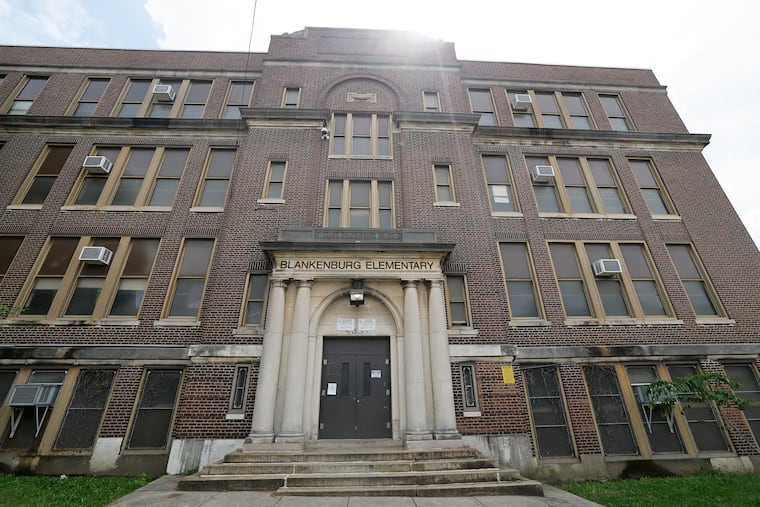
Rudolph Blankenburg Elementary School in West Philadelphia serves kids with complex needs — and test scores reflect that.
The school, where nearly 95% of students are considered economically disadvantaged, had been a Comprehensive Support and Improvement school — a federally mandated designation for schools performing in the bottom 5% statewide.
But last fall, Blankenburg shed that label. Many students are still struggling but are making gains, teachers said — progress they fear will be threatened by a district proposal to close the school as part of a sweeping facilities plan.
“We’ve worked really hard, with a consistent staff and all types of resources in place, for our students to pull ourselves out of that status,” said Flori Thomas, a middle school science teacher at Blankenburg.
That’s her biggest fear, she said: “You’re going to impact our scholars.”
Blankenburg is one of 20 district schools proposed for closure under the plan released last month. Six other schools would be colocated and more than 150 modernized as part of the proposal — which is facing resistance from City Council.

Wholesale changes are coming to the Philadelphia School District, with the school board passing a $3 billion facilties plan that aims to close 17 schools permanently, and renovate 169.
Superintendent Tony B. Watlington Sr. presented the plan to the school board Feb. 26 and it immediately faced strong opposition. After some amendments, the board passed the plan April 30. Here's what we do and don't know about it.
And to see the proposed list school closures and check how your school could be impacted, use our interactive charts.
Each of the schools proposed for closure has its own story. Find them all here.
District officials say closures are needed in a system that has lost more than 80,000 students over the last 30 years, many to charter schools. The district has struggled to fund repairs of aging buildings — including at Blankenburg, where staff report chipping paint and roof leaks.
Marquita Jenkins, the school’s dean of climate and culture, does not disagree that the building, which opened in 1925, needs repairs — or that it is underutilized. The K-8 school, which currently enrolls 278 students, has room for almost 600. Officials said the school’s enrollment has declined by about 100 students over the last four years.
But the relatively low enrollment has also enabled smaller class sizes, helping student growth, Jenkins said. A former fourth- and sixth-grade teacher at Blankenburg, she recalled teaching a class of 33 students, 11 of whom had individualized special education plans: “It was tough.” Classes now are smaller, she said.
Like other staff, she worried about where Blankenburg students would end up. The district proposes to reassign them to Edward Heston School, James Rhoads Elementary School, and a newly colocated Martha Washington Academics Plus School and Middle Years Alternative School.
Blankenburg‘s building near 46th and Girard, meanwhile, would be conveyed to the city for “affordable workforce housing and/or job creation,” according to the district.
Jenkins and other staff questioned the safety of the routes to school for reassigned students.
They also voiced concern for particularly vulnerable students: Blankenburg is surrounded by at least seven homeless shelters and “tends to have attendance fluctuations,” assistant principal Sandra Pitts said at a virtual community meeting with district officials this month. She questioned how families would be “assisted to avoid further trauma.” (Officials said they would be supporting students with housing instability in placements.)
Staffers noted that Blankenburg also has a significant population of students with special needs, who make up 25% of its enrollment.
Among them is Sherell Robinson’s kindergartener, Illiyin, who has autism and medical complexities.
Robinson, who lives in West Philadelphia, said that Illiyin had been denied enrollment at other district schools, and that she was told she had to send her daughter to Blankenburg.
Robinson initially had a negative impression of Blankenburg but was impressed with the school’s principal, Sheena Wilson, who “didn’t try to sell me, or placate me” — just presented what the school had to offer, she said.
What Robinson found was a small environment, “loving people,” and a routine for Illiyin. Now she is panicked at the prospect of the school closing.
“For them to be taking this whole community away is really devastating,” Robinson said. “It takes time to find the correct programming and environment and teachers who are neuro-affirming, especially for Black children.”
A real estate agent, Robinson said there was an irony to the district’s plan to convert Blankenburg to workforce housing — something she believes she currently would qualify for. But if she does not find a stable school environment for her daughter, she isn’t sure she will be able to keep her job.
“They might look at me as a single case, but I can assure you I am not an anomaly,” said Robinson, who also works for a disability nonprofit and is in touch with other parents of autistic children. “This is going to affect how we can take care of our families, how that perpetuates what we’re already experiencing. … I don’t want to normalize that struggle to them.”
Teachers said they are committed to Blankenburg’s students. “We bring a lot of positivity and try to keep our kids safe,” said Jenkins, who has led field trips to places including the Kimmel Center in Center City and the National Museum of African American History and Culture in Washington.
Thomas, who grew up in the neighborhood around Blankenburg and now lives in New Jersey, said that whenever students learn about her commute, she tells them they are worth the drive.
Others outside the city see headlines about crime, Thomas said, but she tells students: “I see you.”