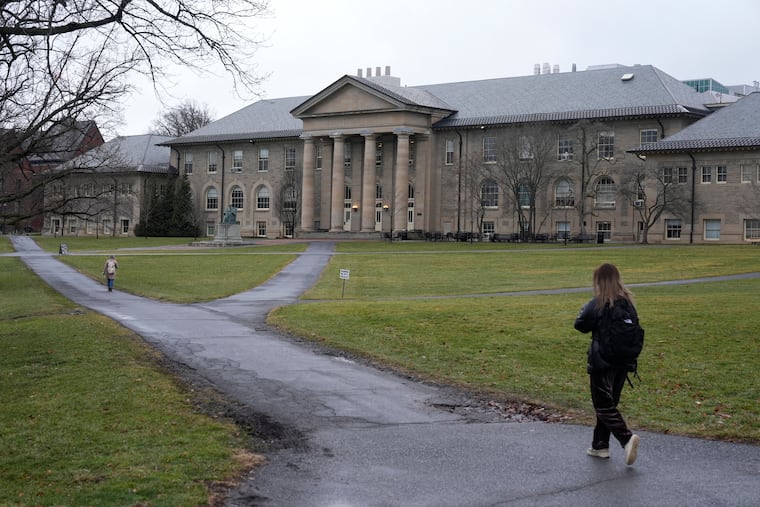
Bryn Mawr College soon could be the only remaining women’s college in the region. The school and its president set a vision for the future
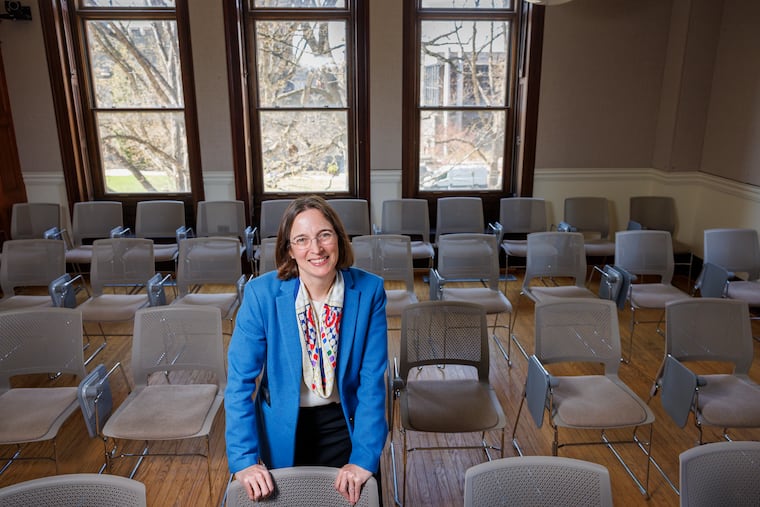
President Wendy Cadge's strategic plan includes more time and money for faculty research, even more emphasis on academic excellence, and remodeling the library, student residences, dining halls.
Bryn Mawr College last spring launched a pilot program to help seniors connect with alumni during their first year post-graduation.
The idea came out of a conversation that president Wendy Cadge had with senior student leaders about how colleges spend a lot of time orienting students to college during their first year, but very little helping them transition into the world after they graduate.
The pilot, which connected 10 students via Zoom with alumni mentors and included guest speakers, worked so well, Cadge said, that it will be offered to all graduating seniors this year.
» READ MORE: Choosing a major can be hard. Here’s how colleges help students figure out what they want to do.
It’s just one example of the kind of leadership Cadge has brought to the 1,370-student women’s college since becoming president nearly two years ago. Cadge also has made $100,000 available to faculty to pilot promising ideas, yielding about a dozen projects, including an “Institute of Failure” in which people share prior failures and nurture student resilience.
“My approach to all things is to pilot and try,” said Cadge, a Delaware County native and sociologist who previously had been dean of the Graduate School of Arts and Sciences at Brandeis University. “If it works, then we can scale it.”
Cadge hopes to bring that love of new ideas to Bryn Mawr‘s new 10-year, strategic direction for the 141-year-old college. The plan, approved by the board of trustees Saturday and being released Monday, was developed with input from students, faculty, staff, and alumni. It includes more time and money for faculty scholarship and research, an even greater commitment to academic excellence, a remodeled library, and updated student residences and dining halls — a key effort given that 90% of undergraduates live on campus.
“Given everything that’s going on in higher education, I think we need to be really clear about what our North Stars are so that we’re always making decisions and directing things toward them,” Cadge said in an interview earlier this month.
The six-page plan notes national challenges, including the “demographic cliff” with fewer high school students, “increased federal scrutiny” under President Donald Trump’s administration, more skepticism about the value of higher education — and the liberal arts in particular — and economic uncertainty.
A decline in women’s colleges
The school soon could be the only women’s college in the Philadelphia region. Moore College of Art and Design is considering whether to go coed, with a decision expected by June. Nationally, the number of women’s colleges has been declining, from a high of 281 in the 1960s to about 30.
» READ MORE: Moore College will consider opening undergraduate programs to men
Bryn Mawr, one of the most prominent women’s colleges in the country, will remain committed to women and those beyond the gender binary, Cadge said.
“I see tremendous need and opportunity for women in leadership,” she said.
Less than 30% of members of Congress and less than 15% of Fortune 500 company leaders are women, and only about 2% of college graduates who are women go to women’s colleges, she said.
“Those graduates have an outsized impact,” she said.
» READ MORE: Delaware County native and sociologist named next president of Bryn Mawr College
The new dean of Dartmouth’s medical school, the vice president of strategy and operations at Comcast, the senior staff privacy engineer for Google, and the cofounder of the largest e-sports company in Asia are Bryn Mawr alumni, she said. So is Michelle Zauner, lead singer of the indie pop band Japanese Breakfast and author of the bestseller Crying in H Mart.
Bryn Mawr’s applications continue to rise — they are up 20% since 2023, she said. And the school has become even more selective. Bryn Mawr accepted 28% of applicants in 2025, down from 31% in 2023 and 40% in 2016-17. And about a third of students accepted choose to attend.
Focus on liberal arts
Cadge emphasized Bryn Mawr’s continued commitment to the liberal arts.
“The liberal arts teach you to think and reason and argue, to be flexible, to be adaptable,” she said. “In many ways, I think the liberal arts makes our students and the jobs they will have AI-proof and technology-proof, because AI and technology are just another tool. If you don’t know how to think about, engage, analyze the tool, you’re up a creek.”
The new plan does call for “more closely aligning academics and experiential learning.” She noted that most students get funded internships and that the school offers “360″ programs in which students learn about a theme or topic through interdisciplinary courses, in some cases taking research trips connected to their learning.
There was a fall-semester course this school year called “K-Power: South Korea’s Rise from Ashes to Icons,” she said, and the students visited South Korea.
“So many of our students do experiential learning and it gets them in the field, seeing the connections across disciplines, meeting new people, and practicing that whole experience in a professional way,” she said.
Also under the strategic plan, faculty will teach two courses in the fall and two in the spring; they currently teach three during one semester.
“We’re really investing in our faculty as scholars because it’s what they bring in their scholarship to the classroom as well,” she said.
She also launched a testing center for students who need accommodations during exams.
Campus upgrades and other initiatives
The college plans to brainstorm new ideas for its library, which could include student support services and spaces for teaching and events, Cadge said.
“I think about the library as the college’s living room,” Cadge said.
Residence halls, some of them castle-style with the original fireplaces and window seats, could get upgrades, including community kitchens, air-conditioning, and wellness spaces.
Increasing financial aid also features prominently. An alumna earlier this year made a $10 million gift toward scholarships, and the school recently announced that students from families that make less than $175,000 annual income with standard assets would attend tuition free.
Cadge also has committed to increased sustainability. The school is transitioning its fleet to electric vehicles; it recently had a contest to name its electric lawnmower. The winner? Lawnda, the Bryn Mower.
“We’re thinking a lot about waste management,” she said. “We have five different pilot projects going right now. My favorite one is in the dining hall. They’re actually measuring dining waste.”
Cadge lives on campus with her wife, her two school-age children, three pugs, two cats, and a frog.
As Bryn Mawr’s 10th president, she consults regularly with her four immediate predecessors: Kim Cassidy (2013-24), Jane Dammen McAuliffe (2008-13), Nancy J. Vickers (1997-2008), and Mary Patterson McPherson (1978-97). Cassidy still teaches at Bryn Mawr, while McPherson lives nearby — Cadge spent New Year’s Day with her.
“What a gift,” she said. “We all help each other.”