CCP faculty and staff union accuses the school of failing to meet promises from contract negotiations
The college said it has complied with all contract terms. The union is urging the school to provide on-campus childcare and free SEPTA passes for students
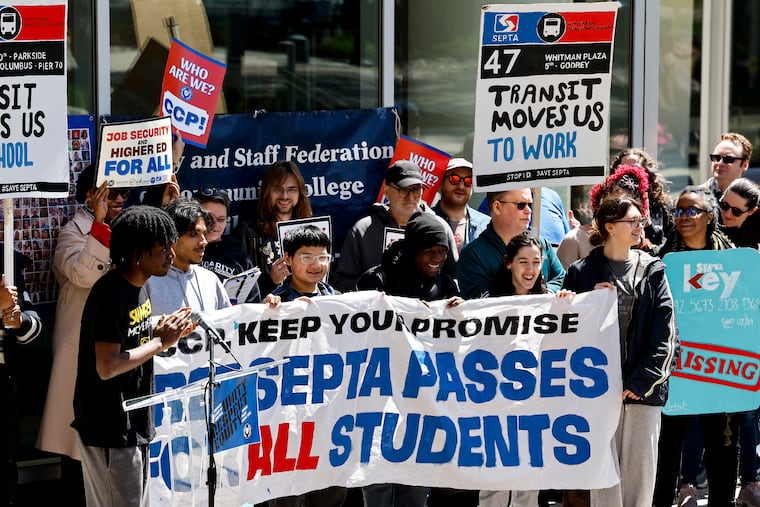
Community College of Philadelphia’s faculty and staff union on Thursday accused the college of failing to meet promises made during contract negotiations, including providing free SEPTA passes for students.
The college also has not taken meaningful steps to provide a new on-campus childcare center, but rather remains in an “exploration” process a year after the contracts were settled, union members said during a news conference on campus.
The college implemented a free transit pilot program for eligible students at its Career and Advanced Technology Center and West Regional Center in January, but nothing for those at its main campus or Northeast regional campus.
“The college is failing to follow through on its word to students,” Jamie Zigarelli, an English professor, said during the news conference.
Student Sarah Bradley, a single mother, also underscored the need for free SEPTA passes for student parents trying to balance work, family, and school. It’s especially crucial now that the college is raising tuition 9.4% for next fall, she said. It is the school’s first tuition increase in nine years.
» READ MORE: CCP board votes to raise tuition 9.4%, the school’s first increase in nine years
“Where’s the passes because they sure aren’t in our hands,” she said.
Physics professor Gabriel Carryon said he has seen firsthand the effect of not having a childcare center on campus. About one-quarter of his students have children, he said.
“I’ve had countless experiences with students who have had to skip class because they couldn’t secure childcare for their kids,” Carryon said. “No student should have to make this choice.”
The college, in a statement, contended that the bargaining agreements reached last year do not include a commitment to free SEPTA passes for students.
» READ MORE: CCP faculty and staff union reaches tentative agreement, averting a strike
“The College and Federation signed a noncontractual memorandum of understanding, which reads: ‘The parties agree that during the term of this agreement the College will negotiate with SEPTA for a free public transportation benefit,’” the college’s statement said.
The college is continuing to negotiate with SEPTA and met as recently as Monday, the school said, while talking with student government leaders about the interest and evaluating the costs.
As for a childcare center on campus, the college said it closed a previous center because of a lack of use and financial losses for the college.
“We are gathering real-time data from our staff and current student population to assess need while also reviewing our fiscal capacity to support such an endeavor during a time of increasing enrollment, operational expenses, and flat state funding,” the college said.
Carryon said the college should be lobbying for more city and state funding. The state, for the second consecutive year, has proposed flat funding for community colleges, and Mayor Cherelle L. Parker, in her budget address last month, proposed an overall funding increase of $1.85 million, or 3.3%, for CCP for 2026-27.
It’s not right that both the city’s and state’s share of college funding has declined, while students’ share has risen, union members said.
“So what happens when the city and state walk away from their promises to Philadelphia’s college,” Zigarelli said. “Who picks up the tab? The students do.”
The college also agreed to a joint committee to study how to pay faculty leaders who design and run 40 programs at the college, Zigarelli said, but only named its delegates to the committee this week.
“The college needs to get serious about working on it,” Zigarelli said.
Union member Ariel Vazquez also discussed ongoing problems with HVAC in college buildings and said the school must take steps to remedy the situation.
“Classroom temperatures are skyrocketing, sometimes hitting 90 degrees, leaving students drained, distracted, and struggling to focus,” Vazquez said.