Drexel’s new president must tackle a deficit and declining enrollment. He sees it as a ‘moment of reinvention.’
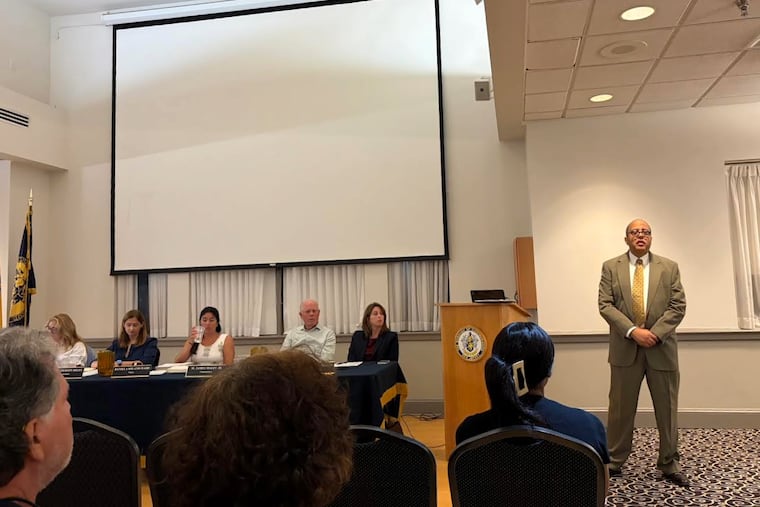
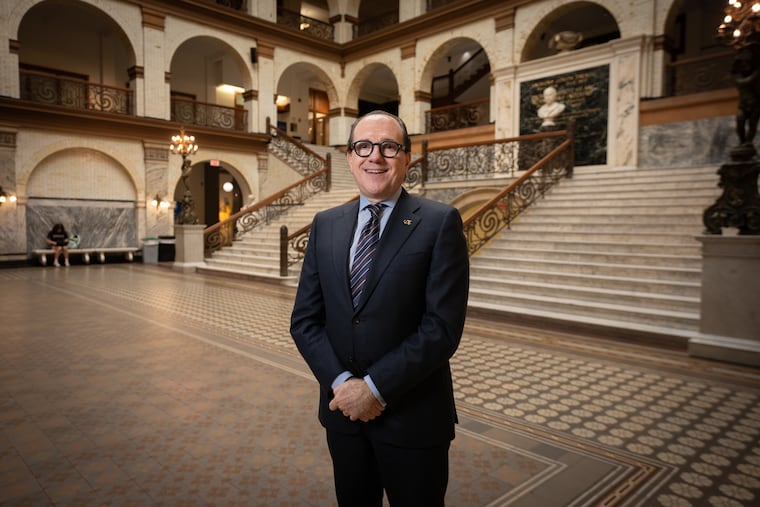
Antonio Merlo was inaugurated as Drexel's president Thursday. Under his leadership, the school will complete its academic overhaul this spring.
More than 100 years ago, Drexel president Hollis Godfrey laid out the “enormous challenges” facing the school, following World War I and a global pandemic.
Antonio Merlo, Drexel University’s new president, referenced that time Thursday in his inaugural address, optimistically noting that the school’s signature co-op program had come out of the adversity Drexel faced at that time.
Drexel now finds itself with another significant set of challenges, as it seeks to overcome budget deficits, overhaul academic programs, change from a quarter-based calendar to semesters by fall 2027, and cope with another national dip in high school students beginning this year.
“This is another moment of reinvention,” Merlo, an Italian-born political economist and former New York University dean, told the audience. “… Drexel will reimagine itself.”
Many colleges are facing challenges similar to Drexel’s in an increasingly competitive higher education market with fewer students and more questions about the value of college education.
Over about the last decade, the West Philadelphia university has lost about 20% of its enrollment. Last fall, Drexel saw a 19% drop in freshmen. And it is projected to continue to run deficits through fiscal year 2028, according to a recent report from Moody’s, which downgraded the school’s rating this month.
» READ MORE: Drexel’s new president says he’s ready to focus on the school’s academic overhaul
But those are not the numbers that Merlo is dwelling on. He touts that 96% of Drexel graduates have jobs or are in graduate school within one year and their starting salaries are 6% above the national average. Alumni, he said, are in the top 3% nationally in lifetime earnings. Ninety-one percent of students do co-ops, which are mostly paid six-month work experiences, and about half get full-time jobs from those co-ops, he said.
The school in the last year has advertised those numbers on banners at 30th Street Station and Philadelphia International Airport, Merlo said.
While some other schools are just beginning to talk about the need for more experiential and career-based learning, “we wrote the textbook” on it, Merlo said, referring to the co-op program.
“There is a palpable sense of optimism and energy,” Merlo said Wednesday in his large office conference room, now adorned by watercolor paintings from his late father’s art gallery in Italy.
The university will complete its academic overhaul this spring, he said, a new team is managing enrollment, and the school is projecting to end the year with a $20 million deficit, down from almost $40 million last year and $63 million in 2024.
A change in enrollment management
Merlo said senior vice president Subir Sahu, who had been overseeing student success, is now also leading on enrollment management, replacing Dawn Medley, who has since taken a job elsewhere. There is a new vice president, too.
Part of the reason for the 19% drop in freshmen was the school’s decision to lower its admittance rate last year by nearly 10 percentage points to 69.9%.
Merlo, who became president last July after the admissions process was complete, said that was not a good move. That strategy is being altered for the fall 2026 class, he said. The school also is restructuring financial aid and offering more merit aid to families who had not previously qualified for assistance, he said.
“Imagine that you’re sitting there in a family that makes $150,000 to $200,000 a year,” he said. “Suppose that you have a kid who has a 4.0 average. This year we went out with a merit-based scholarship that essentially now tells those families a very compelling story. You can come here for a much reduced net tuition.”
The school already is seeing promising signs from the shifts, he said. More students have submitted deposits to attend this fall and attendance is up at admitted student days, he said.
He also anticipates the percentage of admitted students who enroll at Drexel will increase. Last year, only 7.2% of those admitted enrolled, down from 8% in 2024 and 9.1% in 2023.
Overall, Drexel’s enrollment has gone from a high of 26,359 in 2014-15 to 20,868 this year.
Merlo said he does not have a specific enrollment number in mind.
“Bigger is not necessarily better,” he said. “I am actually not chasing after head counts. My goal is to improve the quality of the student experience at Drexel.”
Knocking down deficits
Moody’s earlier this month said Drexel was projected to run deficits through 2028 and then steadily improve.
“That is the plan,” Merlo said. “We know exactly what we need to be doing.”
Moody’s this month downgraded Drexel’s financial rating, citing “a weakness in financial policy and financial management” but noting the school’s “credible plans” to improve. Merlo pointed out that S&P Global, another rating agency, maintained the school’s higher rating this month and gave it a stable outlook.
He puts more stock in that one. Drexel’s regular Moody’s analyst died in a plane crash, he said.
“We had a brand new team of people who knew nothing about Drexel,” he said.
The school laid off 60 employees in 2024 and announced about 3.6% of its workforce had taken voluntary retirement. The school also said at that time it was cutting and freezing some salaries and slashing benefits as part of a plan to reduce the deficit.
Merlo said he has no plans for additional employee layoffs but there will be reallocation of personnel as the university completes academic program changes.
» READ MORE: Years into ‘historic affiliation,’ Drexel University and Academy of Natural Sciences may sever ties
In another potential belt-tightening move, Drexel may sever ties with the Academy of Natural Sciences. A source familiar with the situation told The Inquirer the academy had become a drain on the university. The school, which has provided the academy with more than $8 million in each of the last two years, has given the academy the choice of fully merging into Drexel or disaffiliating.
“We are working collaboratively with the mayor and the governor to figure out what the future of the academy is,” Merlo said this week. “And to be very clear, our primary goal is to protect and preserve the collections, which is an amazing resource for our students, for our city, for our region.”
But, he said, attendance and grant funding at the academy have declined and all parties need to “come up with a plan to have something that is sustainable.”
An academic transformation
Also in 2024, Drexel announced it would undergo a multiyear process to merge two of its colleges and one of its schools into one entity. The College of Engineering, the College of Computing and Informatics, and the School of Biomedical Engineering, Science, and Health Systems are merging into the new College of Engineering and Computing. The consolidation will be complete this spring, and Drexel earlier this month appointed Eunice E. Santos, a University of Illinois Urbana-Champaign dean, as the new college’s inaugural dean.
» READ MORE: Drexel University is consolidating schools and asking several deans to step down
The School of Education also was merged into the College of Arts and Science and the School of Entrepreneurship into the College of Business. The Autism Institute has become part of Public Health. And Drexel is consolidating its medical college programs in University City and likely will sell or repurpose its Queen Lane campus and a building in Center City.
Experiential education, while long a Drexel cornerstone, will become a requirement in the new curriculum, Merlo said.
“We want to just stand up and say this is who we are,” he said.