Ursinus College announces new president as it cuts faculty and faces budget challenges
Gundolf Graml, who had been interim president, is getting the permanent job.
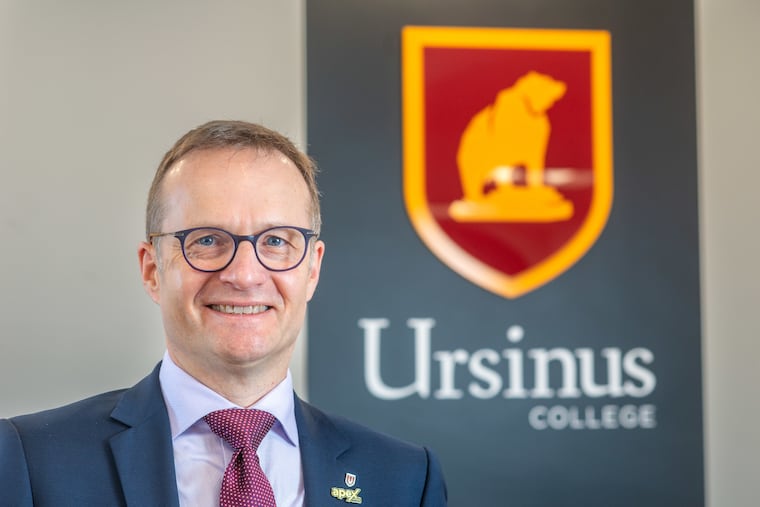
Ursinus College this week named a new president who has vowed to help the college thrive even amid faculty cuts that will affect nearly one-quarter of professors.
Gundolf Graml, who has served as interim president since the board ousted Robyn E. Hannigan in October, will lead the 1,406-student liberal arts college in Collegeville, the school announced Wednesday. Graml, 54, an Austrian native and a German studies scholar, previously served as Ursinus’ provost since February 2024.
His hiring comes as Ursinus faces a tough financial outlook. The college has been running total operating losses for most of the last nine years, reaching $13.4 million in 2024 but falling to $4 million in 2025, financial records show.
And it has already taken belt-tightening measures under Graml’s leadership to help offset that deficit, including an announcement in December that it would reduce its full-time faculty positions by 23%, amounting to 29 positions. He is also aiming to further reduce the school’s operating budget.
“We have looked at our budgets very, very carefully,” Graml said. “We continue to make the necessary adjustments. That’s the reality we operate in.”
The college chose not to conduct a national search for a new president, turning instead to a known administrator who has won the respect and confidence of the faculty and has embraced a sound financial and academic approach to running the college, said Joseph DeSimone, board chair.
» READ MORE: Ursinus College suddenly removes president, citing ‘best interests of the college’s long-term success’
“The interim period provided clear evidence of his ability to lead with integrity, advance the college’s priorities, and build trust across the campus community,” said DeSimone, a 1986 Ursinus alumnus and a professor of translational medicine and chemical engineering at Stanford University.
Lew Riley, a professor in the department of physics and astronomy and cochair of the faculty council, said Graml is collaborative, “leans heavily” into shared governance, and is transparent.
“He’s got the confidence and trust of the faculty,” said Riley, who has worked at Ursinus since 2002. “I’ve been doing this for multiple decades, and I’ve never seen a greater amount of confidence and trust in an administration than I’m seeing here right now.”
The college did not release Graml’s salary or contract term; Hannigan earned $507,000 in fiscal year 2024, according to recent financial statements.
The board did not say at the time why Hannigan was let go, other than to note that the decision was “made in the best interests of the college’s long-term success.” Ursinus had experienced a 10% decline in first-year enrollment last fall and a 6.4% decline in overall enrollment. And the retention rate for returning freshmen in 2024 was 77%, six percentage points lower than the school’s average.
» READ MORE: La Salle University saw a 40% jump in first-year students, as schools across the region see enrollments trending up
Graml acknowledged the rocky leadership change, but said he guided the college through by being transparent, building trust, and practicing “inclusive decision-making.”
“Processes always get better if you open up the channel for ideas to be at the table now,” he said.
Faculty and budget cuts
Faculty cuts at Ursinus, which currently has 130 full-time professors, include nine voluntary separation agreements extended to full-time tenured faculty, 16 layoffs of nontenure track faculty, and five other departures. The cuts saved approximately $3 million.
The faculty-to-student ratio had been about one to nine, Graml said. The cuts bring it to one to 12. That allows for continued small classes, but also budgetary realities, he said.
“It was a painful moment, but also one I’m very proud of,” he said, asserting that faculty played a role in “a very, very collaborative process.”
Riley, the faculty council cochair, said a group of faculty was consulted and made recommendations.
“It felt less like it was being done to us and more like we were being consulted on figuring out a way to keep the college sustainable,” he said. “We’re trying to build a new future for the college.”
Graml is also looking at other ways to reduce spending.
In an email to faculty and staff last week, Graml said the college was aiming to reduce the budget by $10 million by fiscal year 2027. The college has changed or eliminated some large contracts for areas including advertising and cleaning, saving $1 million, he wrote. The college is also tightening procedures for staff credit card purchasing, eliminating some consultants, changing software, ending the annual alumni awards ceremony, and combining family and homecoming weekends — all expected to save more than $1 million.
In addition, Ursinus has suspended nonessential spending and paused nonessential travel and conference costs.
An internal hire
DeSimone said boards often bank on a search to yield a strong leader, and often it doesn’t.
“It is so refreshing and so exciting to know that you can hire from within because you know who you’ve got,” he said. “We are all very, very excited about Gundolf taking the rightful helm at Ursinus College on behalf of the entire legacy of the college and the current students and our future.”
He said he was pleased with how Graml led the recent launch of Ursinus’ new APEX (Applied. Professional. Experiential) learning ecosystem designed to better align academics with career prep.
Ursinus is aiming to emphasize career connections from students’ first year, Graml said. The college is connecting students with advisers and career coaches, and all first-year students participated in an “experiential learning” week this year at nonprofit or for-profit organizations.
Graml also played a major role in Go Global, which, starting in spring 2027, will allow sophomores to travel nationally or internationally for career exploration as part of their regular tuition.
And Ursinus has launched a series of new majors to attract more students, including several in business and health sciences, as well as sports management, applied sustainability, music technology, and marine science.
The school also is looking at the possibility of offering certificate programs, online and hybrid majors, and recruiting more nontraditional adult learners, Graml said.
Graml said Ursinus is up 22% in applications compared with the same time last year and 14.5% in deposits for next year’s freshman class. And the college said it lost 7.1% of its freshmen from fall semester to this spring, compared with 11.4% for the same period last year.
Connecting with students
A recent student editorial in the Grizzly, the student newspaper, noted that Graml regularly eats in the student dining hall, sometimes even on a weekend.
“If we happen to make eye contact, I smile, because he is friendly,” the editorial said.
Graml said he sometimes has breakfast and dinner there, too.
“I really enjoy connecting with students outside of these formal events, and I learn a lot from them,” he said.
Students wanted upgrades in their lounges, and he was able to help.
“An important work of the president’s role is also being a translator … between different units on campus,” he said.
Staff writer Harold Brubaker contributed to this article.