This Haverford teacher didn’t have Black role models in school. Now he’s a finalist for National Teacher of the Year.
Leon Smith has taught at Haverford High School for 25 years and wants to help encourage more young people — especially Black men — to become teachers.
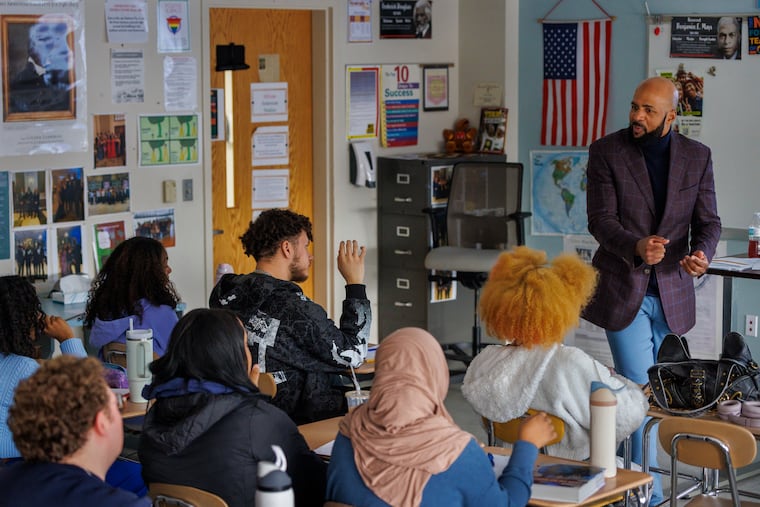
The dozen students in Leon Smith’s Advanced Placement African American Studies class were analyzing Countee Cullen’s conflicted emotions about his ancestral homeland of Africa in his poem, “Heritage.”
Smith challenged the Haverford High School students to consider the Harlem Renaissance-era poet’s intent. Imagery depicting Africa as primitive may have resonated with white readers, he said, helping Cullen connect with a broader audience before the poem’s concluding line: “They and I are civilized.”
“You have to meet people where they are,” Smith told students in class last month. “Once you’ve done that, you can deliver the message you want to deliver.”
A history teacher who has worked at Haverford High School for 25 years, Smith is in the running to gain a much bigger platform: He’s one of five finalists for National Teacher of the Year, an award from the Council of Chief School Officers that would allow him to spend a year traveling the country promoting the teaching profession.
Smith, 46, who was named Pennsylvania’s Teacher of the Year last year, is passionate about teaching, and wants to elevate its standing amid a diminished pipeline of new teachers.
Strong students are often told they should become doctors or lawyers, Smith said, but “the conversation should also be — ‘You are an outstanding leader. I saw the way you communicated with the people in your group. You should be an educator.’”
In addition to teaching African American studies and two sections of AP U.S. History, Smith advises the African American Cultural Enrichment Club and coaches freshmen boys’ basketball.
“The hours outside of the classroom that he informally mentors — I don’t know the number of kids. Students constantly come to his room … he just does it. And then you might find out six months later,” said Pete Donaghy, the high school principal.
He described Smith as a “quiet motor,” researching topics and proposing changes to create a more inclusive school environment.
“He’s opening the doors for people he doesn’t even know he’s opening the doors for,” Donaghy said. “He does it quietly, and he does it modestly. His influence is enormous.”
‘I wanted to make a difference’
As a Black male teacher, Smith is relatively uncommon — particularly in a majority white school district. More than three-quarters of Haverford students are white; 5% are Black.
A decade ago, Smith was the only Black man teaching at the high school; today there are three.
Smith grew up in a similar environment. Attending Upper Dublin schools, he didn’t have a Black male teacher until his sophomore year of high school.
“It was frustrating for me,” said Smith, who drew a contrast between the church environment he grew up in — the historic Salem Baptist Church, which once hosted the Rev. Dr. Martin Luther King Jr. and Rosa Parks.
“I was learning all those things … about Black history, seeing it every Sunday, and going to my school and it was a totally opposite experience.”
Smith — who has two kids and is married to Vivian Smith, a professor at Eastern University — comes from a family of educators. His mother was a longtime administrator in the Philadelphia School District, and his father was also a teacher.
“I just saw how impactful my mom was,” going “above and beyond” her job description, Smith said. He heard stories of teachers visiting students’ homes and making sure kids had what they needed.
While “I knew I wanted to make a difference,” Smith didn’t always know he wanted to become a teacher. The calling grew over time, including at summer camp, where Smith was often put in charge of younger children.
Watching The Cosby Show, Smith admired how Theo Huxtable, the son of Bill Cosby’s character Cliff Huxtable, became a mentor to African American kids while working at a community center.
“I just remember how they looked at him, and I thought it was so powerful,” Smith said. At the University of Maryland, he decided to major in education.
He graduated in 2001, and that fall began working in Haverford.
Teaching about race
In addition to U.S history, Smith began teaching an African American studies elective about five years ago. When the College Board in 2021 announced plans to start offering AP African American Studies, Smith reached out “and asked how I could be a part of it,” becoming a consultant for the course.
In a climate where the right has pushed back on schools teaching about race — Florida banned the new course, while Arkansas and South Carolina restricted access to it — Smith said he hasn’t faced opposition in Haverford.
The field of African American studies “has been around for decades,” grounded in scholarship and drawing on multiple perspectives, Smith said. “This is not something that I make up.”
Teaching African American studies has “allowed me to be my authentic self,” Smith said. In talking about the Great Migration, Smith tells students how his grandparents met in North Philadelphia.
Connecting his life to events “hopefully makes an impact on my students,” Smith said.
Khadija Mansaray, a Haverford junior who took AP African American Studies last year, said the class was “one of the most important” she’d taken in high school — from learning about African kingdoms to gaining a deeper understanding of slavery.
“I don’t think anybody else could have taught it the way he did,” said Mansaray, who called the class “intriguing.“
During last month’s lesson — one of the first of the new semester — Smith displayed photos of modern cities in Ethiopia, Angola, and Nigeria.
“Do you think this is the image people usually have of Africa?” Smith asked, remarking that a picture of Luanda, Angola “could be Miami.”
Trim, dressed in a blazer, turtleneck, and jeans, Smith circulated through the room as students analyzed different stanzas of Heritage. He paused at one student’s desk, encouraging her to read part of the poem preceding her section.
“It’s almost like listening to a song halfway through,” he said, adding that poetry “can be challenging.”
Smith has a “warm, welcoming aura,” Mansaray said, crediting him with helping “open her mind” and find her voice.
A member of the African American Cultural Enrichment Club, Mansaray, who is Black, said hearing Smith describe how he gained confidence to speak up about racist comments empowered her to do so as well.
Smith “has had a very long-lasting impact, I think I’ll take with me throughout my entire life,” she said.
Advocacy work
In addition to teaching classes and leading extracurriculars, Smith is a policy advocate. He’s a member of the National Teacher Policy Cabinet for Teach Plus, an organization that focuses on growing the teacher pipeline and educational equity, among other areas.
In Haverford, Smith has pushed the district to recruit more diverse candidates, Donaghy said.
“It’s never heavy-handed with him. It’s, ‘How are we doing with this?’” Donaghy said.
Across Pennsylvania, teachers of color make up about 6.6% of the workforce, compared to 38% of students.
Smith, who noted that all students benefit from having Black teachers, said policymakers need to address barriers to entering the teaching profession, including by paying student teachers stipends.
But schools also need to be analyzing racial disparities, Smith said, including participation in honors and AP classes and disciplinary rates.
“If we want people to come back” as teachers, they need to have had a positive experience in school, he said.
He advocates for change because of his own experience, Smith said, “realizing it can be quite isolating and challenging to be the only one.”
If he’s selected as National Teacher of the Year in April — a post that comes with a national speaking tour — Smith hopes to talk about the importance of positive school environments for both teachers and kids.
If teachers are “joyful, confident, and can show up as their whole selves,” Smith said, students will also excel.
That “allows students to look at teaching as a job they want to do,” he said