A Camden job training program turned a young man’s life around. Now he’s a Hopeworks mentor.
Hopeworks' alternative program in Camden pays young people to undergo technical training and obtain a skill set to help them get a job.
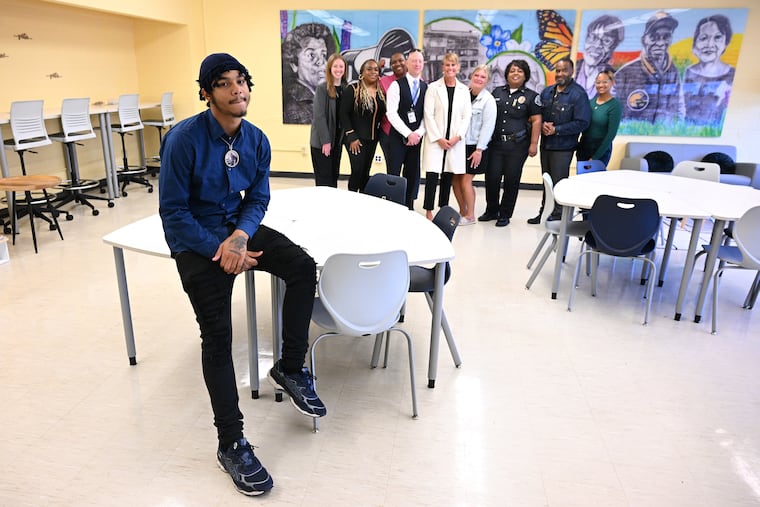
James Horn hit rock bottom when he landed in solitary confinement on his 20th birthday after several run-ins with law enforcement.
That November 2023 punishment, after he fought with another inmate at the Riverside Correctional Facility in Philadelphia, was a turning point.
“That was probably the lowest point in my life,” Horn recalled in an interview. “Life is a lesson, and I went through the lessons.”
Horn spent 17 months in prison after pleading guilty to robbery. After his release, the high school dropout wanted to make up for missed opportunities, obtain a driver’s license, and earn a GED certificate.
He enrolled in Hopeworks, a nonprofit in Camden that provides high-tech training and support, aiming to break cycles of poverty and connect young people with job opportunities.
It was a second time in the program for Horn, 22, of Woodlynne. He dropped out in 2019 after three months, turning back to the streets.
Horn finished the program earlier this year and landed a job with Hopeworks. He began a special assignment in July working with at-risk youth.
“I just look at life differently. There was more to conquer and I wanted to do it the right way,” Horn said.
Horn has become a poster child for Hopeworks and its truancy program, which pays young people to undergo technical training and helps them find jobs.
The program is open to youth from across the region, but has a big emphasis in the city of Camden. Hopeworks also has a location in Kensington.
Hopeworks touts a holistic approach that provides high-tech training and paid work experience. Participants learn web design and Geographic Information Systems (GIS) technology.
A state pilot program for restorative justice
After Horn completed his training, Hopeworks placed him with the Camden County Restorative and Transformative Justice HUB, a pilot state program that tries to keep young people out of the juvenile justice system and help those returning into the community. There are HUBs in Camden, Newark, Trenton, and Paterson.
A peer support specialist, Horn makes $50,000 annually and works in the office assisting with social platforms. He also provides counseling to resolve conflicts and leads group discussions to help the participants make better decisions.
“He connects with the youth,” said his supervisor, Rashein Chandler. “They open up to him a lot easier.”
Horn said he was nervous when he first met the participants in the program, who range in age from 10 to 26. He used his experience to encourage them to stay out of trouble.
“The street stuff is not it. It’s going to lead you to one of two things: death or jail,” he said.
Young people can be referred to the HUB for neighborhood disputes, family conflict, truancy, or low-level offenses such as breaking curfew, loitering, and disorderly persons. Some are on probation or returning from out-of-home placement.
The Camden program is located in the former U.S. Wiggins elementary school and offers activities and extracurriculars like a photography club. Funded by a $1.3 million state grant to the county, it has served about 200 youth since 2024.
“I love it here. I like the kids,” Horn said.
On a recent afternoon, Horn was prepared to lead a counseling session when a melee broke out in a hallway between a group of girls. The staff scrambled to de-escalate the conflict. The girls later apologized and came together.
The fight stemmed from a neighborhood dispute, said Marcie Walton, CEO of Making It Work, a nonprofit that operates the HUB.
Walton jumped into the ruckus, pulling one girl into a hug and whispering in her ear, “I love you too much to let you fight.” The girl cried and stopped resisting, Walton said.
“They have to learn to resolve peacefully. We have to show them a different way.”
In keeping with the restorative justice approach, the girls were allowed to return to the program a few days later. The program uses “peace circles” to mend hurt feelings.
“It’s a family,” Walton said. “It’s not perfect.”
Horn said he can relate to their struggles because of his own upbringing, raised with three siblings by a single mother. He dropped out of high school his sophomore year and went to jail at 17 for a home invasion.
He said he wanted to be a role model for his younger sister. While in prison, he turned to his faith.
“I just looked at it like the storm isn’t always going to be there. I never gave up,” he said.