A Montco college lost its federal grant for first-generation, low-income students, and other schools worry they’ll be next
The U.S. Department of Education ended funding for Montgomery County Community College’s Upward Bound program, and President Donald Trump’s administration has delayed funding for other programs.
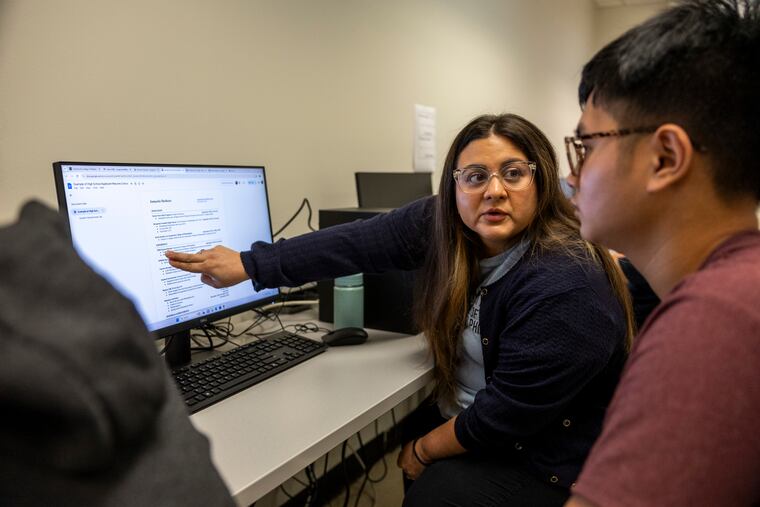
Since 2007, Montgomery County Community College’s federally funded Upward Bound program has taught nearly 300 Norristown and Pottstown high school students from low-income families “skills, study habits, discipline and attitude” to be successful in high school and college.
“This work was a vital part of our mission to expand access to all students and support student success,” college spokesperson Diane VanDyke said, noting that students in the program would be the first in their families to attend college.
But in May, the U.S. Department of Education notified the college its funding for Upward Bound, part of the federal TRIO grant program aimed at helping low-income and first-generation college students, was being discontinued. The school lost access to about $650,000, she said, the remainder of the $1.6 million five-year grant that it received in 2022.
» READ MORE: Trump administration cuts funding to minority-serving colleges. What does this mean for Philly-area schools?
It’s one of many colleges across the country that has lost or feared losing TRIO funding, among the areas targeted by President Donald Trump’s administration as it seeks to cut costs and downsize the Department of Education.
Community College of Philadelphia had feared its Upward Bound program, also funded via TRIO, might face the same fate after it failed to receive funds in August as was usually the practice, said Aimie Contarino, program director.
Instead, the college, which was about to begin the fourth year of a five-year grant for $1.8 million, got a letter from the Education Department that it could operate for another month with whatever money it had left and would hear more by Sept. 30, she said.
On Wednesday afternoon, the college was notified it would get the funding.
“We’re thrilled,” Contarino said.
CCP’s program currently serves 68 students from four Philadelphia high schools: Benjamin Franklin, which is near CCP’s Spring Garden campus; South Philadelphia; Furness; and Building 21 Philadelphia. Students attend sessions on Saturdays and in the summer.
But Contarino said she remains concerned about future funding, knowing Trump had proposed eliminating TRIO funding in his fiscal 2026 budget. Though the House and Senate passed bills that would keep it, the budget has not been finalized yet.
“I guess it’s just so uncertain,” Contarino said. “It feels like at any moment they might decide something new, and it’s scary.”
Such uncertainty has become a new reality as other federal funding for education has also been affected since Trump’s second term began. Earlier this month, minority-serving colleges learned they could be losing federal discretionary funding. Rutgers-Camden and CCP were among local schools that could be affected. The Education Department later announced it would be giving much of that funding to schools designated as historically Black colleges and tribal colleges.
» READ MORE: Penn scrubs diversity initiatives from its website to comply with Trump order
Diversity, equity, and inclusion programs also have been targeted, and the administration has attempted to dramatically reduce research funding to universities by reducing indirect cost reimbursements — the University of Pennsylvania, for example, stands to lose $250 million — though that has been paused via a court injunction.
Scrutiny on grant funding
Kimberly Jones, president of the Council for Opportunity in Education, a nonprofit that supports TRIO programs, said the department’s decision to delay disbursement of TRIO funds to programs across the country last month was “a shock wave.” She estimated that about $660 million was withheld from more than 2,000 programs.
“Many programs were forced to temporarily shut down or to severely limit services,” she said.
And while most of those grants were handed out last week, “we’re not taking our foot off the gas,” she said. “Until we get our grant awards … everybody is going to be on edge.”
TRIO programs, around since the 1960s, received $1.19 billion in federal funding in the most recent fiscal year.
Education Department spokesperson Ellen Keast told Inside Higher Education last week that Trio awards would be going out by Sept. 30 after proper vetting.
“The Trump Administration is no longer allowing taxpayer dollars to go out the door on autopilot — we are evaluating every federal grant to ensure they are in line with the administration’s policy of prioritizing merit, fairness, and excellence in education,” Keast said.
The department did not respond to The Inquirer about why funding for the Montgomery County Community College program was ended. But in its termination letter to the college, the department said it was among programs that conflict with the administration’s policies in that they “violate the letter or purpose of Federal civil rights law; conflict with the Department’s policy of prioritizing merit, fairness, and excellence in education; undermine the well-being of the students these programs are intended to help; or constitute an inappropriate use of federal funds.”
VanDyke said the college had requested reconsideration but has not heard back.
Temple University said its Upward Bound (UB) and Upward Bound Math and Science programs, which serve almost 150 Philadelphia high school students annually, have not received notice they were in danger of losing funding.
“In fact, we just received the Year 4 Grant Award Notification for UBMS a few weeks ago,” said spokesperson Steve Orbanek.
» READ MORE: Community College of Philadelphia announces rebranding campaign to attract and retain students: ‘Rise from Within’
‘It opened up my world’
At CCP, Contarino had feared that if federal funding were lost, the program would have had to shut. She has worked there full-time 17 years, her entire career.
“It means a lot to so many people in so many different ways,” said Contarino, who talked through tears during an interview before she knew funding had been approved.
Contarino led an effort to gather letters from alumni about the program’s impact so she could mount a fight.
Ghanashyam Gautam wrote that he was born in a refugee camp in southeastern Nepal and moved to the United States with his family in 2008.
“For six months, I struggled — until a friend introduced me to Upward Bound," Gautam wrote. “UB was my anchor. I found the structure and support I desperately needed.”
With help from Upward Bound staff, Gautam applied to 14 colleges, wrote more than 20 essays, found scholarships, and decided on majoring in computer science. With a bachelor’s degree from Albright College, Gautam is now a software engineer for a large accounting firm.
Maria Cabrera had attended an under-resourced high school in Philadelphia and her parents did not attend college. She felt ill-equipped for the college application process.
But her involvement in the program changed that. She said she received SAT prep, visited college campuses from Boston to Baltimore, got tools to help her select the best college, and benefited from mentoring.
“It opened up my world to outside North Philadelphia,” Cabrera said. “It was being able to explore all the options available to students out there that I had no idea about.”
Cabrera, who has since obtained a bachelor’s degree from the University of Scranton and an MBA from Delaware Valley University, now works for the 25-year-old program.
For Contarino, 47, who lives in Philadelphia, it has been a particularly difficult year. She was diagnosed with breast cancer in November, the day after the presidential election.
“Being with the kids, they give you a lot of reasons to fight and a lot of reasons to hope,” she said.
At CCP’s program this month, high school seniors are getting assistance with their college applications. On Saturday, more than a dozen students were working on letters to teachers to ask for recommendations, polishing their resumés, and preparing scholarship applications.
Deshaun Semple, 17, a senior at Building 21, said he has been coming to the program since he was a ninth grader.
“I really maintained my GPA because of the assistance I got here,” said Semple, who has a 3.6 grade-point average.
He said he is relieved the program got funded again because he wants his younger brother to have the same opportunity.
Asheilia Hernandez, 17, also a senior at Building 21, said her mom, who transports special-needs students, and father, a mover, had not gone to college. Getting the help at Upward Bound has been vital.
“My parents don’t know anything about this stuff,” said Hernandez, who is interested in studying political science. “So being in this program helped me understand what I need for college and helped me grow as a person in my own emotions.
“These people are my family.”