This Philly elementary school isn’t on the closure list, but parents are fighting plans to turn it into a middle school
The plan for Moffet "will have an inordinate impact on a thriving, ingrained, multicultural elementary school that does not exist in many other places across our city," one teacher and parent said.
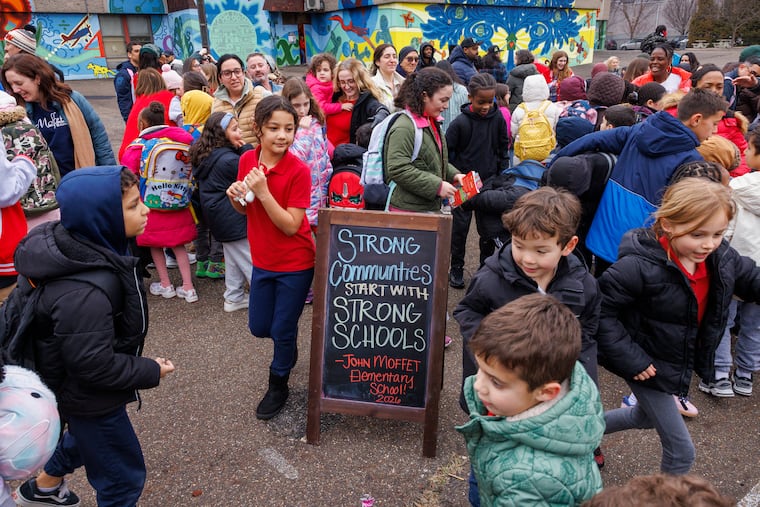
Moffet Elementary has never shown up on a list of city schools that are proposed to be shut down.
But the families and teachers at the South Kensington elementary school say the changes the Philadelphia School District has proposed amount to closing it.
Moffet, now a K-5 school, would become a middle school serving grades five through eight under the district’s proposed facilities plan.
The district wants to make that change by merging the catchments of Moffet and Hackett, another K-5 a mile away in Kensington. Students in kindergarten through fourth grade would attend Hackett, and would then move to Moffet for grades five through eight.
“That’s a closure,” said Ariel Vazquez, a Moffet parent.
Supporters of the small, diverse school on West Oxford Street are mounting a fierce fight against what they say is Moffet’s dismantling.
They claim the move is inequitable and will harm the community by leaving South Kensington without a single elementary school, forcing students from predominantly Black and brown and economically challenged families into long walks to and from school, and endangering a large community of students with special-education needs.
Megan Zor, a Moffet teacher and parent, said she is optimistic some parts of Superintendent Tony B. Watlington Sr.’s $2.8 billion facilities plan, which involves closing and merging some schools and modernizing many more, will result in better academic outcomes.
But the district’s plan for Moffet does not fit in that category, she said.
“This plan is incomprehensible because it will have an inordinate impact on a thriving, ingrained, multicultural elementary school that does not exist in many other places across our city and certainly will not continue within the proposed merger of Moffet and Hackett catchments,” Zor said.
Monique Braxton, a district spokesperson, said the Moffet recommendation was a response to parents’ desire “to keep children in strong neighborhood schools through middle school.”
Moffet’s enrollment trails off in the higher grades, Braxton pointed out, and few students in the neighborhood continue on to Penn Treaty, the current catchment middle school, which the district has also recommended for closure.
“The proposal is designed to create a clear K-8 pathway, so families who want to stay in their neighborhood public schools have that opportunity,” Braxton said in a statement.
Paying taxes in a neighborhood with no schools?
Over the hum of a fish tank set up in the school library, Katy Hoffman-Williams led a recent Moffet Family School Organization meeting with updates on a petition circulating to block the proposed changes, a review of advocacy points, and plans for future events.
Frustrated by what they say is a backdoor dismantling without the same scrutiny given to other closures, Moffet supporters have already forced a meeting with the district, which took place earlier this month. They are brainstorming alternate plans to present to leaders.
“I think our neighborhood businesses are going to care about this,” Hoffman-Williamson told FSO members at the meeting on Tuesday. “I just emailed my neighbors: ‘Hey, you all are about to pay taxes in a neighborhood that has no schools.’”
Across the city, the district has 70,000 empty seats; Moffet is considered “moderately underutilized,” with 218 students in a building that holds 333.
COVID-19 hurt enrollment, but signs of new momentum had been stirring. Moffet has a new pre-K, and parents say it is filled mostly with neighborhood families who had planned to keep their kids at the school to kindergarten and beyond.
“I see far more young families on the playground now,” Hoffman-Williams said.
For the forthcoming school year, 82 families from outside Moffet’s catchment listed it as their first choice in the school selection process, signaling the growing interest. (That’s up from 55 the prior year and 40 the year before.)
But because the district’s plan was announced before families had to make decisions about where to send their children in September, news of the coming changes tanked enrollment. Only 15 of the 86 out-of-catchment families ultimately chose Moffet; a paltry four families showed up to the kindergarten open house, Hoffman-Williamson said.
Hoffman-Williamson said she recently ran into a neighbor who switched course after the district said it was making Moffet into a middle school.
“He said, ‘We heard you guys are closing, so we just signed up for Adaire,’” Hoffman-Williamson said.
The neighborhood surrounding Moffet has boomed with development in the last decade, said Anthony Krupincza, a dad of three Moffet students and a local Realtor and landlord, driven in part by the idea of an elementary school in walking distance.
“Moffet,” Krupincza said, “has been integral in keeping those new homeowners in the neighborhood. This directly benefits the city, with property taxes and income. Without Moffet, you will inadvertently see less home buying in that direct neighborhood, and more young parents moving when their children reach elementary school age.”
A cozy school
Beyond the economics, proposing fundamental changes to Moffet threatens a community that feels a lot like what district officials are trying to build around the city, supporters say.
Moffet outperforms district averages in reading and math. There is no racial majority — its families speak several languages. Most of its students are from economically disadvantaged families, and a quarter receive special-education services. Its faculty is stable, with staff planting roots at Moffet.
Amy Canary, parent of two children, including a Moffet first grader and an older child no longer at Moffet, said the school’s role in the neighborhood is invaluable.
“As a small school, it has a really cozy community feel,” Canary said. “But it’s been academically successful — my kids have been challenged, their teachers are really experienced.”
In drawings and letters to be presented to district officials, Moffet students made their case about why they love their school: It treats everyone fairly. It respects people’s differences.
“Why I love Moffet and hope they don’t change it is because a lot of my family went here, and I’ve been here for six years and it is the best,” one student wrote. “I also love a lot of the teachers are so nice.”
Parents say they worry about students walking more than a mile to Hackett. The new Moffet-Hackett catchment, viewed on a map, looks like a noncontiguous butterfly, touching only in one spot.
Many Moffet families are closer to Ludlow, which is slated for closure, and Adaire, which is nearly full, than to Hackett, said Leah Scherzer, a Moffet parent.
“Going all the way” to Hackett “doesn’t make any sense,” Scherzer said. “Adaire is so much closer to us. The only way this plan would work is if they rethought all of the catchments.”
Moffet supporters also note their school was built with elementary schoolers, not middle schoolers, in mind.
State Sen. Nikil Saval (D., Philadelphia) opposed the plan for Moffet in a letter sent to Watlington on Thursday.
South Kensington needs a neighborhood elementary school, especially considering its “significant growth,” Saval wrote.
“As a superintendent who has served other jurisdictions, you are certainly aware of the dynamic nature of ‘buy-in’ to neighborhood schools: something observable in many neighborhoods throughout South Philadelphia, where enrollments have decreased, and then steadily increased with a slight lag behind growth in residential populations,” Saval wrote. “Something similar may and is indeed likely to happen in South Kensington.”