Closing this North Philly school would be ‘severing a lifeline’ for special-education students, supporters say
The School District of Philadelphia has proposed closing James R. Ludlow School, which educates a significant special education population alongside general education learners.

James R. Ludlow Elementary School in North Philadelphia educates a substantial population of special-education students.
And the learning environment for those students would be upturned by the school district’s recommendation to close Ludlow after next school year, teachers say.
“For our children in special education, that consistency isn’t a luxury, but a requirement for them to learn. If we relocate our students, we aren’t just changing their school address; we’re breaking their routines and undoing their progress,” Vanessa Martin, an autistic support teacher in kindergarten through second grade at Ludlow, said at a community meeting last month with school district officials.
“This building isn’t just a facility. It’s the one predictable place where our students feel safe and supported every single day,” she said.
The district says Ludlow was slated for closure because of an “unsatisfactory” building quality score, a lack of appropriate space for programming, and only utilizing 47% of its capacity. Ludlow has 237 students enrolled across general and special education, of whom 75% are Black and 20% are Hispanic.
The K-8 school will celebrate its 100th anniversary in what could be its final school year of operation. The district, which has proposed closing 18 schools, plans to convey the building at 550 Master St. to the city so it could be converted into affordable housing or used for job creation. Ludlow students would be reassigned to one of three schools: Paul L. Dunbar School, Spring Garden School, and Gen. Philip Kearny School.

Wholesale changes are coming to the Philadelphia School District, with the school board passing a $3 billion facilties plan that aims to close 17 schools permanently, and renovate 169.
Superintendent Tony B. Watlington Sr. presented the plan to the school board Feb. 26 and it immediately faced strong opposition. After some amendments, the board passed the plan April 30. Here's what we do and don't know about it.
And to see the proposed list school closures and check how your school could be impacted, use our interactive charts.
Each of the schools proposed for closure has its own story. Find them all here.
‘Severing a lifeline’
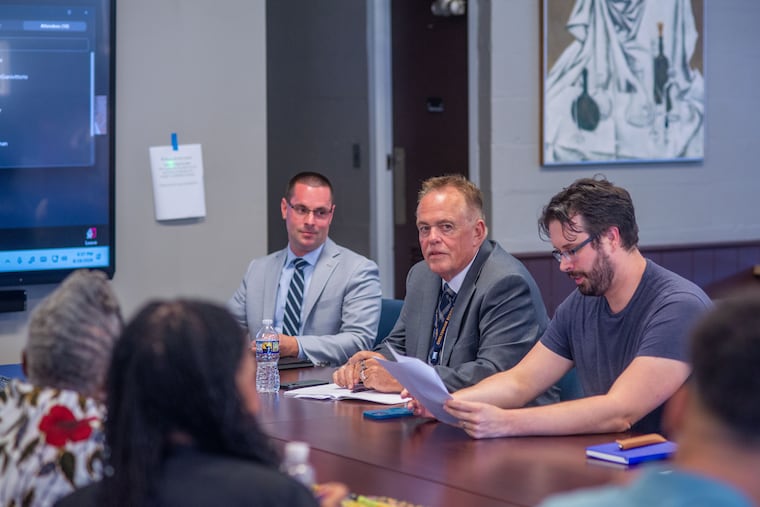
The Ludlow community is strong and connected, and about a hundred people packed the school’s cafeteria for the community meeting on a recent Thursday evening to show their support for the school and fight against the district’s plan.
“I felt very angry. I felt upset. I felt like they were taking something away that was a part of me,” said Deilyhanix Vazquez, a Ludlow eighth-grade student who has attended the school since kindergarten. She said her teachers “feel like home,” and she had been planning to continue visiting the school even after she graduates.
“I’m worried that the students will have to travel far just to get an education. Something they have to do on the daily starts to feel like a burden,” said Savannah Lindsay, another Ludlow eighth grader.
Another young student broke down into tears as she spoke into the microphone, saying she had planned to attend Ludlow for “my whole life.”
If the plan goes forward, she said, she may have to split up from her friends as they get assigned to one of three different schools.
“I don’t want to leave them,” she said, as others in the room clapped and cheered her on.
Should Ludlow close, the neighborhood and the wider school district would lose a valuable special-education resource and hub. Its offerings include autistic and other learning support for all grades, and emotional support for grades three through eight.
Ludlow often receives student referrals from other schools and catchments across the district, staff members said, including from the schools that would take in Ludlow students in the closure plan. It can feel like the district dumps its most difficult students on Ludlow, Martin said, but those children are accepted and become like family.
District officials have said that in addition to closing buildings that are not operating at full capacity, another goal is focusing on K-8 schools over middle schools to reduce transitions. That goal especially doesn’t square with the plan to close Ludlow, critics said.
“Ludlow is an exceptional school that works. By moving forward with this proposal, the district would be doing more than just closing Ludlow’s doors — it would be severing a lifeline and dismantling a support system that children and families depend on for their stability,” Martin said.
Affordable for whom?
Community members questioned the plan to turn Ludlow into affordable housing. They doubted whether those units would actually be affordable for the people living in the neighborhood, where the annual median household income is about $58,000.
The area sits next to Fishtown and Olde Kensington, where gentrification has made living more expensive for longtime residents.
Ludlow community members said they did not want or need more housing. They wished the district would instead invest in the building for learning purposes, and said the district had let it fall into its poor condition.
“It’s money before our kids,” said Valerie Johnson, known better as Valerie Brown, a beloved former Ludlow staff member who worked at the school for more than 30 years.
While housing may bring new residents and investment to the neighborhood, the loss of Ludlow could drive some to leave, one mother said.
“I stay in this neighborhood because of Ludlow,” said Darlene Abner, a mother of six whose children have attended the school, including a kindergartner enrolled this school year.
Abner herself was born in the neighborhood, and she said she does not want her children to attend any school but Ludlow.
She wears a nearly full face-covering niqab, and credited the school and its teachers for never letting that be a barrier to building a relationship with her and caring for her children.
“They know me. They see me,” she said.