The Norristown school district is eliminating its DEI director but rejecting accusations of ‘MAGA behavior’
The board, which previously moved to oust its superintendent over test scores, said school leaders will be held accountable for reducing racial disparities. Critics are skeptical.
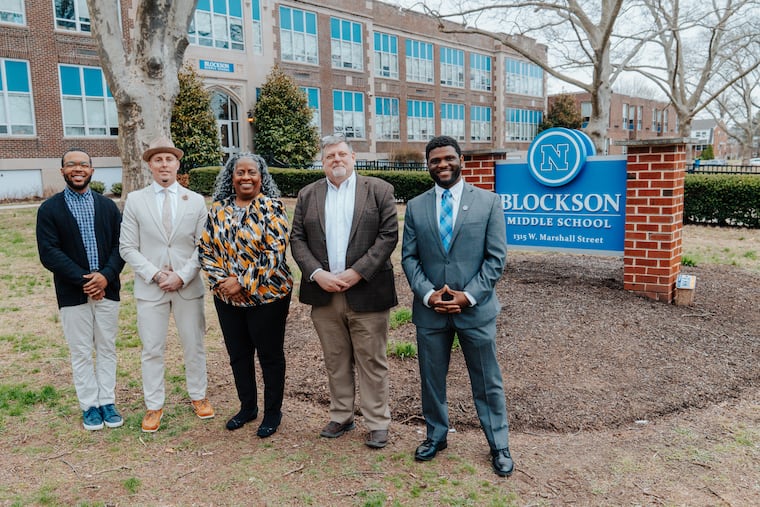
The Norristown Area School District is terminating its chief of diversity, equity, inclusion, and belonging position, the latest move by the new school board to upend the district’s leadership.
The Democratic board, which voted in April to scrap the role at the end of the school year, has said it is not abandoning DEI, but instead intends to make improving equity everyone’s responsibility.
“We’re not moving away from DEI. We’re changing the approach because it’s so important to us,” Jeremiah Lemke, the board’s president, said in an interview.
But the move, which comes as President Donald Trump has threatened to withhold federal funding from schools that encourage DEI initiatives, has shocked some community members in the diverse Montgomery County district. More than half of Norristown’s students are Hispanic and 28% are Black, and its residents tend to vote overwhelmingly Democratic.
“Who is closing DEI offices today? … This is a type of MAGA behavior,” said Obed Arango, executive director of the Centro de Cultura Arte Trabajo y Educacion, a community center that works with immigrants in Norristown.
He accused the board — which moved earlier this year to oust Superintendent Christopher Dormer over test scores — of dismantling the district without consulting the community.
“You don’t have to belong to a party or movement to behave like that,” Arango said in an interview.
Board members have pushed back on the criticism. At a school board meeting last Monday, Lemke said, “There’s been a narrative put forth … that we’re taking a right turn, that we’re all MAGA Republicans up here.”
“That is absolutely not the case,” Lemke said.
Lemke, who was elected along with four other new members in November, said the nine-member board is taking an “upgraded approach” to DEI, with a focus on reducing inequities in academics and discipline. Data on everything from participation rates in Advanced Placement courses to staffing diversity and student voice and perception will be frequently monitored and publicly reported, he said.
“Our concern is not primarily whether positive events occurred or whether cultural celebrations were supported,” but “concrete key performance indicators,” Lemke said.
He said the district’s DEI efforts had become “symbolic rather than systemic, and that is not acceptable.”
The district’s DEI chief, Steven Willis, said at the school board meeting that he had created an equity action plan for the district, and that Lemke had mischaracterized his work.
“If anybody on this board has listened to a thing I’ve said for the last three years … it was to move away from those type of events, and to get deeper into the culture and the connection that results in what happens each and every day for every single child,” Willis said. “I do take a bit of umbrage with the idea that that’s what I was doing.”
Willis, whose position will end June 30, did not respond to a request for comment last week.
A former high school teacher, Willis has served as DEI chief since 2023, when the position was created. Dormer, who remains superintendent through June 30, had proposed the position; he declined to comment last week.
Accountability for racial disparities
Proponents of eliminating the DEI position say the district has not taken enough accountability for disparities between student groups.
While less than 10% of the district’s students are white, they make up more than 37% of students in gifted programming.
About 25% of gifted students are Hispanic and about 19% are Black, “representing our struggle to identify high-performing students of color,” the district’s assistant superintendent, Yolanda Williams, said during a presentation at a school board meeting last month.
Black students, meanwhile, account for a “staggering” 55% of out-of-school suspensions, Williams said. And while the district’s overall graduation rate is 81.5%, the rate for Hispanic students is 77%.
Williams — who said that “when equity lives in a position, it can be eliminated; when equity lives in our leadership culture, it cannot” — called the disproportionality in student suspensions and graduation rates “the most urgent priorities for the distributed leadership model that we must reverse and address.”
» READ MORE: Lower Merion led racial equity efforts in the ′90s. But its achievement gap has only widened.
As part of the new approach, the district is creating a chief of schools position that will “align expectations across all of our leadership roles,” Williams said. The new chief will supervise all of the district’s principals and provide leadership coaching.
Lemke, who pointed to Reading and Lancaster as districts with a similar chief of schools position, said in the interview that “it’s going to be impossible to be somebody that has an influential position — principal, assistant principal — in the Norristown Area School District and not feel a sense of urgency” around improving outcomes.
A lack of Hispanic representation
Arango, who is also a lecturer at the University of Pennsylvania and has a podcast, noted that the job description for the new position does not include the words diversity, equity, and inclusion — signifying “it is not a priority,” he said.
Arango accused the board of adopting a “charter school model” in its focus on data, saying that while racial disparities are real, “diversity cannot be reduced to scores.” He said that the Hispanic community was experiencing trauma from federal immigration enforcement under Trump.
In “none of the discourse they have recognized that 52% of their students are under this distress,” Arango said.
Arango had supported the board’s former leaders, who were Hispanic. The local Democratic Party last year refused to support the incumbent slate, in a move the former board president attributed to his refusal to support tax abatements favored by party leaders.
The new board, which took office in December, has no Hispanic representation.
Ernie Hadrick, a retired school counselor and supporter of the new board, said the former board’s backers had been trying to create a “culture war.”
“We’re talking about belonging, which is something that we should be talking about, but the academic disparities — we should be talking about that," said Hadrick, who is Black and said the district’s past approach to DEI has been ineffective.
Lemke, a former youth pastor in Norristown, said his candidate slate did not seek to exclude Hispanics. The board is supporting Spanish-speaking students through numerous positions in the district’s budget, he said.
Lemke, who works for a Philadelphia nonprofit that coaches school leaders, including many at charter schools, said he has been thanked by community members for the leadership changes, and thinks critics like Arango will ultimately appreciate the board’s approach.
“We’re not on a power trip,” Lemke said. But change is necessary, he said: “We don’t believe we have another year to wait.”