Don’t make Parkway Northwest a ‘sacrificial lamb’, those fighting its closure say
Students are concerned about the effect a larger school would have on growing their education and feeling safe.
Lyric Jenkins is a strong student, with a report card full of As and Bs.
She approached her high school selection process seriously, finally zeroing in on a school that checked all her boxes. Jenkins chose Parkway Northwest High School for Peace and Social Justice, she said, because it was an academically rigorous magnet school, safe — and not huge.
“I wanted a small community where I could be seen,” said Jenkins, now a 10th grader at Parkway Northwest in East Germantown.
Last month, Jenkins was “shocked” to find her school was being targeted for closure, in part because of the very size that drew her to choose it.
Philadelphia School District officials have proposed closing Parkway Northwest and 19 other schools, colocating six more and modernizing 159 under a sweeping facilities plan. The proposal calls for closing Parkway Northwest in 2027 and making it an honors program inside Martin Luther King, a large comprehensive high school about half a mile away.
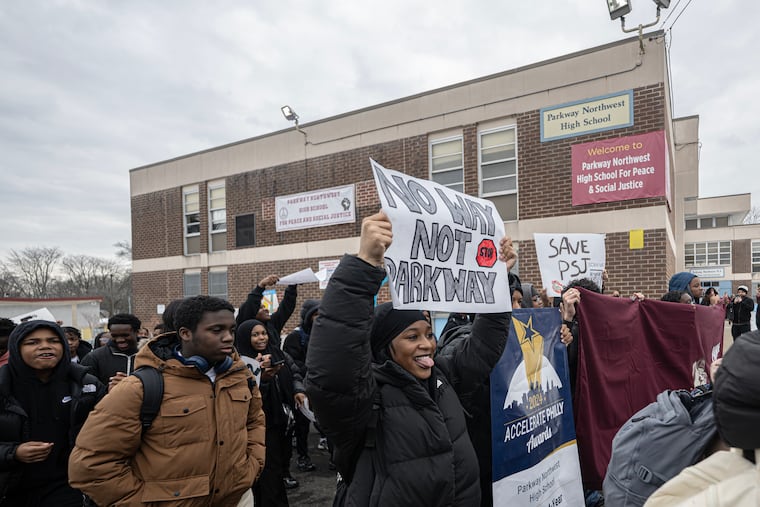
That plan has drawn fire from many, including more than 100 Parkway Northwest students, who walked out of school en masse Wednesday to protest — waving signs, singing, and banging drums.
Those fighting to save the school argue that its small size is an asset, and enrollment has been growing, and they have expressed safety concerns about sending children to Martin Luther King.
More students choosing Parkway NW
District leaders have said their plan is not motivated by finances, though there is clearly a desire to shrink the school system’s footprint, with 70,000 empty seats citywide. Some schools are less than a quarter full, and others, mostly in the Northeast, don’t have enough room to accommodate all the students enrolled.
Superintendent Tony B. Watlington Sr. said the plan will provide a stronger and more equitable education for students citywide.
Closing Parkway Northwest is part of a strategy to shut a handful of small district magnet or citywide schools, moving them into reinvigorate neighborhood high schools.
That strategy has been uniformly denounced by staff, students, and parents at Parkway Northwest and the other schools that would be forced to surrender their independence — Parkway West, Motivation, Lankenau, and Robeson. All have been affected by changes to the district’s special admission process, which shifted the district to a strict centralized lottery, stripping away from schools the ability to have any discretion over their incoming classes.
Parkway Northwest and the other magnets all saw enrollment tumble after the forced move to the lottery — a factor that’s now being used against them.
The school has worked diligently to build enrollment back up, said Beth Ziegenfus, Parkway Northwest’s school-based teacher leader and the coordinator of its robust dual enrollment program.
“More students have been choosing Parkway,” Ziegenfus said. “If you think about what our projected enrollment is for next year, we’re looking at an extra 150 kids that we could have here.”
The closure recommendation discounts that growth, Ziegenfus said, and it also threatens students like Jenkins.
“These small schools offer something to students who don’t thrive in large environments,” said Ziegenfus. “There is something to be said about kids knowing every single adult in the school — it contributes to the safety. When every child knows you and you know every child, you’re able to offer support, or redirect behaviors, or offer assistance.”
Ziegenfus spent years teaching at Frankford, another large neighborhood school. She said she cares about comprehensive high schools, sees their value, and believes they need more resources. But those resources shouldn’t come at the expense of Parkway and other small schools.
“We should invest in King, but two things can be true at the same time. We need Parkway,” said Ziegenfus. “They’re really disrupting the children here, and the children at King, and the incoming kids who are going through the school selection process.”
‘They’re going to flee somewhere else’
At recent district meetings about the proposed Parkway Northwest closure, anger bubbled over.
Students, teachers, and community members disputed the district’s statistics around the school in a meeting with district officials, saying its 60% building capacity score was off.
But mostly, they raised alarms about safety.
“My question is, how will I be able to grow my education at a bigger school if I don’t even feel safe there?” said Sanai Williams, a Parkway Northwest 10th grader. “I don’t feel like I’m going to be able to grow my education if I’m watching my back, thinking I’m going to get attacked every which way at King.”
Rodrigo Fernández, the Parkway Northwest Spanish teacher, said he was frustrated by a perceived lack of real opportunity to shape the plan.
“You are not listening to us,” Fernández said. “You haven’t heard one single person saying, ‘I am excited about this plan.’ If you want to retain our students, you won’t retain them by doing this. They’re going to flee somewhere else. They didn’t choose that setting.”
Over 1,500 community members have signed a Change.org petition calling for the district to reverse the closure recommendation.
A peace and social justice mission
Parkway Northwest, said Elliott Seif — a retired educator and author who’s volunteered at Parkway Northwest for 15 years — is being offered up as “sacrificial lamb to do something at Martin Luther King, which it may not be able to do.”
And Paula Paul, another longtime Parkway Northwest volunteer, said the very nature of the school makes it essential in the city.
“Does not our city need a school devoted to peace, social justice, and violence prevention, and one where people have formed a community that is functional, a school that works, a school where kids want to be?” Paul asked district officials. “We’ve been struggling to get schools that are functioning, not to lose students, for students to feel safe, to feel connected. Why would we close this school?”
Watlington is expected to present his plan to the school board Thursday, but the board will not vote then. A date for the final decision on closures and other changes has not yet been set.