Penn rejects Trump compact offered to colleges
Brown and MIT have also rejected the proposal, which would have given the White House influence over the universities' operations in exchange for preferential consideration in federal funding.
The University of Pennsylvania on Thursday rejected the compact proposed by President Donald Trump’s administration, which would have given the school preferential consideration for federal funding in exchange for agreeing to operational demands.
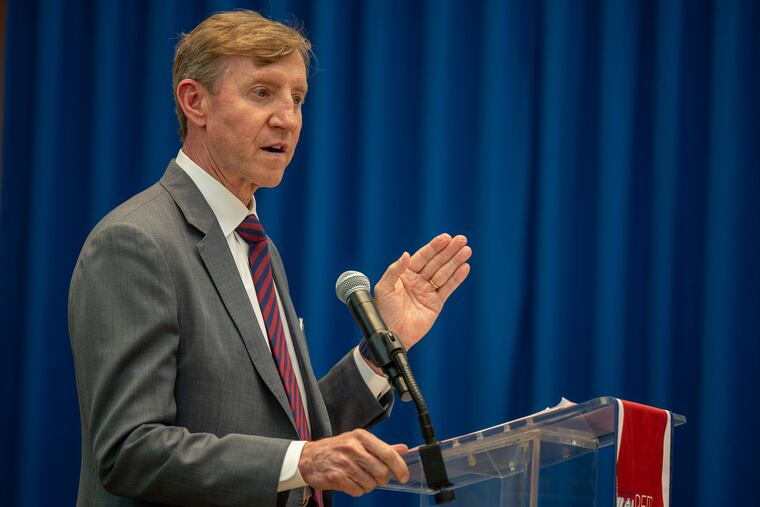
“At Penn, we are committed to merit-based achievement and accountability,” Penn president J. Larry Jameson said in a campus message sent Thursday afternoon.
He said he had informed the U.S. Department of Education that Penn “respectfully declines” to sign.
The compact was the latest attempt by the Trump administration to force changes in the way universities operate as the president tries to reshape higher education to match his vision. Many groups on campus had spoken out against the compact and were watching closely, given that the university had struck an agreement with the Education Department in July over the participation of a transgender athlete on the women’s swim team.
“We are relieved, and we very much feel that this is the result of the power of campus organizing,” said Jessa Lingel, president of Penn’s chapter of the American Association of University Professors, one of the earliest critics of the compact. “We’re looking forward to making sure the university follows through on its promise to live up to its values.”
Jameson said the university provided feedback to the federal government on where Penn found “existing alignment” with the compact — it already, for example, requires applicants to submit standardized test scores. But the university also pointed out “substantive concerns” about other areas of the pact, he said.
Penn declined to release that letter.
Jameson said the decision was made after he sought input from faculty, alumni, trustees, students, staff, and others.
“The goal was to ensure that our response reflected our values and the perspectives of our broad community,“ he said.
Penn follows Brown University, which similarly said no to the Compact for Academic Excellence in Higher Education on Wednesday, and the Massachusetts Institute of Technology, which rejected the proposal last week. Concerns also have continued to mount at most of the six other universities that were offered a chance to sign the compact earlier this month. The Trump administration has since opened the offer to all colleges, according to Bloomberg News.
» READ MORE: Penn faculty senate overwhelmingly votes to urge university leaders to reject Trump compact
The compact would have given the Trump administration wide-ranging influence over Penn’s hiring, admissions, tuition pricing, and even curriculum to some extent.
Penn had until Monday to give official feedback to the White House, and the colleges had until Nov. 21 to decide whether to sign it.
It is not clear whether the decision will jeopardize Penn’s federal funding.
“Institutions of higher education are free to develop models and values other than [those in the compact], if the institution elects to forego federal benefits,” the compact states.
The university, which receives about $1 billion in federal funds, already stands to lose about $250 million if Trump’s cap on indirect cost reimbursement from the National Institutes of Health, currently the subject of litigation, is allowed to proceed.
Reactions to Penn’s decision
Penn’s announcement was applauded locally.
Gov. Josh Shapiro, a Democrat, called it “the right decision” and said he had been “engaged closely with university leaders on it.”
“I was adamant that the independence of our higher education institutions — institutions like Penn that have made groundbreaking and lifesaving research breakthroughs, and educated business, nonprofit, and government leaders with the ability to think critically and discern fact from fiction — is of the utmost importance," Shapiro said in a statement.
Penn was right to reject “the Trump Administration’s attempts to dictate what private colleges and universities teach and use the long arm of the federal government to censor ideas with which they disagree,” the statement read.
City Councilmember Jamie Gauthier, who was among a group of elected officials who urged Penn at a news conference Wednesday to reject the compact, also cheered the decision.
“Thank you to the University of Pennsylvania for listening to our feedback by rejecting Trump’s racist compact and standing up for inclusion and academic freedom,” she said. “When we fight, we win.”
“As a law school grad of Penn, I could not be prouder,” said William Lamb, a graduate of the Penn Carey Law School, former state Supreme Court justice, and founding partner of Lamb McErlane PC.
Penn’s announcement came a day after the faculty senate voted overwhelmingly to urge university leadership to reject the compact “and any other proposal that similarly threatens our mission and values.”
The body cited concerns over loss of scholarly diversity and academic freedom, and criticized the idea of awarding funding to universities based on anything other than “scholarly excellence, scientific merit, and societal impact.”
On Thursday, law professor Eric Feldman, past chair of the faculty senate, said Jameson’s response made clear that the compact “is at odds with the university’s mission and values.”
“We are delighted that he shares our perspective,” Feldman said.
Other groups at Penn, including graduate student workers, postdoctoral researchers, and the undergraduate assembly, also have spoken out against the compact.
Jameson had said earlier this month that Penn would evaluate the proposal against Penn’s values and mission but was seeking “no special consideration” in regard to funding; the university wants to be judged on its work.
Among the provisions in the compact, colleges would have to agree to ban the use of race and sex in hiring, admissions, and financial support for students; limit international undergraduate enrollment to 15%; and require applicants take the SAT or other standardized admission tests. It also says the schools should freeze tuition for American students for five years, prevent grade inflation, and make conservative students feel more welcome on campus.
Colleges also would have to commit to “defining and otherwise interpreting ‘male,’ ‘female,’ ‘woman,’ and ‘man’ according to reproductive function and biological processes,” the compact states.
In the July agreement with the Trump administration, Penn agreed to apologize to teammates of transgender women’s swim team athlete Lia Thomas, retroactively give Thomas’ individual Penn records to swimmers who held the next-best times, and adhere to a Trump executive order’s definition of male and female in regard to athletics. The new compact, in effect, would have spread what Penn agreed to for women’s athletics across the entire university’s operations.