City Council members grill school district officials on plan to close 20 schools — and superintendent says he could have closed 40
Superintendent Tony B. Watlington Sr. stood by his plan, saying he could have recommended closing "twice as many schools and been able to defend it.”

Philadelphia City Council may not have a vote on Superintendent Tony B. Watlington Sr.’s sweeping facilities plan, but it indicated Tuesday that it will have a say in school closings.
As a packed hearing began in Council’s chambers Tuesday morning, both Council President Kenyatta Johnson and Isaiah Thomas, chair of the Education Committee, said Council refused to be a “rubber stamp” to Watlington’s proposal to close 20 schools, colocate six, and modernize 159.
Though only the school board gets to vote directly on the plan, Johnson has indicated he is willing to hold up city funding to the district over the school closure plan. And his colleagues echoed that sentiment Tuesday.
“I’m infuriated that we don’t get a say,” Councilmember Jimmy Harrity said, warning the district officials who appeared before him. “But, Council president, you and I both know we do get a say, because budget’s coming. And we will be looking. Mindful is the word I would use for today — be mindful.”
About 40% of the district’s nearly $5 billion budget comes from local revenue and city funding, which City Council and Mayor Cherelle L. Parker must approve in the annual city budget by the end of June.
Harrity, an at-large Council member, said he was “tired that every time cuts come, they come from a certain neighborhood. You know, I live in Kensington, in the 7th District. I talk to these kids. They’re good kids. They deserve everything that other kids in other neighborhoods are getting. … You can see that this isn’t what our people want.” Watlington has proposed closing four schools in the 7th District.
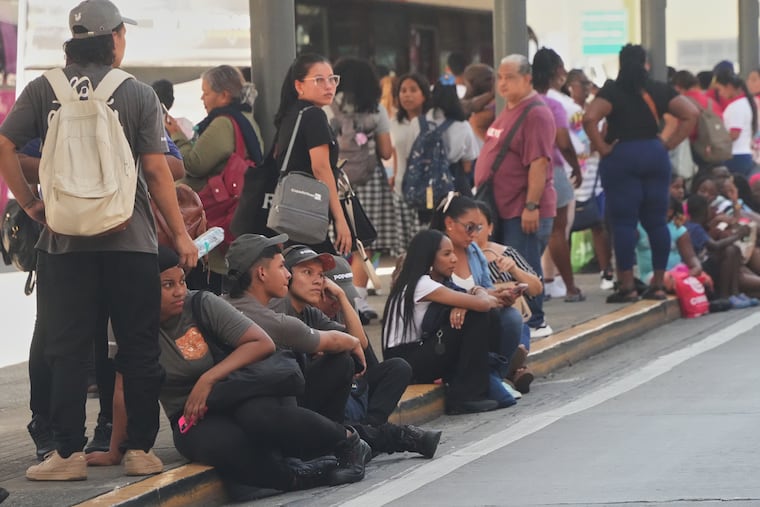
More than 100 community members holding babies and waving signs opposing the facilities plan filled Council chambers on the fourth floor of City Hall on Tuesday as Council members spent hours grilling Watlington and other district officials.
Watlington, meanwhile, stood by his plan in testimony to Council on Tuesday, saying that 20 closings was a much smaller number than he could have settled on.
“We could have come here and presented a plan that closed twice as many schools and been able to defend it,” Watlington said.
A once-in-a-lifetime opportunity?
District officials have said the facilities process is not about saving money, but about optimizing education and equity for the city’s 115,000 students.
But it was clear Tuesday that finances played a part: The district has lost 15,000 students in the last 10 years, and over 80,000 since 1997, when charter schools were first authorized in Pennsylvania. It has 300 buildings, many of them 75 years and older and in poor repair, and some schools with more than 1,000 empty seats, while others are overcrowded.
“We’ve got to be very careful with our limited resources in a historically underfunded district,” Watlington told Council.
Watlington and board president Reginald Streater, who also testified, pitched the plan as a way to add things the district cannot now offer — Advanced Placement courses in every high school, the opportunity for all eighth graders to take algebra, more prekindergarten, and career and technical education programs.
“I do not believe we’ll get this opportunity again in our lifetime,” Watlington said.
The superintendent dropped a few previously undisclosed facts about the facilities road map, indicating that his recommendations could shift slightly before he presents the plan to the school board on Feb. 26. No date has been set for the board’s final vote, which is expected later this winter.
“It’s premature to say how the final recommendations will land,” Watlington said.
But, the superintendent said, “if there are schools that Council wants me to take off the list, and add others on that list, we are open to you telling me what those are, but we cannot get to a place where we address our 35% non-utilization rate in buildings if no changes are made.”
Debora Carrera, the city’s chief education officer, who spent three decades as a district teacher and administrator, told Council that Parker believes “the current district footprint is unsustainable.”
Carrera said her own experience as principal of Kensington High School for Creative and Performing Arts shows that it is right for the district to focus resources on neighborhood high schools.
“My high school was a small high school,” Carrera said. “I could only offer my children two AP courses, when other schools like Central — where my son went — could offer them over 20-plus AP courses.“
‘Breaking down of public education’
The hearing got tense at times.
“I feel like this is the breaking down of public education in Philadelphia,” said Councilmember Cindy Bass, who said some of the district’s own decisions had led to closures.
Several members of Council raised questions about the plan’s price tag. Prior district and city estimates put the cost just under $8 billion, but members of Watlington’s team said they could they could actually do the work for $2.8 billion — $1 billion from district capital funds, and $1.8 from yet-unpromised state and philanthropic sources.
In the past, the district had made public detailed facilities condition assessments for every school in the district, Councilmember Rue Landau noted.
Residents could look up their school and see exactly what the condition of every system in the building was, and how much money would be required to fix those that needed repair.
“We don’t have any of those details,” said Landau, who went so far as to say she believed the district should be spending more than $2.8 billion on the plan. “What is the increased investment, and why don’t we have any of those details? They are not out there in the public for us, so none of us have any understanding as to why this is happening, This should all be public so all of the public can see.”
Jerry Roseman, the Philadelphia Federation of Teachers’ longtime environmental director, who has had a first-row seat to district facilities conditions for decades, said he believed the $2.8 billion figure was not realistic.
“You need much more money than that,” Roseman told Council. “We need more money than this plan comes close to.”
Some Council members pushed the district and the board on the plan’s timing.
The city has been asking for a long-range facilities plan for years, Councilmember Quetcy Lozada pointed out.
“It’s taken us all this time,” Lozada said. “Now, you guys have come up with a plan, and now we want to rush through it. Now all of a sudden there’s this urgency to get through this plan, which I don’t understand.”
Streater said the board is moving forward with hearing Watlington’s plan on Feb. 26, but won’t vote until it hears more feedback.
But ultimately, he said, the board will vote on “a plan that is dynamic, that can evolve over time. … I think that we all understand that things change, facts change, funding changes, enrollment trends change.”
And, Streater said, there will also likely be policy changes based on redrawing some catchment areas, or boundaries that determine which neighborhood schools children attend.
Streater, who introduced himself at the beginning of the hearing as “Reggie from Germantown,” underscoring his history as a graduate of two district schools that closed — Germantown High and Leeds Middle School — said that changes must be made.
“I think if we continue doing the same thing, expecting a different result — which I would argue is chronic underachievement — we are doomed.”