The start of Philly’s school year is shaping up to be a doozy with SEPTA cuts and a looming PFT contract deadline
Some Philly students will face commutes so long due to SEPTA bus service cuts that their parents are considering moving in order to help them get to school.
In the days leading up to the first day of school, jitters are a given for Nicole Wyglendowski, a teacher at Steel Elementary in Nicetown: Are her supplies ready? Has she reached every parent? Is she ready for a new crop of students?
Now, it feels as if there’s “a dark cloud” hovering, Wyglendowski said. The Philadelphia School District’s 117,000 students are scheduled to return to class Monday.
“The start of school year definitely feels more ominous than other years because of the SEPTA cuts and the PFT negotiations,” said Wyglendowski, a special-education teacher.
» READ MORE: PFT says contract negotiations are slow and a strike is still on the table
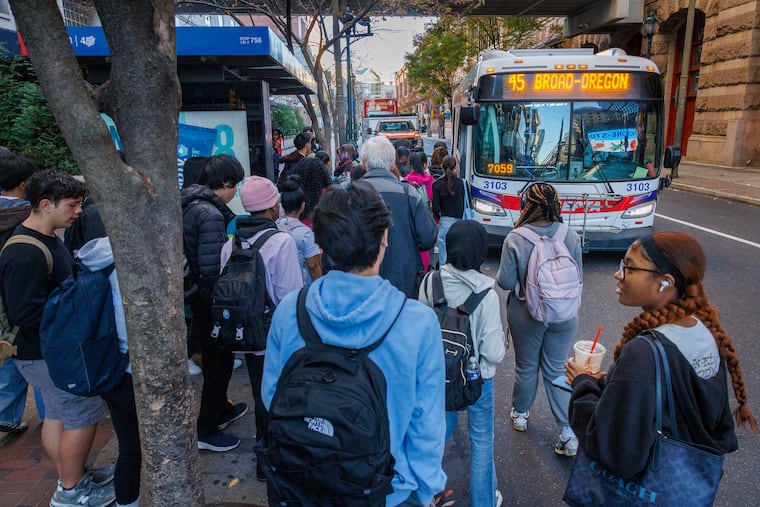
School is starting amid a funding crisis for SEPTA, the transit system that gets more than 50,000 district students to class — and thousands of employees to work.
A budget standoff in Harrisburg means significant transit service cuts are coming Monday, just in time for students to go back to school.
Then there’s the contract for 14,000 teachers, counselors, nurses, secretaries, and paraprofessionals that expires Aug. 31. Philadelphia Federation of Teachers officials have said they are frustrated by the slow pace of negotiations, members have already authorized a strike, and the union has begun preparations for a possible work stoppage.
School communities are also bracing for the outcome of the district’s facilities planning process, which will result in some school closures and forced building colocations. Announcements are expected this fall, with a final decision scheduled for the end of the year.
SEPTA cuts will have the most immediate impact. If students are not in class on time, that affects the district’s end result, said Superintendent Tony B. Watlington.
SEPTA cuts impact “our efforts to keep our foot on the gas to accelerate academic improvement,” Watlington told the school board at a Thursday meeting. “We need every day, every hour, and every minute of instruction.”
Here’s how three local students will be affected by the transit changes.
90 minutes one way and an hour late, or moving?
Journey Singleton was thrilled to be admitted to the Arts Academy at Benjamin Rush, a district magnet in Northeast Philadelphia.
Singleton lives in West Philadelphia, but her mom, Geneya, started thinking about how Journey would get to school as soon as they learned she was accepted to Rush Arts’ freshman class.
The best route wasn’t ideal — an hour on a bus, but it was a straight shot, and worth the sacrifice, the Singletons felt. Then came news of the cuts, and the one-bus, one-hour, one-way ride suddenly became 90 minutes, at least, with two trains and a walk.
Even the best-case scenario will get Journey to school two minutes late for first period based on when trains start running, and if Journey took a slightly easier route, she would arrive at school a full hour late.
Geneya Singleton thought about driving Journey, but she has to factor in getting her 1-year-old to daycare and making it to work on time herself. She reached out to Latoyia Bailey, Rush’s principal: What should she do?
Bailey was sympathetic, helpful, Singleton said, but there’s nothing the principal, or any other educator, can do.
“She said, ‘There will be a grace period, but not an hour,’” Singleton said. “It’s a great opportunity for her academically — she is very artistic. I don’t want her to be late. But I don’t know what to do.”
The best option, and the one Singleton is now pursuing, is a drastic one: She’s putting her West Philadelphia house on the market and moving closer to Rush Arts so Journey has a better commute.
“It’s a big deal, selling a house, but I’m willing to make a significant investment, and if we can get closer to the school, she’ll have a commute of maybe 20 minutes on public transportation,” Singleton said.
Still, it will take time to prep her house for sale, find a buyer, and find a new place to live. Singleton is thinking Journey will have maybe two months of the long commute.
Her rising ninth grader is just excited to throw herself into a new school, Singleton said.
“She said, ‘Mom, it’s fine,’ but she’s not thinking about the rainy days and the windy days and the snow,” Singleton said. “She’s 14.”
‘We don’t know what that’s going to mean’
Sophia Kilbride is acutely aware of the SEPTA situation. Her dad drives a SEPTA bus, and Kilbride is about to begin her senior year at Rush Arts, where she is a bright light in the drama program.
Kilbride commutes from Holmesburg to Rush Arts, on Knights Road in the Far Northeast.
She typically takes the 66 bus up Frankford Avenue, then transfers to the 84, which takes her to school. Both routes are affected by the cuts.
“It’s going to be more crowded because there’s less buses coming, and the 84 was already every 30 minutes,” said Kilbride, 17.
At schools like Rush Arts, where students rely heavily on SEPTA to make their way to school, the cuts are on students’ minds, big-time, Kilbride said.
One of her friends takes the 67 bus from Fox Chase.
“The 67 already ran hourly, and now there’s fewer buses,” Kilbride said. “We don’t know what that’s going to mean.”
Another friend made play rehearsals and working a part-time job work by relying on the 19 to get to work.
Now, due to cuts, “he won’t be able to work weekdays anymore. He can only work weekends.”
‘Another potential struggle’
When Christine Savard was looking for a new place to live, top on her priority list was a place that would make it easy for her son to get to the Philadelphia High School for Creative and Performing Arts, where he will enter ninth grade.
Savard and her son, Lincoln, lived in Roxborough, and she thought about moving to Chestnut Hill or Manayunk. Instead, she chose to stay in Roxborough, where Lincoln could hop the 27 bus — not a short commute, but an uncomplicated one, right to school.
Savard looked for notices about the 27, but didn’t see any. She signed another lease at her apartment complex, which is across the street from a 27 stop.
Then she saw that the 27 will be shortened, stopping at City Hall instead of continuing to South Broad, where CAPA is located.
Now, Lincoln’s commute “is going to be more than an hour, no matter which way you slice it.” It will also include a walk of about a mile down Broad Street — OK in nice weather, but tough in the dark, or inclement weather.
Savard worries the SEPTA situation will affect her son’s ability to adjust to high school.
“This whole transition to high school is huge, and this just adds another potential struggle for him,” said Savard, who is about to start a job with an AmeriCorps program working with struggling readers in a Philadelphia school.
Depending on what time her assigned school begins, Savard might be able to drive Lincoln to school, but there’s no guarantee. So she’s even considering breaking her lease — which would cost her $5,000 — or moving out of the city if things go poorly.
“I don’t really want to give up on Philly. We moved here to be in Philly,” said Savard, who moved to the city from Louisiana a few years ago.
She chose Philly in part because of its transit system, Savard said.
“There were more interesting schools,” Savard said, “and we thought there was a lot of great public transportation.”
Learning loss
Steel Elementary draws heavily from the surrounding neighborhood; most students are able to walk to school.
But its most vulnerable students — those who face housing insecurity — rely on SEPTA to make it to class, Wyglendowski said. They often face long commutes already.
“The district always talks about attendance being a priority, and it’s a real priority for us, and this is not going to help,” Wyglendowski said. “We can excuse them, but we can’t get that hour of learning back. SEPTA cuts mean learning loss.”