Philly school district leaders are identifying schools to close. Here’s a look at the data that will inform those decisions.
District officials are expected to decide by the end of the year which buildings to close, which schools will share buildings, and which might get new construction or upgrades.
Nearly half of Philadelphia public school buildings are in poor condition. Twenty are mostly empty, or less than 30% occupied, but 25 are at more than 100% of their capacity, including nearly every school in the Northeast.
As Philadelphia School District officials prepare to make decisions about the fate of its 200-plus schools — which ones will close, which ones will share buildings, which might get new construction or upgrades — the data that will drive those decisions have been opaque. And for months, the data set was not publicly released, despite promises to do so.
In recent weeks, however, the district has begun sharing the numbers — but only at public meetings about the facilities planning process, and via limited paper copies. The data are still unavailable on the district’s website.
An Inquirer analysis of the data — which district officials said are not yet final and which in some instances have been questioned by those with firsthand experience in those schools — underscored that many buildings are in poor condition and have far fewer students than they are intended to hold. The findings include:
Of the 215 school buildings included in the school system’s learning networks, or geographic groupings of schools, 64 — about a third — are using less than half of their capacity. Five are more than 80% empty.
Building conditions are generally poor systemwide. Forty schools were given the district’s lowest rating, “unsatisfactory,” and 47 more were judged in “poor” condition. Those 87 buildings account for 40% of the district’s inventory — not including district-owned buildings that are used by charters.
And some of the most fatigued buildings are in the city’s most fragile neighborhoods.
Decisions over which schools will close and which will be spared, spruced up, or built new are expected this year. A draft plan is due in the fall, with final school board votes promised by December.
It will not be a straight numbers call.
Officials have said they will include four factors in decisions: building condition, utilization, the school’s ability to offer robust programming, and neighborhood vulnerability — a metric that includes features like poverty and whether the area has endured prior closings.
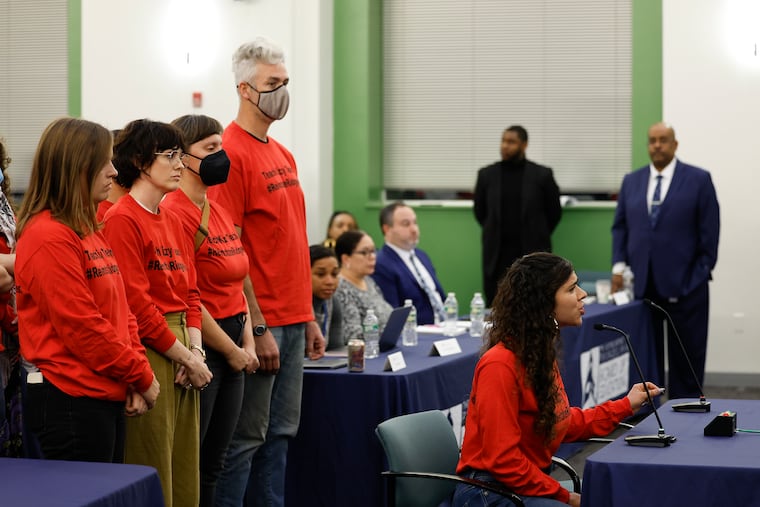
“The district needs to increase access to high-quality academic and extracurricular programs across neighborhoods, recognizing that many of the district’s aging and unequal facilities are under-enrolled or overenrolled,” a district facilities staffer told a small group of community members — mostly teachers — who came to a July facilities meeting at Julia deBurgos Elementary in North Philadelphia.
All options are on the table, no secret closing plan has been devised, and the feedback given by the public and members of advisory groups matters significantly, staff said.
“There’s no list,” Teresa Fleming, the district’s chief operating officer, told community members at Julia de Burgos.
“We’ve been through this before,” said Melissa Achuff, a teacher at Sheppard Elementary in Kensington, which was targeted for closure in 2012 but ultimately spared after an outpouring of community support. “We’re short on trust.”
Though much remains unclear, the data point to the schools most at risk. Here are some takeaways:
There’s a big mismatch between capacity and students
Although school officials have not explained how much each category will weigh in decision making, it is apparent that the district has a significant mismatch between capacity and students, and many buildings are in poor condition.
Collectively, the 215 buildings under review have a capacity of 186,736 students. But they hold just 118,337, the data say.
The 87 buildings in unsatisfactory or poor condition have a capacity of 68,874, and last year nearly 30,000 seats were empty.
Fourteen schools are less than one-quarter utilized, including Middle Years Alternative and Parkway West, which share a building on Fairmount Avenue in West Philadelphia that is 24% occupied. Crossroads at Hunting Park and Philadelphia Learning Academy North also share a building that is less than 14% used.
Some school buildings check multiple undesirable boxes. Of the 68 schools that are at least half empty, 16 also ranked poor or unsatisfactory for their program alignment and building scores.
Among them, neighborhood schools Ludlow (North Philadelphia), Comegys (Southwest Philadelphia), Penn Treaty High (Fishtown), Blankenburg (West Philadelphia), Martha Washington (West Philadelphia), and Sheppard (Kensington) were given the lowest mark of “unsatisfactory” for program offerings or the condition of their building.
That was also true for three citywide programs — the U School, Philadelphia Military Academy, and Alternative Middle Years Program at James Martin. (AMY at James Martin, a citywide admissions middle school in Port Richmond, is getting a new, $62 million school building; its students are currently housed at nearby Penn Treaty.)
There are some hot spots of schools in poor condition
The district’s most fatigued buildings can be found across the city, though four zip codes have the most, with three schools apiece rated “unsatisfactory”: 19119, Mount Airy; 19122, in North Philadelphia; 19124, Frankford; and 19148, which spans the east side of Broad Street in South Philadelphia.
Some schools are out of room — including nearly every school in the Northeast
At the other extreme, the report flagged 20 schools with building capacity ranging between 105% and nearly 200%.
Constitution High, a citywide admissions school in rented space in Center City, has 421 students occupying a building meant to hold 212, according to district data.
The list of crowded schools also includes A.S. Jenks Elementary in South Philadelphia, with about 60 students over site capacity, and Masterman, which is 200 students over capacity.
While many of the crowded schools are in buildings rated fair to excellent, Jenks’ and Masterman’s buildings are rated “poor.”
Eight other schools are also crowded, with usage between 100% and 105%. This includes Crossan Elementary in the Northeast, which is at capacity and the only school rated unsatisfactory for both its building and program offerings.
The Northeast largely lacks buildings in poor shape, but it is a particular hot spot of overcrowding. Of the 15 schools in Learning Network 10, which includes elementary and middle schools across the Northeast, nine schools are operating over 100% capacity.
» READ MORE: Overcrowding in the Northeast puts schools in ‘crisis mode,’ staff says
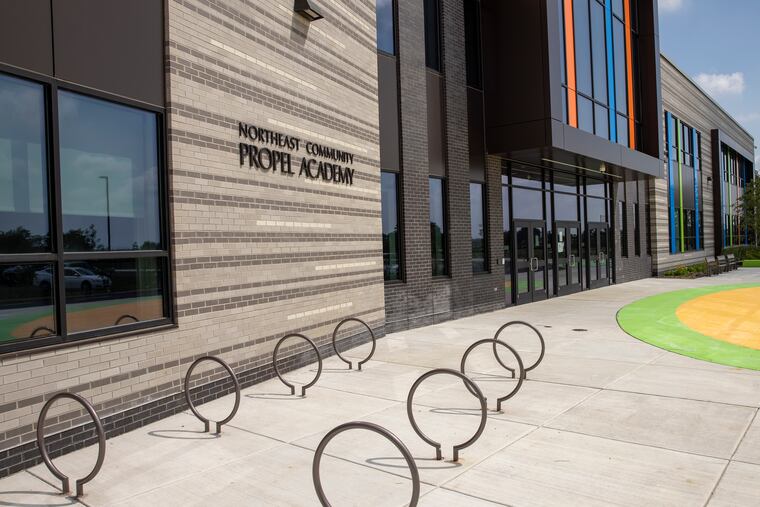
The most overcrowded district-owned building, according to the data, is one of its newest: Northeast Community Propel Academy, a K-8 on the Lincoln High campus. Opened in 2021 for 1,200 students, it housed 1,789 last year, operating at 146% capacity.
One theme that emerged at community meetings: questioning the district’s data. At Rhawnhurst Elementary School, one second-grade class had 39 students last year; English-language learners had to take classes in a hallway because there was no other space, said Melanie Silva, whose daughter attends the school.
But the school shows up with some room to spare, operating at just 75% capacity.
“There’s no room at that school,” Silva said of Rhawnhurst. “Where does that number come from?”
District officials have said that determining final numbers will include building walk-throughs with principals.
Comprehensive high schools generally have tons of empty seats
Most of the city’s neighborhood high schools, which have no admissions requirements, have hundreds — sometimes thousands — of empty seats.
Vaux High, in North Philadelphia, is just 18% full, with 287 students. Though its building is owned by the Philadelphia Housing Authority, its students are district students. That number comes with an asterisk, though — the district lists Vaux’s capacity is 1,564, but Big Picture Philadelphia, the nonprofit that runs the school, has a contract with the district to enroll no more than 500 students, and the Vaux building also houses PHA offices and other community services.
Overbrook High is just 19% full. It has room for 2,330 students, but last year enrolled only 441.
Roxborough, Martin Luther King, Bartram, and South Philadelphia High are all significantly under-enrolled when building size is taken into account. Roxborough had 1,360 empty seats last year; South Philadelphia High, 1,197; Martin Luther King, 1,149, and Bartram, 983.
(There are exceptions, of course. Northeast High, the city’s largest school, has room for 2,889 students, but last year housed 3,644.)
Neighborhood vulnerability is an X factor
Officials have said neighborhood vulnerability — a district-designed score that factors in poverty, access to transportation and housing, and the impact of prior public school closures — will weigh significantly in their decisions.
But Philadelphia is the nation’s poorest big city, and few corners of the city are untouched by the effects of poverty.
Only about 29% of district schools have low or very low vulnerability scores — most of them in the Northeast and parts of the Northwest.
Every school in Learning Network 8, which serves North Philadelphia, is rated high risk or very high risk on the vulnerability scale. Nearly all schools in Learning Networks 7 and 9 — covering North Philadelphia, Juniata Park, and Kensington — are also in some category of high risk.
Shrinking the number of types of schools is a given
Officials have said they will seek to reduce the types of schools that the district has. Now, it has 13 different school formats, from K-8s, K-4s, and K-5s to 7-12s and 9-12s.
“The data has shown that students are more successful with less transition points,” Fleming, the chief operating officer, said at a community meeting.
One district proposal shared at community meetings is shrinking that number from 13 grade bands to six grade bands — K-4, K-8, K-12, 5-8, 5-12, and 9-12.
That leaves in limbo the future of some schools like the Feltonville complex: Barton, a K-2 school, Feltonville Intermediate, a 3-5, and Feltonville School of Arts and Sciences, a 6-8; and George Washington Carver High School of Engineering and Sciences, which is currently a 7-12. All will likely at least see grade changes.