Suburban parents say they’ve been sucked into smartphone ‘whirlpool.’ Now, they want the devices out of schools.
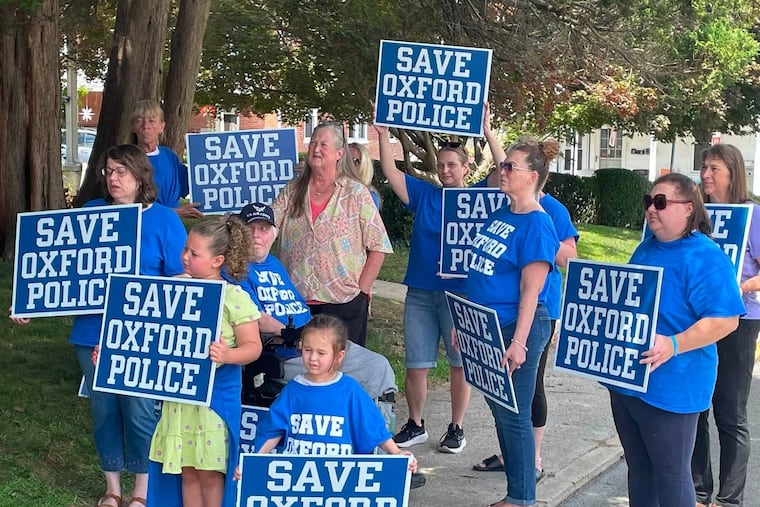
Groups like Delco Unplugged and Wait Until 8th are asking parents to delay giving kids smartphones, pushing back against what they say is a crushing social pressure around technology and social media.
It didn’t take long for Alex Becker to become disillusioned with her tech job.
Becker worked as a Teach for America corps member and public-sector researcher before taking a job with a tech company a few years ago, researching how to get users to spend more time looking at its platforms.
“They are profiting on our attention and our kids’ attention and their vulnerability,” she said of the tech world. “I couldn’t stop thinking about what I had seen.”
Becker, a parent of two children, ages 1 and 4, in Rose Valley, has since left her tech job and is now advocating to keep phones out of schools, joining a growing movement fueled by parental worries about screen time, social media, and mental health.
Becker is the founder of Delco Unplugged, a coalition of Delaware County parents pledging to delay smartphone use until high school. In Lower Merion and Radnor, parents are circulating a similar “Wait Until 8th” pledge. Some are working to take their effort statewide.
They hope that strength in numbers will help them resist what can be a crushing social pressure for kids to have phones, and that they can give kids back precious childhood moments lost to doomscrolling and cyberbullying.
‘They’re created to be addictive’
According to a report from the U.S. surgeon general, 95% of youths ages 13 to 17 reported using social media in 2023, with more than a third saying they used social media “almost constantly.” Nearly 40% of children ages 8 to 12 reported using the platforms.
As a pediatrician, Emily Spengler said, she has seen “a tremendous increase in mental health crises.”
Spengler, a parent in the Wallingford-Swarthmore School District who is involved with Delco Unplugged, said constant phone use has allowed kids to drown out difficult feelings with the tap of their fingers.
It has made it hard for them “to be able to sit with a problem for a little bit of time and figure out what to do with it,” she said. “They’re created to be addictive.”
Delco Unplugged grew out of another group, Haven Hold the Phone, a coalition of parents in the Wallingford-Swarthmore School District who were concerned about phones in schools. The group pushed for the district to ban phones entirely, speaking at board meetings and creating a petition that garnered 681 signatures.
“That was an intense eight-month period of advocacy,” Becker said.
The district tightened its rules, banning phones outright in elementary and middle school and allowing limited phone use in high school.
Becker then broadened her efforts, founding Delco Unplugged. The group has tabled at community events in Media and Swarthmore and hosted a screening of Can’t Look Away, a documentary about social media use.
On the Main Line, ‘Wait Until 8th’ grows
In Lower Merion and Radnor, parents have been organizing around the Wait Until 8th pledge, a national effort that asks families to commit to delay smartphone use until at least the end of eighth grade.
“It just occurred to me, this is the answer. If we can have half the school, half the classroom, not to have social media, it becomes much easier to be a parent saying no,” said John Bellis, a Lower Merion father who has a rising third grader at Penn Wynne Elementary, as well as a preschooler.
One weekend last school year, Bellis said, he pulled 1,000 email addresses of fellow parents from his elementary school’s Home and School Association and sent the Wait Until 8th pledge. (The pledge doesn’t ask parents to forgo all phones; basic phones and smartwatches are still acceptable.)
Bellis — who said two parents asked that he take them off his email list, while 15 others thanked him — has spoken at Lower Merion school board meetings and connected with parents at other schools. Numbers of Lower Merion families who have signed the pledge continue to climb, from 358 in May to 395 in July.
While Bellis believes parents are increasingly on board with delaying smartphones — “It used to be, ‘I got my second grader a phone. Isn’t he lucky?’ Now it’s like, you’re almost embarrassed” — he encounters hesitation from parents who have already given their older kids phones. Some parents also feel the stance is “anti-tech,” which Bellis rejects.
“We’re just drawing the line at smartphones,” said Bellis, who has been trying to work with Lower Merion school officials to help spread the pledge. The district will not officially endorse it, Bellis said, but school board members have assured him no teacher will get in trouble for voicing support or sharing information with parents.
Yair Lev has also been trying to organize parents in Lower Merion. A father of children entering second grade and kindergarten at Cynwyd Elementary, Lev was moved to act after his niece was the only third grader in her school without a smartphone — despite efforts by her mother, a clinical psychologist, to warn fellow parents.
Lev, who worries about the prospect of cyberbullying and exposure to pornography, decided to get involved. He connected with parents like Bellis and others, helped form Wait Until 8th groups on WhatsApp and Facebook, and has been arranging webinars with experts.
“There’s more and more parents who are thinking … ‘This is crazy. What happened?’” Lev said. “In the last 10 years, we got sucked into this whirlpool of social media and smartphones.”
In the Radnor School District, parent David Rosenberg has been spreading the Wait Until 8th pledge, which 220 district families have now signed. Rosenberg, a parent of rising fourth and second graders, said he is as “guilty as anyone” of excessive phone use but sees the addictive qualities as particularly dangerous for kids.
“Just like we think it’s normal we don’t allow kids into bars until they’re 21, hopefully, in a perfect world, they think it’s normal to just not have a smartphone until high school,” Rosenberg said.
From the classroom to Harrisburg
Thirty-one states and the District of Columbia require school districts to ban or restrict students’ use of cell phones, according to a tally by Education Week. Pennsylvania does not have a ban.
Gov. Josh Shapiro in 2024 signed into law a multimillion-dollar pilot program for schools to purchase lockable smartphone bags to use during the day. Only 18 school districts requested funds for the bags.
Becker has helped expand Delco Unplugged and PA Unplugged, a statewide coalition. The group has a live tracker of school districts’ cell phone policies and advocates for model legislation banning cell phones and other electronics in schools.
Lev said he sees multiple “silos” of parent groups organizing around slightly different efforts. If like-minded parents can come together and amplify their message, he said, the movement will be more successful in growing.
Becker emphasized that PA Unplugged doesn’t want to bar kids from communicating. In November, the group will host a regional alternative device fair, where parents will be able to learn about “kid-safe” devices like Troomi and Tin Can phones. Those devices include limited-capacity smartphones and modern takes on the landline, which Becker said can teach independence, foster friendship, and help parents reach their kids.
“There’s an attention crisis. Kids are not able to focus in lectures. Kids are not reading books anymore. I think people are sounding the alarm. I think it’s parents’ job to do this,” Becker said. “We are the first line of defense.”