What’s in a name? Swarthmore College explores new title for a building whose namesake has a troubled past
A panel of college leaders who have removed names from their buildings offered insights.
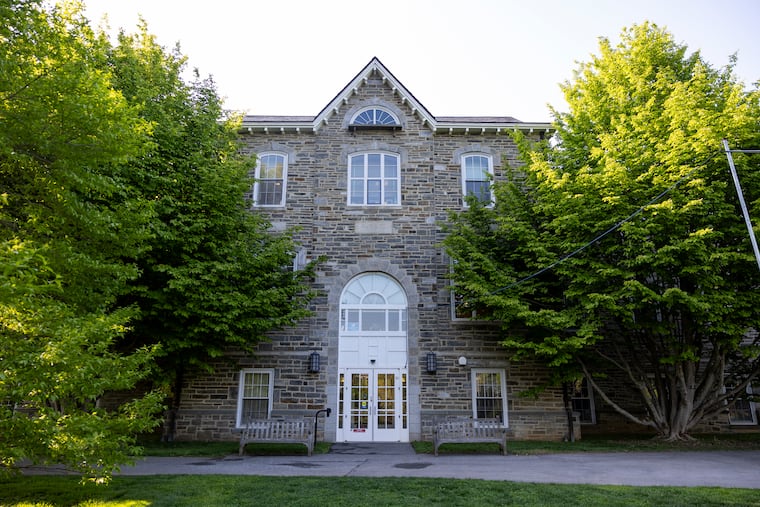
When Bryn Mawr College removed the name of its former controversial president from the library because of her racist views, the school did not stop there.
The college sought to elevate others who figured prominently in the college’s making, including its first Black graduate and Black maids and porters who lived and worked in the dorms until the early 1960s.
“The removal of the stone really sort of freed the community to reclaim that building and reclaim that space,” former Bryn Mawr president Kim Cassidy said. “I never dreamed it would have the impact it had.”
» READ MORE: Swarthmore College apologizes for digging up a Native American burial ground a century ago
Cassidy was among a panel of college leaders whose campuses in recent years renamed buildings after controversies surfaced regarding their namesakes. They spoke last week at Swarthmore College, which is undergoing its own renaming process after learning that a former professor and building namesake had dug up a Native American burial ground in Chester County in 1899 and displayed human remains on campus.
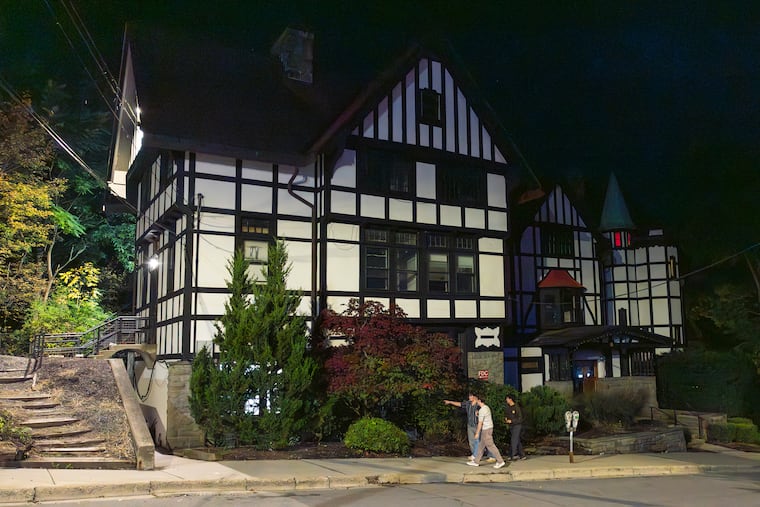
Swarthmore president Valerie Smith announced in December that the college would rename Trotter Hall and Trotter Lawn, which had been dubbed for that professor, Spencer Trotter. The college appointed a task force of faculty, staff, and students, and began a monthslong process that included surveying the campus community, hearing from a leader of the Delaware Tribe of Indians, researching potential new namesakes for any problems in their pasts, and holding the panel discussion to learn from other colleges.
Also on the panel were Lisa Alvarez-Cohen, a vice provost at the University of California, Berkeley, which last month removed the name of disgraced labor leader César Chavez from a building; Roberta Cordano, president of Gallaudet University, which in 2024 renamed a building that had been known for a former U.S. senator whose policy was detrimental to Native Americans; and Erin Brownlee Dell, Swarthmore’s chief of staff and secretary.
The Swarthmore task force expects to suggest potential names to the president this week, and the college plans in the fall to unveil a new name for what has been temporarily renamed Old Science Hall.
“I’m glad that they are putting so much work into the process … and doing their due diligence in terms of naming the hall,” said senior Finn Verdonk, 22, a double major in dance and linguistics from Vermont.
“It definitely makes the students feel heard,” said Aniah Coleman, 22, a senior neuroscience major from New Jersey.
A Swarthmore task force explores renaming
Around the country — and with increasing frequency since the racial reckoning after George Floyd’s 2020 murder by Minneapolis police — colleges locally and nationally have been grappling with how to handle campus buildings and spaces named for people whose pasts are viewed with new scrutiny.
In June 2020, Princeton University stripped Woodrow Wilson’s name from its public affairs school, citing the president’s racist past. A month later, the University of Pennsylvania said it would remove a statue of a supporter of slavery and review all campus iconography. Bryn Mawr in 2023 removed the block-lettered inscription of M. Carey Thomas, its second president, from above its library; it previously had issued a moratorium on using Thomas’ name when referring to the building. But the college left it above the entrance until students during a strike insisted the name come off, sparking another review process that led to its removal.
And Haverford College’s president had been weighing whether to establish a committee to consider whether to take U.S. Commerce Secretary and megadonor Howard Lutnick’s name off its library. But the school announced Wednesday it would not take that step.
Swarthmore’s process started after a 2022 article in The Inquirer that mentioned how a former Swarthmore professor and student had dug up a burial ground and moved a skeleton and objects buried with it to the college.
» READ MORE: A Native American burial ground in Chester County is returning to its ‘rightful owners’
Swarthmore researched and discovered the professor was Trotter. The college first checked to make sure there were no remains from Trotter’s collection being improperly handled at the school — there were not. Officials found a collection of unidentified human bones that the college likely had obtained legally — but probably were initially acquired unethically — and moved them into storage.
Then the school began to consider the matter of the Trotter building.
The hall opened in 1882, and Trotter was hired by Swarthmore as a professor of natural history in 1888. The college in 1920 received a gift from 1890 alumnus Morris L. Clothier, chairman of the board of directors of Strawbridge & Clothier, to expand the hall. The expanded wing was named for Trotter, the only professor who had taught the Class of 1890 and was still active on the faculty at that time. After Trotter died, the entire building was named for him.
The Swarthmore renaming task force surveyed the campus, yielding more than 500 responses. Among the themes that emerged: The community wanted the new namesake to be directly associated with Swarthmore and “expand the diversity of representation” on campus.
Of Swarthmore’s 70 primary buildings, 67% are named for people, said Swarthmore spokesperson Alisa Giardinelli. Of those, 53% are named for one or more men, 26% for one or more women, and 21% for both.
All but two of the namesakes are white and about half are Quakers, Giardinelli said.
The community also favored a namesake who honors the departments housed there — history, political science, classics, and the writing associates program.
The survey yielded about 80 nominations, including a few for Jim Bock, Swarthmore’s longtime dean of admissions, and English professor Eric Song.
Students had some fun. One kidded on LinkedIn he was “incredibly honored” that the building had been named for him and a classmate, posting a picture of a fictional plaque with the inscription “Two Baddies.”
Not everyone embraced the work. The task force received some criticism that Swarthmore should not be judging someone’s actions by standards not in place while the person was alive, said Cat Norris, associate dean of the faculty for academic programs and research, who led the task force. Trotter, who had a medical degree, was considered a top-notch scholar in his time and was written about in journals, she said.
But, she said, it was not just his burial ground activity. In a textbook, he espoused “racial hierarchy,” a belief that some racial groups are superior to others, the college found.
Renaming has its challenges, too. The task force discovered some nominees also had “difficult aspects” in their pasts, and a few were removed from consideration, she said.
“We’re not going to catch everything, and things may be seen in a different light 100 years from now,” said Norris, an associate professor of psychology. “That means 100 years from now a different task force may be revisiting this issue.”
While college buildings often are named for donors, the task force decided that because of the sensitivity, donations would not be a factor, Norris said.
The task force scheduled four educational events related to the process, including a session on Philadelphia as a former hub for the unethical medical bone trade, one on Swarthmore’s process, and another to hear from the Delaware Tribe of Indians. The fourth was the panel of higher education leaders.
A ‘very emotional’ process
Gallaudet, a college for the deaf and hard of hearing, held “a healing ceremony” and established an exhibit when it renamed Dawes House òkànkwèpihëna tëtpi, which means Circle of Signers in the Lenape language, said Cordano, its president. It was originally named for the late Sen. Henry L. Dawes, a Republican and architect of the Dawes Act of 1887, which led to the taking of 90 million acres of tribal land from Native Americans.
“This experience provided for us an opportunity to engage the Indigenous deaf community,” she said.
Renaming a building stands for something larger than the process, she said. Indigenous members of the community had been asking for years to change the name of the house, which triggered a review.
“That’s democracy in action right there,” she said.
Alvarez-Cohen, the Berkeley administrator, said her campus has gone through six “unnamings.”
“We always separate the unnaming from the renaming because the unnaming can be very emotional,” she said.
The first one took 2½ years, she said, while the most recent, the Chavez unnaming, occurred in a month. The move followed a New York Times investigation that found Chavez, the United Farm Workers cofounder, had groomed and sexually abused girls.
Alvarez-Cohen said 95% of the campus community that responded favored removing the name. When the request went to the system’s president, he “was like sitting there with his pen,” ready to sign, she said.
The building is now called the student center, she said. The university intends to rename it.
At Bryn Mawr, Cassidy said, critics accused the school of erasing history. Others, she said, worried it would remove Thomas’ name and do nothing else.
» READ MORE: Bryn Mawr College’s first Black graduate had to walk a mile to get to class. A new monument honors her journey.
But Cassidy said Bryn Mawr installed exhibits, put information on its website, and recommitted to a course on the college’s history.
It installed a plastic covering over a plaque with M. Carey Thomas’ name that explains the building was renamed Old Library because of Thomas’ racist views and practices. Thomas, a leading suffragist who led the women’s college from 1894 to 1922, was reluctant to admit Black students to Bryn Mawr and rebuffed the hiring of Jewish faculty.
In an open courtyard in the middle of the library, a monument of custom clay pavers honors Black servants and groundskeepers who maintained the campus in the early 1900s. It also recognizes Enid Cook, a 1931 alumna who was Bryn Mawr’s first Black graduate. She was not permitted to live on campus and had to walk a mile to and from it; the artwork encompasses a 5,800-square-foot area, symbolizing the distance she walked.
“We all committed to ongoing education and ongoing revisiting of the college’s history,” Cassidy said. “We have a wonderful metaphor from one of our history professors who said we want to turn down the volume on M. Carey Thomas and we want to turn the volume up on other stories that we’re telling because many, many people made this college.”