Temple has released its plan for the next decade. See what the North Philadelphia university has in mind.
The plans include a new residence hall, STEM center, more green space, and an honors college. President John Fry said it's ambitious but achievable.
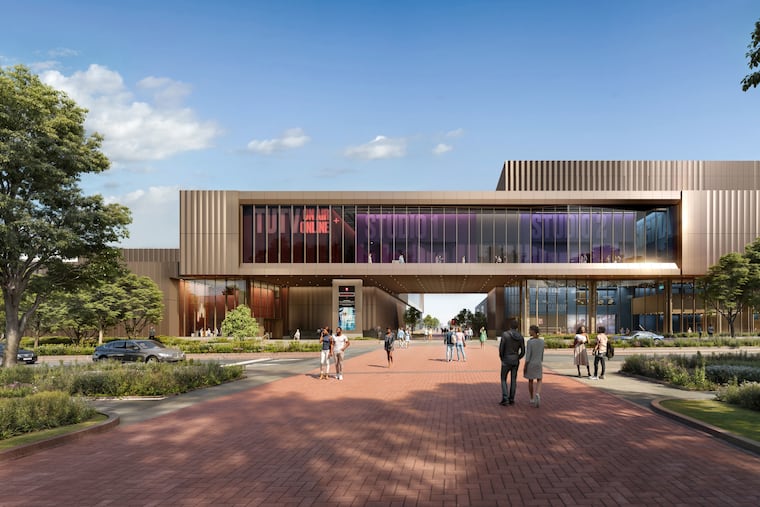
Temple University on Wednesday released its plans for the school’s future, including a new 1,000-bed residence hall, STEM complex, quad with green space, and more attractive and defined entrances to its North Philadelphia main campus.
That’s just part of the 10-year strategic plan, which will take the more than 33,000-student university through its 150th anniversary in 2034 and includes supports for students and learning, a campus development plan, and a new vision for Broad Street both near and beyond its campus.
It emphasizes the student academic experience, with plans to elevate its honors program to an honors college, implement systems to identify and help students who are at risk of failing early on, increase online offerings to accommodate non-traditional students, and require career development and experiential learning for all students.
And the 20-year campus development plan, which is part of the strategic plan, also reiterates President John Fry’s desire to create an “innovation corridor” stretching from the recently acquired Terra Hall at Broad and Walnut Streets in Center City to Temple’s health campus, a little more than a mile north of main campus on Broad Street.
Temple is in the quiet phase of a $1.5 billion capital campaign — its largest to date — to raise money for faculty support and student financial aid, but also for initiatives outlined in the plan.
“What we’re trying to do is build on the momentum we think we have right now as already one of the most consequential urban research universities that wants to go to the next level,” Fry said in an interview before trustees approved the plan Wednesday. “This is a very ambitious plan that I think honestly will be a very big lift for us. But I think it’s achievable.”
Interim Provost David Boardman, who led the strategic planning effort, emphasized that the top priority is student success and new buildings and development are meant to support that.
“That, more than anything, is the heart of what we do,” Boardman said. “This is about providing meaningful research ... It’s about us becoming the most important academic institution and partner in this community and really partnering for the future of Philadelphia and the region and the Commonwealth.”
The planning effort, which included input from more than 2,000 Temple faculty, staff, students, and community members, started as an update of the 2022 plan that Fry initiated after becoming president in November 2024. But Temple officials realized a new plan was needed, Fry said.
» READ MORE: Amid a challenging time nationally, John Fry is inaugurated as Temple’s 15th president with much hope and optimism
More greenery for campus and Broad Street
Fry envisions more green space for recreation and events and for making North Broad Street more aesthetically pleasing.
“It is a really harsh streetscape,” Fry said. “It’s really not inviting. Traffic is moving very quickly. ...That street needs to be calmed down, and the best way ... is to create medians, plants — both sides of Broad Street — making it a much more civilized area than it is now.”
The effort, he said, is modeled after the recently announced $150 million streetscape plan to make the Avenue of the Arts in Center City greener. Temple also is involved with that through its ownership of Terra Hall, which will become Temple’s Center City campus, he said.
» READ MORE: The Avenue of the Arts to break ground on an ambitious $150 million streetscape to make Broad Street greener
“But we can’t do that without other public and private partnerships,” he said. “It’s beyond the institution’s capacity to fund that.”
To start, Temple will fund “significant greening” around the entrance to the under-construction Caroline Kimmel Pavilion for Arts and Communication, he said. More green work is planned at Burk Mansion at Broad and Oxford, which Temple owns, as development occurs there, he said.
With a large green lawn and courtyards, a quad is planned for the campus center, surrounded by Paley Hall, Tyler School of Art, the Charles Library, and the biology life sciences building.
Temple in December purchased the former McDonald’s site at 1201-1219 N. Broad St., by Girard Avenue, which is adjacent to the Temple Sports Complex. Fry envisions using that property to create a major campus gateway.
“Right now, you don’t really know when you come onto the Temple campus,” he said. “We would like Broad and Girard to announce you’re starting to enter Temple’s campus district.”
More on-campus student housing
Temple wants more on-campus residential space to improve the student experience and safety, Fry said.
“We think we’re at a minimum several thousand beds short of where we need to be,” he said. “A stronger residential experience really does make for a much more fulfilling undergraduate experience. The more kids living on campus, the more dense campus is, I think the better we’re going to do on safety.”
The plan calls for beginning to build a 1,000-bed residence hall along Broad Street on the former Peabody Hall site, south of Johnson and Hardwick Halls, in 2027. That would increase the current 5,000-bed capacity on the main campus by 20%. When that opens, Temple would upgrade Johnson and Hardwick, which have another 1,000 beds, he said.
The Annenberg Hall/Tomlinson Theater building, which will relocate to the new arts and communication building in 2027, could also be converted into more residential space if needed, Fry said.
An emphasis on STEM
Temple intends to upgrade facilities for science, technology, engineering and math.
“We just don’t have the research space, the wet lab space in particular, to accommodate the work that our faculty are doing,” Fry said.
Several buildings, including the biological life sciences facility, will be renovated, and the school plans a new STEM building, perhaps behind the engineering building, or the conversion of an existing facility, Fry said. The decision on whether to build new will come within six months, he said.
Temple needs to close some current science facilities to gain more space, he said.
The Beury building, next to the Bell Tower and across from the new Barnett College of Public Health, will begin to be demolished this summer, he said.
“Think of that as sort of the first down payment on this quad,” he said.
That would be the first step toward developing an innovation district, Fry said. While not on the scale of University City’s, it would be “a very good attempt to begin to build that capacity in North Philadelphia,” he said.
Terra Hall will nurture an arts hub, and both would contribute to creating an innovation corridor, he said.
The plan also calls for a new ambulatory care center to better serve North Philadelphia. Fry said those plans are in very early stages.
“A lot of outpatient care is occurring within the hospital right now,” Fry said. “It’s not great for patients... It also puts a real strain on our capacity to serve people who need inpatient services.”
A new academic home for star students
Temple aspires to make its honors program into an honors college, like Pennsylvania State University’s popular Schreyer Honors College, though with different parameters.
Boardman said that effort would require major fundraising. Currently, the program exists within the college of liberal arts and enrolls more than 2,200 students.
Elevating it to a college would require more programming, study-abroad and research stipends, experiential learning opportunities, and an option for those enrolled to live together in a residential community.
Temple’s college would consider more than grade-point averages and SATs for admission, Boardman said. Various talents and leadership potential would be considered, with interdisciplinary studies and public service infused, he said.
Staff writer Peter Dobrin contributed to this article.