Temple’s new provost has an academic background in urban planning and comes from Arizona State University
Elizabeth "Libby" A. Wentz, 62, an Ohio native with a doctorate in geography from Pennsylvania State University, will step into her new role at Temple this summer.
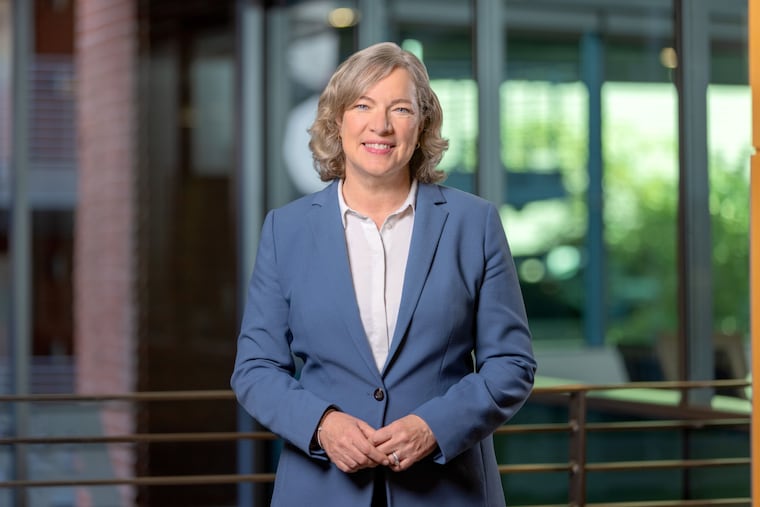
An Arizona State University vice provost and dean, who has degrees in mathematics and geography and has studied urban planning, will become Temple University’s next senior vice president and provost.
Elizabeth “Libby” A. Wentz, 62, an Ohio native with a doctorate from Pennsylvania State University, will step into her new role at Temple July 1, subject to approval by the board of trustees, the school announced Monday.
“My background in urban planning has kind of shaped who I am and shaped my thinking, and I just think that there’s so many great opportunities for recruiting students, for creating internships for students, for creating research experiences for students in an urban environment that the university’s rural counterparts don’t have in the same way,” Wentz said in an interview.
» READ MORE: Temple joins national university group trying to graduate more students from low-income families
Wentz has overseen Arizona State’s Graduate College since 2020 and previously was dean of social sciences, which included geography and urban planning. She will replace David Boardman, who has been Temple’s interim provost since July when Gregory Mandel left the job. Boardman was not a candidate for the job and will continue his role as dean of the college of media and communication.
As Temple’s provost — essentially the university’s number two leader — she will oversee 17 schools and colleges, multiple campuses, and the school’s undergraduate, graduate, and professional programs.
She is the first provost in at least more than a decade to come from outside the university and was selected through a national search, chaired by a faculty member and a dean.
“Libby sort of stuck out for me after the hour I spent with her as being literally right on the same page relative to her ability to articulate the mission and the purpose of Temple and why that was so important,” Temple president John Fry said in an interview.
He was struck by her commitment to student success, he said. “She obviously had time to interact with students and, I think took like really special care and interest in our students,” he said.
And, Arizona State has grown tremendously in part because of its commitment to online programs, he said, which are a priority in Temple’s strategic plan. Temple has lost about a quarter of its enrollment over the last decade.
“We don’t have the kind of online enrollment that you would expect a place like Temple to have,” Fry said. “One of the things Libby and I did speak about was her familiarity with the ASU online infrastructure. She’s taught in it. She obviously has led parts of it.”
Temple remains amid searches for several other key positions, including chief operating officer and law and engineering school deans.
Wentz said she was attracted to Temple because she wanted to remain at an urban university and has long admired the work of Fry, who has had a longstanding relationship with Arizona State president Michael M. Crow. Temple a year ago became part of the University Innovation Alliance, a small nonprofit sponsored through Arizona State that is aimed at finding innovations to improve learning and increase college attendance, retention, and graduation rates ― especially for low-income students ― then scaling those innovations.
“They built a really strong rapport and have a very similar philosophy around higher education which also very much aligns with kind of my own interest and my own philosophy,” Wentz said.
Both Temple and Arizona State, which has its main campus in Tempe, are major research institutions; Arizona is much bigger with over 194,000 students, compared to Temple with more than 33,000, including its international campuses.
“Honestly the biggest difference [between the two] is the weather right now,” Wentz joked, noting that it was 81 and sunny in Tempe on Sunday as Philadelphia prepared for blizzard conditions.
Arizona State does not have a faculty union, so learning to work with Temple’s faculty union will be new.
“That’s going to be an exciting area for me to learn about,” she said.
Urban planning background
Fry has a reputation as an urban planner and in his prior leadership jobs at the University of Pennsylvania, Drexel, and Franklin and Marshall focused on development and improving the campuses and their neighborhoods. He has aspirations for Temple, too, including building an “innovation corridor” stretching from Temple’s recently acquired Terra Hall at Broad and Walnut Streets in Center City to the health campus, a little more than a mile north of main campus on Broad Street.
Wentz said she and Fry had not talked about urban planning, but that she looks forward to working on the university’s new strategic plan, which includes more green spaces, a new 1,000-bed residence hall, a STEM complex, and an emphasis on more attractive and defined entrances to its North Philadelphia main campus. The three pillars of the plan are student success, research in action, and place-based impact.
» READ MORE: Temple has released its plan for the next decade. See what the North Philadelphia university has in mind.
“Those are going to be some really exciting conversations that I look forward to having with John, as well as with the Temple planners to think about how do we make it a safe space for students and a great learning environment.” she said.
During a 2022 talk at Arizona State, Wentz discussed how urban planning figured into her work.
“Most of the work that I do applies to the urban environment and urban analytics, so trying to understand how it is that cities work and trying to make the physical urban environment a better place for people to live,” Wentz said during that talk.
Building trust and collaboration
In her new role at Temple, she said, early on she will focus on getting to know the community and the university’s financial model and make clear her commitment to shared governance and data-informed decision making.
Wentz, who grew up near Cleveland and got her bachelor’s in mathematics and master’s in geography at Ohio State University, spent the last 30 years at Arizona State. She became a professor there in 1997.
She helped the university launch its medical school and has grown graduate enrollment and graduate student funding.
Wentz said she prides herself on building a culture of trust and collaboration and has worked with the local community. She said she’s looking forward to doing the same at Temple.
She plans to come to Philadelphia in a couple weeks and look for a place to live, she said.
“I’m going to come after the snowstorm, I think, instead of before,” she said Sunday.