This Southwest Philly school had resources poured into it thanks to the soda tax. Now it’s facing closure.
The school district has proposed repurposing its building as a sports facility for Bartram High.
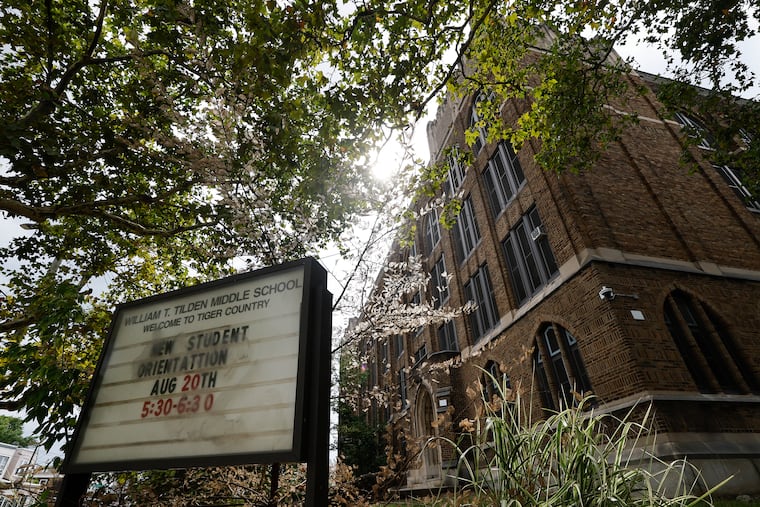
Students streamed out the front doors of William T. Tilden Middle School on a recent Friday afternoon, past the “Welcome to Tiger Country” sign at the corner. As they shouted to friends and threw snowballs to celebrate the weekend, they were dwarfed by the massive brick school building behind them.
That building, which spans half a city block in Southwest Philadelphia, is a primary reason the Philadelphia School District has proposed closing Tilden alongside 19 other schools.
Capable of holding roughly 1,400 students, Tilden had only 266 enrolled last year, the district said. That means it is at just 18.5% capacity — the second-lowest of all the schools tapped to close, according to an Inquirer analysis. While enrollment in the school district overall has increased in the last four years, it has declined at Tilden, with just 24 students in this year’s fifth-grade class, district data shows.
The district has rated Tilden’s building as “poor” when it comes to being safe and accessible, meeting environmental standards, and having modern technology. Tilden is also one of six middle schools that Superintendent Tony B. Watlington Sr. has proposed closing in an effort to shift the district’s focus to the K-8 model.
Unlike some of the other schools on the chopping block, the Tilden community so far has not mounted an organized fight against its closure as the school board prepares to vote this winter on Watlington’s recommendations. Just a dozen employees and residents showed up to an in-person meeting on a frigid Saturday morning earlier this month to discuss the school’s possible closure, according to Chalkbeat Philadelphia, and about 30 attended a virtual meeting about Tilden a few days later. There is no online petition to keep it open, as there are for many other schools slated for closure.

Wholesale changes are coming to the Philadelphia School District, with the school board passing a $3 billion facilties plan that aims to close 17 schools permanently, and renovate 169.
Superintendent Tony B. Watlington Sr. presented the plan to the school board Feb. 26 and it immediately faced strong opposition. After some amendments, the board passed the plan April 30. Here's what we do and don't know about it.
And to see the proposed list school closures and check how your school could be impacted, use our interactive charts.
Each of the schools proposed for closure has its own story. Find them all here.
Students who were set to graduate before the proposed changes would take effect said in interviews outside the school that they did not care much about the possible closure, though some adults expressed more concern.
“This school has had, and still does have, excellent community programs,” said Tilden teacher Cheryl Padgett through tears at the virtual meeting.
The district’s draft facilities plan recommends that in the fall of 2027, Tilden stop accepting new fifth graders, and then gradually phase out its remaining classes, closing for good in 2030.
All of Tilden’s current students would be able to graduate from the school under the proposal; new students who would have attended Tilden for middle school will instead stay at Patterson, Catherine, and Morton — the elementary schools that currently feed into Tilden. The district said all three of those schools would receive increased investment as they add grades and become K-8 schools.
Tilden is in a neighborhood deemed especially vulnerable by the district, which ranked it as “high risk” to account for its experience with previous school closures, as well as its high poverty rate, lack of public transportation, and language barriers. (The district’s top vulnerability ranking is “very high risk.”)
Tilden’s building would eventually be repurposed as a sports facility for Bartram High and the broader neighborhood under the plan.
At the virtual meeting, community members worried that the buildings slated to become K-8 schools are not equipped for older children, and that younger students would be exposed to problematic behavior from older kids.
Some community members said they feared that changes resulting from the district’s plan, which spans a 10-year period, would not come soon enough.
“Do something now,” said Mama Gail Clouden, a longtime community activist. “While you’re talking about ‘in two years,’ and what you’re planning to do — right now, children and parents and staff are suffering in these schools."
Tilden also has received additional support and funding from the city’s tax on sweetened beverages through the community schools program pioneered by former Mayor Jim Kenney.
“Our kids can succeed,” Kenney said at a 2017 news conference at Tilden announcing funding for the first group of schools. “They can meet their potential if we give them the resources.”
As a community school, Tilden’s building serves as a center for such resources: The school hosts a food pantry every Friday, and families can access case management and utility and housing assistance and other supports through a partnership with Methodist Services.
“These kids, they have a way of growing on your heart,” said Wanellie Cummings, an attendance case manager with Methodist Services assigned to Tilden.
Cummings works with kids who have three or more absences to try to address any barriers at home that might prevent them from getting to school. She said she has not heard much from her clients about the potential school closure, though she did worry about Tilden’s food pantry closing.
“When you take that away from a community, what’s left? If those grandmoms and grandpops have to go somewhere else to get food …,” she said.
The district has said it would spend the 2026-27 year planning for how to maintain the resources now offered at Tilden.