There are 37,000 individual plants at Calder Gardens. Here are five not to miss.
Philly’s newest greenspace is designed to mature into something that goes beyond visual beauty.
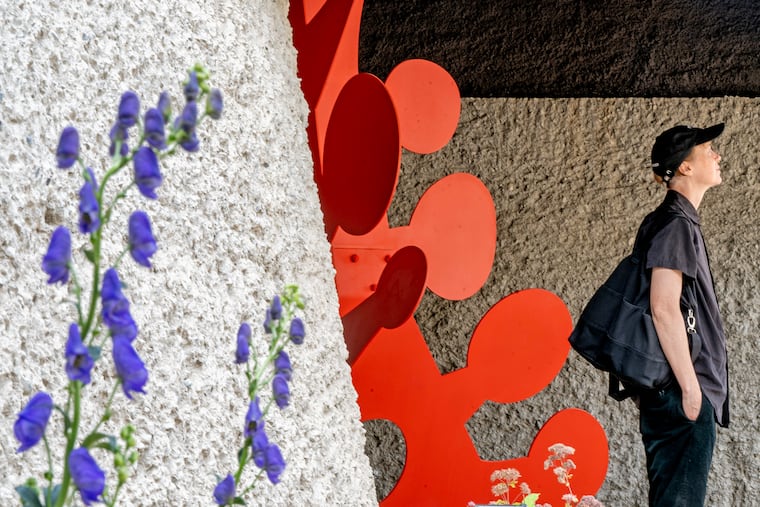
There are plants called Rattlesnake, Red October, and Meadow Rue.
And there’s Prairie Smoke, whose feathery seed heads appear like wisps of silver-pink smoke. Purple Prairie Clover, whose spiky flowers are a butterfly’s summer delight. Plants with names like potions and spells, like Goatsbeard and Masterwort and Hairy Beardtongue. Plants with names like poems, such as Stardust and Autumn Bride. The Rocky Top plants have nothing to do with a fictional boxer’s controversial perch. Shaped like a sunbonnet, they bloom the color of Rose.
There’s Toad Lily, orchidlike flowers the color of peppermint taffy. And Moerheim Beauty Sneezewood, known for flaming petals and coffee-colored cones. Plants that smell like buttered popcorn and plants that smell like spicy jelly beans. Gumball plants. Pincushion plants. Poofy plants. Fuzzy plants. Leathery plants. Papery plants. Plants that dance, like a pale, purple coneflower, whose drooping petals sway and amid the wild grass, like a Hula dancer.
Designed by world-famous Dutch landscape designer, Piet Oudolf, Calder Gardens is a plant-lover’s paradise.
In all, there are 37,000 individual plants at Calder Gardens, the long-awaited showcase of one of Philadelphia’s most famous artists on Benjamin Franklin Parkway. The exhibition space and garden dedicated to sculptor Alexander Calder represent the first addition to Museum Row since the relocation of Barnes in 2012.
Meticulously bedded-out with over 200 perennials, shrubs and trees, the dreamlike urban meadow sprawls and slopes toward a reflective stainless steel-paneled structure designed by Herzog & Meuron, where a rotation of Calder’s sculptures will be displayed.
“The goal is to prepare you to leave the business of the city and the noise and everything behind and be able to be in a good space to enter the building and experience Calder’s art,” said Erin Conley Monda, Calder Gardens’ horticultural manager.
Oudolf — who designed the plantings for the High Line in New York — is celebrated for his almost preternatural knowledge of plant life. In his design, even the skeletal stems and seedpods on display in winter are carefully curated. It’s an approach toward gardening that utilizes nature, wildness, and time. Philly’s newest green space is designed to mature into something that goes beyond visual beauty.
After all, Monda said, Oudolf doesn’t try to recreate nature. He interprets the emotions of it.
Here are five plants and floral moments not to miss at Calder Gardens.

- The Parkway’s luminous, magical spirit cave
- After two decades, Calder Gardens has finally arrived
- Take a virtual 360° tour of Calder Gardens
- When looking at a sculpture in the Calder Gardens, there is ‘no wrong answer’
- Calder Gardens architect on why it is a uniquely Philadelphia institution
- There are 37,000 individual plants at Calder Gardens. Here are five not to miss.
- The building may be done but the gardens are just getting to work at Calder Gardens
- 5 of our favorite sculptures at Calder Gardens and the stories behind them
- Calder Gardens’ programs will cultivate community and plant artistic seeds
“Sporobolus Heterolepis” (Prairie Dropseed)
In an Oudolf garden, it’s not just how a plant blooms, but how it decays and dies. The cycle of the garden is key to Oudolf’s aesthetic. If the garden is an ocean, said Monda, then all year long, Prairie Dropseed, a fine grass that turns the color of copper then bronze in winter, “is the water.”
Atop slender stalks, its tiny golden clusters and airy seed heads — that buttered popcorn culprit — hover above the meadow.
“It’s the backdrop — the foundation,” said Monda.
“Succisella inflexa” (Frosted Pearls)
Oudolf appreciates plants not just for their color — but for their structures and shapes of flower heads and seed heads, and the textures created by their leaves and stems. Frosted Pearls, a pincushion perennial, scores on all accounts. In late summers, its pink-budded flowers open to white blooms with an icy blue hue.
Calder Gardens features the hardy Frosted Pearls in four different locations, Monda said.
“They flower now,” she said, during a recent tour in mid-September. “And they’re just getting started. They’ll have these little poofballs, kind of like there’s another plant.”
“Gentiana andrewsii” (Closed Bottle Gentian)
Designing with perennials, Oudolf prioritizes a plant’s structure, often selecting varietals that are in a constant state of change. Closed Bottle Gentian can said to be an exception. The striking, sprawling wildflower, with whorls of dark-green leaves, produces purplish petals that remain stubbornly budlike even when mature.
“The flowers look like they’re going to open, but they never open,” Monda said. “The only pollinator that can get in there is bees, so they literally have to pry their way in.
“Aconitum carmichaelii ‘Arendsii’” (Monkshood)
In the ocean analogy, Monkshood are the jumping dolphins — the “exclamation points,” Monda said. The tall perennial’s moment to shine comes in late summer when its rich blue flowers, resembling a medieval monk’s hoods, reach peak bloom.
“Kind of your exclamation points — your accent plants to be kind of sprinkled throughout,” Monda said.
The 22nd Street Entrance
Ever-changing, Oudolf’s wild urban meadows are designed to be dreamlike oases of ceaseless discovery. Like Calder’s art, visitors are left to interpret the moods and emotions of the plantlike. For Monda, one of those moments is found while admiring the garden view from its 22nd Street entrance. From there, amid the Swamp White Oak and Black Tupelo trees, and clusters of Autumn Bride Coral Bells, the sloping grasses and popping blooms work together, in all their subtle textures and colors, leading one through the landscape.
“It’s such a complex and beautiful view,” she said. “It’s a ‘wow’ moment where you’re like everything works.”
“The Magic of Calder Gardens” is produced with support from Lisa D. Kabnick and John H. McFadden. Editorial content is created independently of the project’s donors.
To support The Inquirer’s High-Impact Journalism Fund, visit Inquirer.com/giving