The first prison synagogue in the United States can be experienced at Eastern State Penitentiary
Eastern State has opened a new permanent exhibit in the restored prison synagogue.
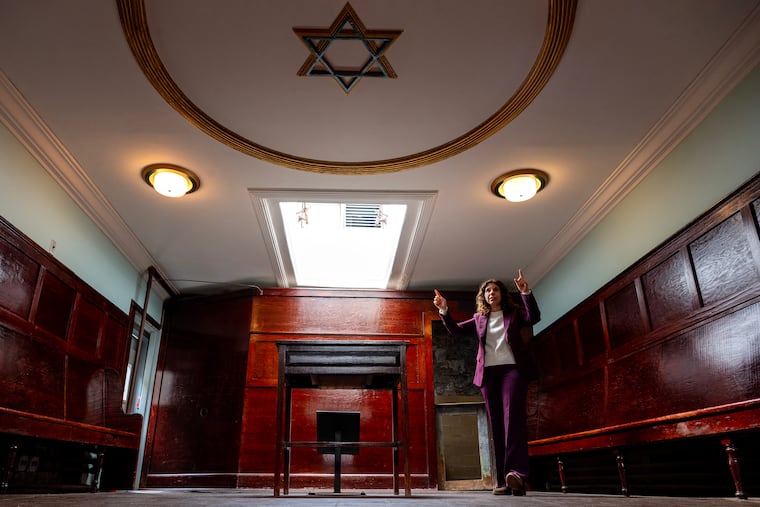
The sacred space sits quiet now. But amid the ruins and solemn silence, one can almost hear the ghostly prayers of the damned. Inmates from a century ago, whose bodies were incarcerated, but whose souls found escape.
On July 2, Eastern State Penitentiary opened its new permanent exhibition, “Freedom Through Faith: Judaism at Eastern State and Beyond.” Centered in the historic penitentiary’s painstakingly restored synagogue — the first within a U.S. prison — the exhibit powerfully recounts how incarcerated Jewish people and local Philadelphians came together amid rising antisemitism in the 1920s to construct a sacred space unlike any other in the United States.
“We are so excited to open our newest permanent exhibition, especially in such a powerful year, to explore this remarkable story,” said Kerry Sautner, president and CEO of Eastern State. “This is a powerful sacred space that all Americans should visit and learn from.”
A tale of hope
As the nation continues to celebrate the 250th anniversary of the Declaration of Independence, the exhibit examines how one of America’s founding ideals — religious liberty — was experienced at America’s first penitentiary, opened in Fairmount in 1829, and which emphasized strict solitary confinement as a path to true penitence.
By combining a gripping mix of personal stories, archival materials, letters, photographs, and historical artifacts, and the power of the space itself, the exhibit tells a tale of hope.
The space was first established as an informal synagogue in 1922 in a former prison yard and weaving shop. It was restored by researchers in 2009.
“In the very place that invented solitary confinement, a small group of civically minded Philadelphians came together to build a community rooted in faith and belonging,” said Sautner, who served as chief learning officer at the National Constitution Center before coming to Eastern State in 2023. “Their work was revolutionary then, and we still have much to learn from it today.”
The story of Jewish Philadelphia
To tell the tale of the forgotten synagogue, Eastern State researchers tell the tale of Jewish Philadelphia itself.
Fleeing pogroms and poverty in Eastern Europe, more than two million Jews immigrated to America between 1880 and 1924. Tens of thousands settled in Philadelphia, where, like so many other marginalized immigrant groups, they experienced hardships and prejudice. Some landed behind Eastern State’s imposing 30-foot granite walls, and served their sentences mostly in solitude.
Until the synagogue, Christianity dominated life in the prison, where ministers preached in the cell blocks. Isolated from their families and religious life, Jewish inmates were pressured to convert, Sautner said.
“The only time people got real human contact with another human was the rabbi and the clergy from the Jewish community coming in and checking on their cells,” she said.
With urging from the outside community, prison officials allowed Jewish inmates to hold religious ceremonies in the prison’s cramped emergency hospital in 1913. It was the first known communal gathering in the prison’s history.
“This is a revolutionary act,” said Sautner. “It happens because of the influence of the Jewish community in Philadelphia.”
A grim mellowness
Soon the inmates were holding weekly Shabbat services. In 1917, an article in The Jewish Exponent, a local Philadelphia paper, reported on the first inmates-led Passover Seder at the prison. The article described how the inmates built a Torah ark — the sacred and ornate chamber that houses the Torah scrolls — for the service.
By 1922, with the help of Philadelphia philanthropist and prison reformer Alfred W. Fleisher, the inmates began meeting in their makeshift synagogue in the tucked away weaving shop. In 1928, the prison rabbi, Isaac Feinberg, worked with local Philly design firms to design a proper synagogue, which was unprecedented in an American prison.
“The Jewish community on the outside is working with the community on the inside,” said Sautner. “This is communal teamwork to give one another a chance to hold onto their identity and hope.”
The designs were eventually implemented by two incarcerated men: Jacob Forbes and David Goldman — and other inmates who learned trades to help complete the synagogue.
“It was designed and developed by incarcerated people here,” Sautner said. “Some who were Jewish and some who were not. But it was really about, ‘How do you hold onto community?’”
Named in memory of Fleisher, the completed synagogue, according to a 1920s newspaper article, “lends a mellowness to that grim institution.”
The synagogue was built of dark cherry wood with a white-tiled ceiling, and bearing a metal Star of David on the door.
‘A sacred place’
By 2009, the synagogue was in ruins, buried beneath a caved-in roof in a mostly abandoned section of the prison. Researchers meticulously sifted through the dirt and disrepair, finding a jar holding the synagogue’s former Star of David.
For the exhibit, the nonprofit that owns the former prison spent more than $500,000 to restore the space to its 1950s solemnity, also rehabbing a nearby prep kitchen that served as the synagogue Seder space.
The exhibit, open seven days a week, occupies an adjacent room, allowing visitors to stand in the quiet of the synagogue to imagine the peace and belonging found there by souls gone by.
“We wanted you to be in the synagogue,” said Sautner. “To be in a sacred place.”