The Bryn Mawr Film Institute turned 20 this year. Here are 20 iconic movies from its history.
To celebrate the beloved Main Line theater's anniversary, its staff compiled a list of the most iconic films screened there, from "Silver Lining's Playbook" to "Blue Velvet."
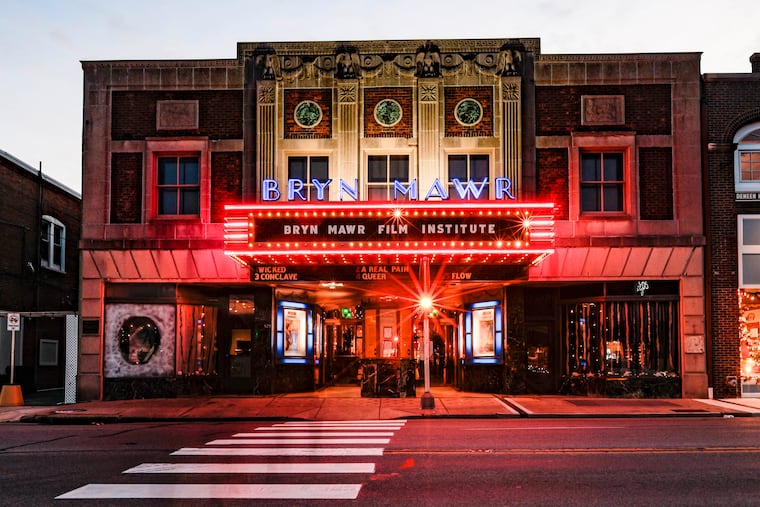
There are few facades more iconic in Bryn Mawr than the marquee of the Bryn Mawr Film Institute (BMFI), an enduring Main Line institution and watering hole for cinephiles from across the region.
BMFI has turned 20, marking two decades of the nonprofit community theater founded by Juliet Goodfriend in 2005. In the early 2000s, Goodfriend found herself dismayed when a historic movie theater in neighboring Ardmore was converted into a short-lived gym. To protect Bryn Mawr’s historic Seville Theatre from the same fate, Goodfriend rallied a team of local stakeholders around the theater. In December 2004, BMFI purchased the Seville, and in March 2005, the film institute opened its doors. Today, BMFI screens new and historic films, hosts lectures, teaches courses for children and adults, and celebrates the art of the film.
“It means a lot … to see what this place has become through the generous support and engagement of the community,” said Andrew J. Douglas, deputy director of the film institute who has worked at BMFI since it first opened.
To celebrate BMFI’s 20th anniversary, its staff compiled a list of 20 of the most iconic films the theater has screened, from Philly-based flicks to beloved musicals:
‘Blue Velvet’
If there’s an iconic filmmaker with a Philadelphia connection, it’s the late David Lynch, said Jacob Mazer, BMFI’s director of programs and education.
Blue Velvet is Lynch’s 1986 mystery thriller. It follows college student Jeffrey Beaumont after he discovers a severed ear in a vacant lot in his suburban hometown and is drawn into a dark world of crime.
“When we look at this arc of [Lynch’s] career, it’s really the film where he finds his way,” Mazer said.
Lynch began his filmmaking career in Philadelphia at the Pennsylvania Academy of the Fine Arts and regularly discussed basing his landmark debut Eraserhead on the city in the 1970s. When Lynch returned to Philly for a retrospective of his work at PAFA in 2014, he visited BMFI for a screening of his films and a Q&A session with the audience. Blue Velvet was the first film BMFI played to commemorate Lynch after his death in January.
‘The Philadelphia Story’
There’s a lot of local love for The Philadelphia Story, George Cukor’s 1940 romantic comedy set on the Main Line and based on the life of socialite Helen Hope Montgomery Scott, said Gina Izzo, BMFI’s communications director.
Plus, Izzo added, “It’s funny. It holds up.”
‘Lawrence of Arabia’
The annual summer screening of David Lean’s 1962 film Lawrence of Arabia is the oldest-running BMFI tradition. It’s a movie that is just “not done justice on a small screen,” said Mazer.
‘The Sound of Music’
Each December, lovers of The Sound of Music descend on BMFI for what Izzo describes as an “interactive screening” of the 1965 musical directed by Robert Wise. Over the course of three hours and many songs, The Sound of Music tells the World War II-era story of Maria (Julie Andrews), a young woman who becomes a governess for the von Trapps, an aristocratic Austrian family.
At the annual Christmastime screening at BMFI, moviegoers sing along from their seats and, each year, wear increasingly elaborate costumes. Last year, there were nuns, goats, and “brown paper packages tied up with strings” (a la the song “My Favorite Things”). The showings sell out months in advance.
As Izzo put it, “It’s sort of our Rocky Horror Picture Show equivalent.”
‘Harold and Maude’
Hal Ashby’s Harold and Maude has been a mainstay at the Seville Theatre since it was released in 1971. It was the last movie shown on the Seville’s single screen before the theater was twinned (split into two screening rooms) in the 1980s.
“Harold and Maude just comes back again and again and again" in the theater’s history, said Mazer. “It’s one of the quintessential cult movies.”
‘Casablanca’
Michael Curtiz’s 1942 romantic-drama Casablanca is “one of the great examples of the difference [between] seeing a movie in a theater with other people versus by yourself at home,” said Douglas.
BMFI screens Casablanca every summer, and Douglas teaches an annual lecture on the film. When he watches Casablanca at BMFI, Douglas says he regularly hears people sniffling at sad moments or guffawing at funny ones, a stark comparison to the muted reactions one often has from the comfort of their own couch.
“You’re reminded how funny it is, you’re reminded how moving it is, and you’re reminded, in a sense, how human it is,” he said.
‘The Grand Budapest Hotel’
Why include Wes Anderson’s 2014 film The Grand Budapest Hotel? Put simply, people just love Wes Anderson, Izzo said.
‘2001: A Space Odyssey’
Stanley Kubrick’s 2001: A Space Odyssey was the first film shown at the theater after it developed the capacity to screen 70 mm film. Mazer called the 1968 movie an “iconic film” in cinematic history.
‘Silver Linings Playbook’
In a way, Silver Linings Playbook is a “modern-day Philadelphia Story,” said Douglas. The 2012 film, directed by David O. Russell, follows Pat Solitano Jr. (Bradley Cooper), recently released from a psychiatric hospital who works to win back his estranged wife, and Tiffany Maxwell (Jennifer Lawrence), a young widow also struggling with mental illness, as she prepares for an upcoming dance competition.
Philadelphia’s favorite rom-com is an homage to Delco, Eagles fans, and the Montgomery County-born-and-raised Cooper. It’s a “local guy makes good” story, Douglas said, referring to Cooper. It’s also the highest grossing main attraction in BMFI history.
“For our community, it was an enormously meaningful movie‚" Douglas said.
‘La La Land’
Benj Pasek and Justin Paul, known as Pasek and Paul, are a composing and songwriting duo responsible for the lyrics in La La Land, the acclaimed 2016 musical directed by Damien Chazelle.
Pasek is “Bryn Mawr’s son,” Izzo said. The composer graduated from Friends Central, the Wynnewood Quaker school, and is a longtime supporter of BMFI. When Pasek and Paul won an Oscar for the movie, everybody at home “had a little piece,” said Izzo.
‘Barbie’
Greta Gerwig’s 2023 Barbie felt like the “big wave back after the pandemic,” Izzo said. People dressed in pink and flocked to the movies after months of isolation and uncertainty.
‘Oppenheimer’
Same with Christopher Nolan’s 2023 Oppenheimer. Remember "Barbenheimer"?
‘Parasite’
Parasite, Bong Joon Ho’s 2019 South Korean Oscar winner, was the third-longest running main attraction in BMFI history with a 16-week run.
“We were proud to show that one,” Izzo said. “It was very popular here.”
‘Rocky’
Rocky, the 1976 film directed by John G. Avildsen about boxer Rocky Balboa (Sylvester Stallone), may seem like an obvious addition to any Philly-area iconic movies list. But the local history behind the movie is deeper than meets the eye, Mazer said.
Rocky was one of the first to be filmed with the Steadicam, a revolutionary invention of Garrett Brown, a Haverford High School graduate and prolific Philadelphia inventor. The Steadicam, created by Brown in 1975, is a camera stabilizing device that revolutionized the movie industry, allowing filmmakers to shoot scenes without having to mount cameras onto cranes or dollies.
In testing out his new invention, Brown shot various scenes around Philadelphia, including one of his future wife running up the steps of the Philadelphia Art Museum. That scene would later become an iconic motif of Rocky, shot by Brown.
“It’s this place where film history and Philadelphia history really connect,” Mazer said.
Brown is a friend of BMFI and has given numerous lectures at the theater, including for the 40th anniversary of Rocky.
‘Superman’
James Gunn’s 2025 Superman is another story of a local hero. David Cornswet, who played Superman, was raised in Lower Merion and graduated from the Shipley School, a Bryn Mawr private school. Cornswet hosted a friends and family debut of Superman at BMFI.
‘Brooklyn’
Brooklyn, John Crowley’s 2015 period drama, stars Saoirse Ronan as Ellis Lace, a young Irish immigrant to New York City. The movie was immensely popular at BMFI, said Izzo.
‘On the Waterfront’
Elia Kazan’s 1954 crime drama On the Waterfront helped revolutionize BMFI’s educational programming. The film was the first of the theater’s one-night seminars, during which moviegoers listen to a short lecture, sit for a screening, and then stay for a discussion. Now, they’re a popular part of the theater’s educational menu.
‘RBG’
RBG, Julie Cohen and Betsy West’s 2018 documentary about late Supreme Court Justice Ruth Bader Ginsburg, was the highest-grossing documentary screening in BMFI history. It’s also in the top 20 of the highest-grossing screenings in the theater’s history (including movies and documentaries).
National Theatre Live: ‘The Audience’
Though movies are at the core of BMFI’s work, the theater has expanded its repertoire to include cinematic presentations of ballet, theater, opera, and behind-the-scenes tours of art museums, all filmed and fit for the movie screen. BMFI’s most popular alternative program to date was a screening of The Audience, a 2013 play starring Helen Mirren as Queen Elizabeth II. BMFI sold out 13 showings of the show.
Izzo and Douglas said the screenings help transport locals to places that can be difficult to get to — New York City’s Broadway, London’s West End, or European museums.
“Even at current prices, it’s still a tremendous bargain for access to the arts,” said Douglas.
‘Metropolitan’
To commemorate the 30th anniversary of Whit Stillman’s 1990 movie Metropolitan, the director visited BMFI in 2022 for a screening of the film and Q&A with the audience. Metropolitan follows the Sally Fowler Rat Pack, a group of young Manhattan socialites in the throes of debutante season.
Stillman’s visit to BMFI “was the beginning of a really nice friendship,” Mazer said.
This suburban content is produced with support from the Leslie Miller and Richard Worley Foundation and The Lenfest Institute for Journalism. Editorial content is created independently of the project donors. Gifts to support The Inquirer’s high-impact journalism can be made at inquirer.com/donate. A list of Lenfest Institute donors can be found at lenfestinstitute.org/supporters.

Inquirer Lower Merion