Philly is a hub for artists of color today, thanks to trailblazers like Toni Cade Bambara
The writer, educator, activist, and filmmaker worked to create a city that serves the city's artists. 'In many ways, she had prophesied BlackStar.'
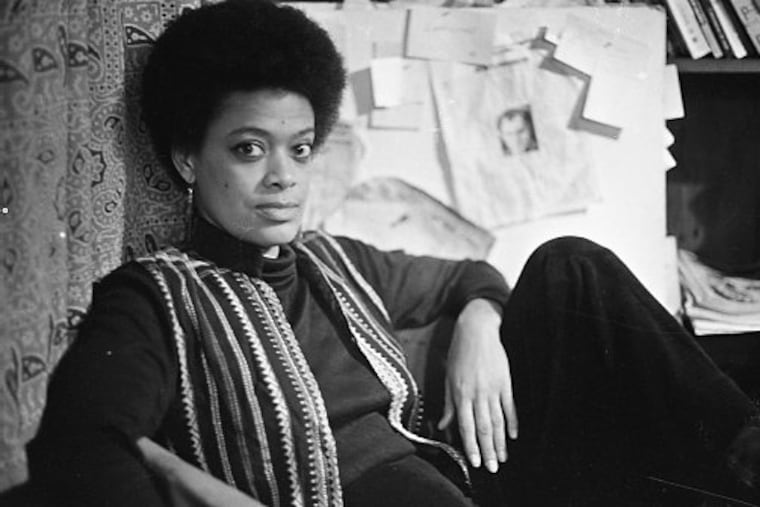
In the fall of 1986, Toni Cade Bambara moved to Philadelphia from Atlanta.
That same year, she gave a reading at My Solitude, a bookstore on Germantown Avenue. Filmmaker Louis Massiah, who had founded Scribe Video Center just a few years prior, went to see her speak. Her commitment to movement-building appealed to him.
Sixteen years before that, in 1970, Bambara had edited and published The Black Woman, an anthology featuring poems, essays, and stories from a coterie of insightful and incisive thinkers, introducing readers to Alice Walker, Audre Lorde, Nikki Giovanni, and other writers who’d go on to carve out new paradigms for Black women in American literature and the world at large.
“Recognizing [that] cultural movement gave energy to writers who had been doing it and to a new generation,” Massiah said.
At the reading, Massiah spoke to Bambara, a writer, educator, activist, and then a burgeoning filmmaker, about her filmmaking ambitions. He suggested she take a workshop at Scribe.
Massiah was hopeful she would show up but was “horribly embarrassed” when she did: Bambara was the only student to take the class. She insisted Massiah teach her anyway. Thus began a decade of friendship and rich creative collaboration.
Bambara went on to teach writing classes at Scribe. Together, she and Massiah made The Bombing of Osage Avenue, an important early documentary on 1985’s MOVE bombing. They launched Scribe’s Community Visions initiative, pairing filmmakers with community groups to produce documentaries about housing issues, domestic violence, sexual abuse, and other urgent concerns.
Along with Amiri Baraka, Wesley Brown, and Thulani Davis, Bambara appears in the 1996 Massiah-directed documentary W.E.B. Du Bois: A Biography in Four Voices.
“The intentionality of making Scribe accessible and connected to communities, Toni had a lot to do with it,” Massiah said. From her, he learned that being deliberate about the audience can expand the potential of any work — a lesson he has applied in TCB — The Toni Cade Bambara School of Organizing, the opening night film of this year’s BlackStar Film Festival.
“I wanted to make a film that would be of interest to community culture workers, people who are thinking really intentionally about how to use their art form as a way of building and strengthening communities,” Massiah said.
Monica Henriquez, who edited W.E.B. Du Bois, codirected the film.
Structured as a syllabus, the documentary surveys Bambara’s life and influential work through archival footage of her public appearances and interviews with friends, family, students, and contemporaries, including Toni Morrison, Nikki Finney, and Sonia Sánchez.
“There were no strangers for [Bambara] in the world,” Toni Morrison says in the film.
Bambara approached lectures to a thousand people as if they were intimate conversations and engaged passersby on the street like old friends. As a teacher — at the City College of New York, Rutgers University, Emory University, Spelman College, and elsewhere — she stood to the side of classrooms rather than up front, undermining her own authority presupposed by the traditional teacher-student dynamic.
Bambara’s personality — her intelligence and social skills, her presence and poise, her deadpan sense of humor, her audacious but unaffected sense of style — comes up often in the film. Whether in her creative work, her organizing, her teaching, or her day-to-day interaction, it was all in service of Bambara’s activism toward Black feminist liberation. She understood what that sort of commitment requires.
“Are you sure, sweetheart, that you want to be well?” begins her debut novel, The Salt Eaters (1980), weighing the urgency of activism against the toll it takes on an individual.
It’s a toll Bambara felt for most of her life, from her writings as a child in 1940s Harlem until her death in Philly in 1995 from colon cancer.
“She made such a commitment to working in community settings, instead of being a star,” Massiah said. “Sometimes being committed to community and to struggle and to trying to make this society the best it can be, if you don’t prioritize yourself, there’s a cost.”
Today, Massiah said, conditions for culture work in Philadelphia are friendlier, particularly for young independent filmmakers of color.
“BlackStar is a fountain of life for the film community, beyond Philadelphia,” he said. BlackStar, Scribe, and organizations like Independence Public Media Foundation and the Wyncote Foundation bolster an international movement of independent filmmakers and encourage the work Bambara championed throughout her life.
“We need to create those spaces where filmmakers of color can have a chance to share their work, and so that we can be empowered in seeing it. In many ways, she had prophesied BlackStar as being a necessity. The need continues.”
Nearly 30 years after Bambara’s death, Massiah considers her work as relevant as ever.
“We look at this as an exceptional time, the particular struggles we’re going through and the state of the world, but in some ways, each age has its cross to bear … Toni was able to prioritize what is eternal: how we take care of each other. Our relationship to family, our relationship to children, gendered relationships. If we fall back on what truly makes us human, that’s a strength.”
How to watch ‘TCB — The Toni Cade Bambara School of Organizing’
The documentary TCB — The Toni Cade Bambara School of Organizing will screen in person on Thursday, July 31, at 8 p.m. at the Perelman Theater (300 S. Broad St.) as part of the BlackStar Film Festival.
You can also watch it online through BlackStar’s virtual platform. For tickets and more information, visit blackstarfest.org