Bruce Springsteen’s ‘Land of Hope and Dreams’ Philadelphia show was an unabashedly partisan, spirit-lifting revival meeting that sounded astoundingly good
“Philly you kill me and I want to thank you," the Boss said in the show where he took on the President, got very political, but also threw a "heart-stoppin’, pants droppin’" rock and roll party.
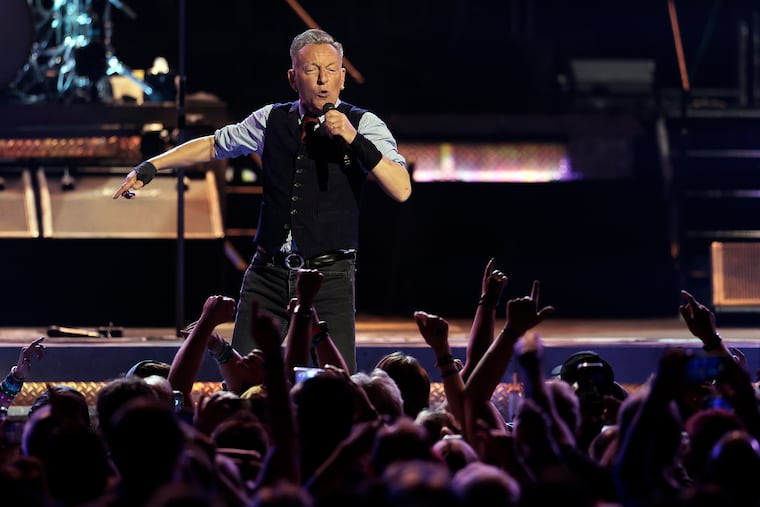
Bruce Springsteen began Saturday night with a speech.
Ever since President Donald Trump was elected for the second time, Springsteen has taken the extraordinary step of not letting his music speak for itself at the start of his shows.
Instead, when he stepped on stage at 7:30 p.m. sharp at the Xfinity Mobile Arena in South Philadelphia for the final date of his “Land of Hope and Dreams American Tour,” the Boss came out swinging.
Labeling the Trump administration “corrupt, incompetent, racist, reckless, and treasonous,” he asked his audience to join him in embracing a communal, inclusive version of America that he believes runs counter to the president’s.
(The president has frequently hit back at Springsteen, calling him “dumb as a rock” and “not a talented guy,” among other things.)
Immediately getting down to business in sleeves-rolled-up preacher mode on Saturday, the 76-year-old Jersey rocker invited the sold-out crowd to stand with him.
He asked the true believers to join him and the E Street Band “in choosing hope over fear, democracy over authoritarianism, the rule of law over lawlessness, ethics over unbridled corruption, resistance over complacency, truth over lies, unity over division and peace over …”
And with that, the band emphatically slammed into “War,” Edwin Starr’s 1970 anti-war hit. It comprised the core unit of longtime Springsteen compadres like guitarist Steve Van Zandt, drummer Max Weinberg, pianist Roy Bittan, and bassist Garry Tallent along with a five-member horn section, four backup singers, percussionist Anthony Almonte, and guest guitarist Tom Morello.
“War” wasn’t the only cover that the E Streeters included in a thrilling, sharply-focused marathon that played like an unabashedly partisan spirit-lifting revival meeting — and sounded astoundingly good in a cavernous sports arena — as the band roared through a standard Springsteen-length 3 hour show that included 27 songs and several spoken interludes.
Early on, Springsteen drew strength from British rebel rockers the Clash, taking turns on vocals with Morello on “Clampdown,” the anti-fascist salvo from the band’s 1979 album London Calling that exhorts listeners to “Let fury have the hour, anger can be power. Do you know that you can use it?”
Later, a five-song encore began with a shout-out to the Pennsylvania Immigration Coalition as a prelude to Springsteen’s own careening Celtic-Appalachian folk song “American Land” (which celebrates “the hands that built the country we’re always trying to keep down”) and ended with Bob Dylan’s 1964 “Chimes of Freedom.”
With that, Springsteen explicitly connected his current tour to the socially conscious folk rock movement of the ’60s that has always animated his work. And he reached back farther with a recording of Woody Guthrie singing “This Land Is Your Land,” which played as exit music after Springsteen urged his faithful to “stay hard, stay hungry, stay alive. And stay involved.”
Trump supporters and critics on the right often bash Springsteen for his left-leaning politics, or mock him on social media with meant-to-be-cutting comments such as claiming he looks like Ellen DeGeneres. (Wow, sick burn!)
Longtime Springsteen followers frequently point out that he has been a political artist for decades, reaching back to the 1979 No Nukes concerts or the widely misconstrued, massively popular 1984 “Born in the U.S.A.,” which you can tell is not a purely patriotic flag waver if you pay attention.
But Springsteen’s right-wing critics are right about at least one thing: He never has been this political before.
Sure, he has plenty of songs that have leaned into topicality over the years. One example is “The Ghost of Tom Joad,” the title song to his 1995 album. It draws from John Ford’s 1940 movie adaptation of John Steinbeck’s The Grapes of Wrath, and promises that “where there’s a fight against the blood and hatred in the air, look for me, Mom, I’ll be there.”
On Saturday, Springsteen and band did an incendiary take of the song, keyed by the “how-does-he-do-that?” guitar histrionics of Morello, who previously covered the song with his rap-rock band Rage Against the Machine.
Another example is “American Skin (41 Shots),” the 1999 song about the fatal shooting of unarmed street vendor Amadou Diallo in New York by plainclothes police officers. It’s one of Springsteen’s most deftly turned, deeply empathetic songs, which examines racial injustice and division from a humanist point of view.
On Saturday, it was delivered — to a crowd that was overwhelmingly white — in a graceful version whose central lyric “You can get killed just for living in your American skin” also resonates with the deaths of Renee Good and Alex Pretti at the hands of ICE agents. Their deaths moved to Springsteen to write the seething broadside “Streets of Minneapolis,” earlier this year. That song was also a show highlight.
» READ MORE: Bruce Springsteen’s last Philly show was elegiac. This time, it’ll be a ‘teeth-kicking’ protest.
But besides that explicitly political material, what was fascinating about Springsteen’s set during this tour is how easily the sturdy, durable songs that have been staples of his repertoire for decades meshed with the tour’s “No Kings” theme.
The powerless protagonist who feels “so weak I just wanna explode” in “Promised Land” speaks to a moment in an embattled America where many concerned citizens are unsure how to react to what they see as “the lies that leave you nothing but lost and brokenhearted.”
The same goes for rousing fist pumpers like “Badlands” that look skyward in hopes of finding belief “in the faith that can save me,” as well as gospel-leaning rousers like “Land of Hope and Dreams” itself and “My City of Ruins.”
The latter was originally written for a crumbling Asbury Park, then worked as a 9/11 memorial on The Rising, and is now an inspirational anthem about rebuilding democratic institutions, with a coda that quotes Curtis Mayfield’s “People Get Ready.”
And of course, Springsteen has plenty of songs about putting up a fight, with neither retreat nor surrender as an option. Even “Wrecking Ball,” an ode to the demolished New York Giants’ football stadium which was met by good-natured booing, is about refusing to be bullied or back down.
“Go ahead and take your best shot, let me see what you’ve got: Bring on your wrecking ball!”
All this might sound deathly serious. But was the show also a redemptive rock and roll party? It was.
The set loosened up with “Two Hearts,” a duet with Van Zandt that ended with a bit of Marvin Gaye and Kim Weston’s “It Takes Two” and “Hungry Heart.”
The band was cohesive and frequently on fire, with Lofgren blazing away on “Youngstown” and Van Zandt cutting loose on “Murder Incorporated.” Much fun was had in “Born To Run,” “Dancing in the Dark,” and “Tenth Avenue Freeze-Out.”
Before that last song, the tireless septuagenarian bandleader was particularly animated. He shouted out “PHILLY!” five times and told the crowd to “Go home tonight, get on your cell phone, pull on your pajamas, call up all your neighbors, and tell them you’ve just witnessed the heart-stoppin’, pants-droppin’, earth-shaking, hard-rockin’, booty-shaking, earth-shaking, love-making, Viagra-taking, history-making, legendary E Street Band!”
In his closing remarks, he was more thoughtful about what Philadelphia has meant to him since it became a popular stronghold for him early in his career.
“Philly, you kill me,” he said and thanked the band, his manager Jon Landau and wife Patti Scialfa (who was not present for this show), and others.
“And I want to thank you, Philadelphia, for supporting our band all these years. I first came here, I think it was 1973 at the Main Point in Bryn Mawr. I was 23 years old.”
He paused, and laughed.
“That was a little while ago. So I want to say to you, Philly: Thanks for a lifetime.”