Bruce Springsteen tells us his version of American music history with some help from Sheryl Crow, Mavis Staples, Public Enemy, and more
The Boss' "Music America: The Songs That Shaped Us" shows were in advance of the opening of a new museum at the Bruce Springsteen Center for American Music in Monmouth University
Next weekend, the museum at the Bruce Springsteen Center for American Music will open its doors to the public in Long Branch, N.J.
And if the home of the Bruce Springsteen Archives — which will also feature exhibits covering the broad spectrum of American music — turns out to be nearly as rewarding as the concerts that Springsteen and guests put on last week to celebrate it, then the Jersey Shore is going to have an impressive new attraction.
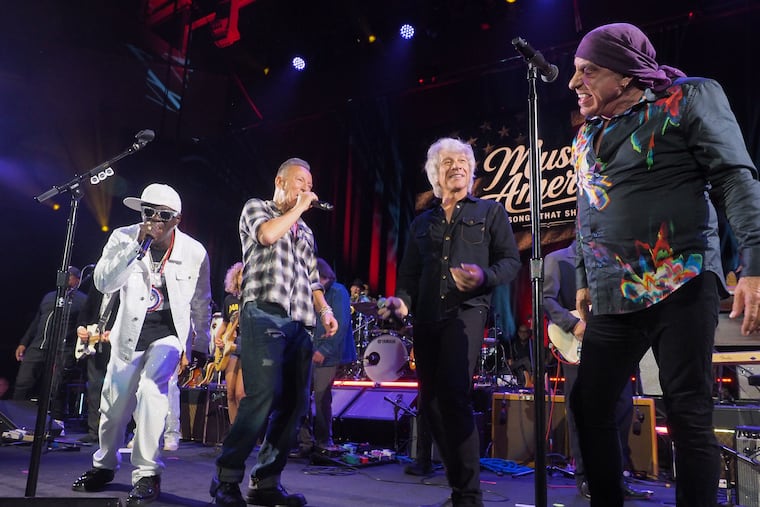
On Thursday and Friday at the OceanFirst Bank Center on the campus of Monmouth University — not far from the rented house where Born to Run was written — Springsteen led an all-star cast in two “Music America: The Songs That Shaped Us” concerts that aimed to be as educational as they were entertaining.
The lineup of genre-spanning acts was extraordinary.
On Thursday, in a show that focused on folk music, country, and blues leading up to World War II, guests included Keb’ Mo’, Kenny Chesney, Trombone Shorty, and Rosanne Cash. Springsteen even joined Cash on a cover of Woody Guthrie’s timely immigrant saga “Deportee (Plane Wreck at Los Gatos).”
On Friday, which focused on the 1950s to the present — and was the show that this critic saw — the volume turned up.
The staggering guest list of seasoned performers included Sheryl Crow, Jackson Browne, Gary Clark Jr., Jon Bon Jovi, and Jimmie Vaughan. Then there were Public Enemy’s Chuck D and Flavor Flav, the latter of whom, it’s fair to say, stole the show.
E Street Band members Steven Van Zandt (who sang Chuck Berry’s “Bye Bye Johnny” and paired off with Browne for his own “I Am a Patriot”) and Nils Lofgren (who teamed with Bon Jovi for Neil Young’s “Rockin’ in the Free World”) also performed, as did former E Streeter David Sancious, in a jazz-rock duo with drummer Will Calhoun.
The stage at the 4,100-capacity venue was also blessed by the presence of three octogenarian legends, all in fine form, who provided living history lessons.
Gospel great Mavis Staples sang the Band’s “The Weight,” which she had sung with her family band the Staple Singers in 1968. 1950s rock and roller Dion did both his early hit “The Wanderer” and his mournful folk song “Abraham, Martin and John.” And Darlene Love delivered a powerhouse version of Ike and Tina Turner’s “River Deep, Mountain High.” Yowza.
The show, which was presented as a “curated concert” hosted by the center’s executive director, Bob Santelli, opened with Springsteen clearly relishing the opportunity to cover Elvis Presley’s “Jailhouse Rock” and “Burning Love.”
He was backed by the Disciples of Soul, E Street Band guitarist Van Zandt’s own 11-person ensemble. Santelli, who introduced each song with a music history lesson about Mississippi Delta blues or psychedelic rock, referred to the band as “the official house band of the Bruce Springsteen Center.”
The concert did not take on the confrontational tone of Springsteen’s just-finished “Land of Hope and Dreams” tour, which wrapped up at the Xfinity Mobile Arena in South Philly on May 30. But Friday night’s concert was dotted with songs of protest, like Browne’s “For America” and Public Enemy’s “Fight the Power.”
The evening was intentionally structured to tell a story about American music that, as the Springsteen Center says in its mission statement, “celebrates the history of American music and its diversity of artists and genres” while it “interprets and honors the cultural impact of American music past, present, and future.”
Before the show, Monmouth University president Patrick F. Leahy delivered opening remarks that spoke to the value of presenting a version of America and its music that celebrates the nation in its 250th year while reflecting its complicated and contentious history.
When the museum at the center opens next weekend, it will feature an exhibit titled “Chimes of Freedom: Protest, Patriotism, and the Power of Song.”
“As my dear friend Bob Santelli says — I stole this directly from him,” Leahy said. “What Washington, D.C., could do — that is, build an institution and place it right there on the Mall in Washington dedicated to the preservation and celebration of American music in all of its forms — what they could do in D.C., we just did right here on the campus of Monmouth University, right here in the great state of New Jersey.”
Friday’s show lasted three hours, including a 20-minute intermission.
The boomer-centric evening was by no means a comprehensive history of American music of the last 75 years, with only cursory nods to jazz and hip-hop; no Beach Boys or indie rock. But asking for more from the star-studded evening — or complaining about the sometimes murky vocal sound mix in a gym that’s home to the Monmouth Hawks basketball team — feels like nitpicking.
Highlights were many. Sheryl Crow, in particular, was outstanding. First, she turned in a classy take on Patsy Cline’s “I Fall To Pieces” while wearing a shimmery floor-length red gown.
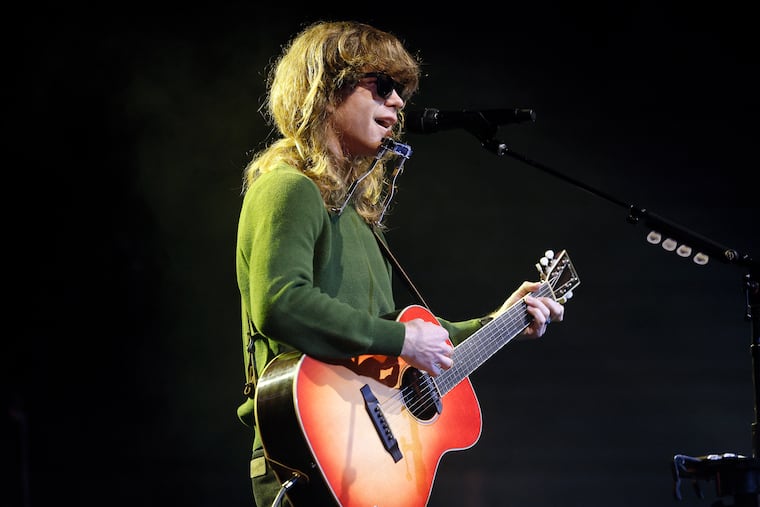
Then, a few numbers later, after Gary Clark Jr.’s electric “Catfish Blues,” she came back in more casual garb for a stellar acoustic guitar and harmonica reading of Bob Dylan’s “A Hard Rain’s A-Gonna Fall.”
She followed that by calling Springsteen on stage for an expertly sung version of Dylan’s yearning for the infinite, “I Shall Be Released,” that also featured former Dylan guitarist Larry Campbell and his wife, Teresa Williams.
Flavor Flav made his presence felt. Gentleman that he is, he could be seen helping Love off the stage after she completed her “River Deep” number.
During “Fight The Power,” the hype man bounded around the stage with relentless energy, shouting out Springsteen at every opportunity, but also showering lavish praise on the backing band, which he seemed to believe was the E Street Band, not the Disciples of Soul.
A guitar summit on Bobby “Blue” Bland’s “Further on up the Road” gave Springsteen, Vaughan, Lofgren, and Clark, as well as Disciples music director and guitarist Marc Ribler, a chance to take turns stretching out.
After that, it was time for an all-hands-on-deck encore, with that guitar group joined by Bon Jovi, Public Enemy, Browne, Love, and others; first for Eddie Floyd’s “Raise Your Hand” and then Southside Johnny’s “I Don’t Want to Go Home.”
When Flav kept on shouting out the E Street Band, Springsteen and Van Zandt at first made it seem as if they were going to correct him, but then just threw their hands up and laughed.
In the end, Springsteen was alone on stage, remembering time spent at Monmouth College more than a half century ago. Playing shows, he said, “not going to school.”
He finished with an acoustic “Land of Hope and Dreams” that contrasted with the full version he did in South Philly a week earlier. It was quieter and more reflective, but equally stirring and full of hope as it closed out a remarkable evening with a vision of an America where “dreams will not be thwarted” and “faith will be rewarded.”
The Bruce Springsteen Center of American Music, 382 Cedar Ave., Long Branch, N.J., opens on June 13. springsteencenter.org.