Eric Clapton fills a sold-out Xfinity Mobile Arena with familiar riffs and roars of approval
In a rare Philly appearance in one of only six shows on a mini U.S. tour, the British legend reminisced about his 'greatest gig' in Philly
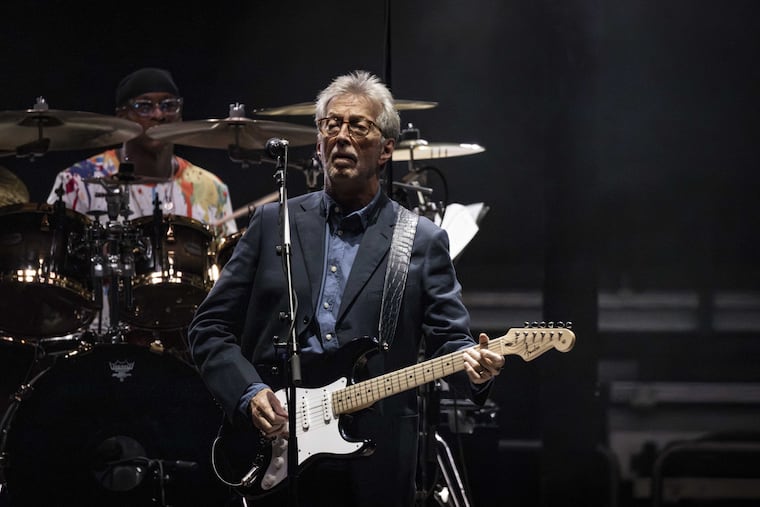
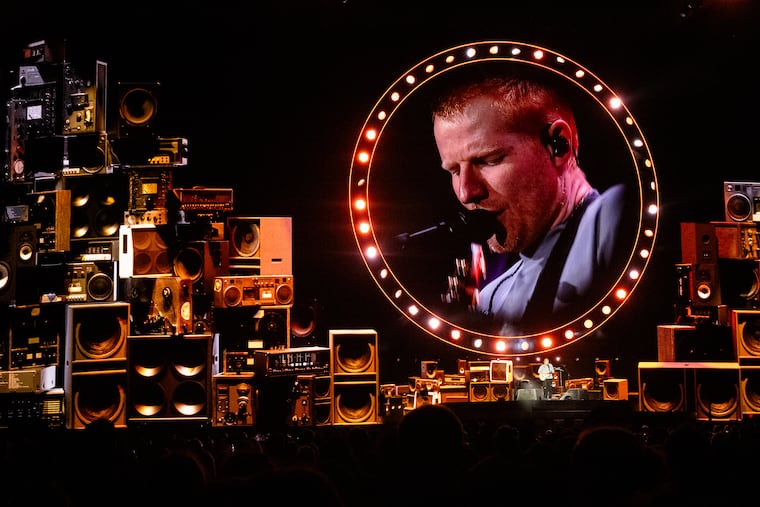
When Eric Clapton strode onto the stage of the Xfinity Mobile Arena on Saturday night, elegantly dressed in a dapper blue suit, the occasion marked his first time in front of a Philadelphia audience in 16 years.
Or to put it in South Philly sports arena terms, that’s two naming rights ago — when the building was known as the Wachovia Center, and Clapton co-headlined the venue with his Blind Faith bandmate Steve Winwood.
The blues-rock legend’s own memories reached further back. In a rare moment of audience engagement, Clapton reminisced about playing the Spectrum in 1967 and thinking, “This is the best we’ll ever play.” (He was likely referring to Cream’s final Philly show in 1968, which he has in the past called, “one of our greatest gigs ever.”)
Saturday’s show couldn’t hope to reach the frenzied heights of that blistering trio in its prime, but the 80-year-old rocker and his band were impeccable. The 90-minute set brought no surprises, alternating classic blues numbers with favorites from his various bands and his early solo career.
Cream’s catalog was well represented: “White Room” opened the show, followed later by “Sunshine of Your Love,” and the George Harrison cowritten “Badge,” bringing the electric portion of the evening to an epic pitch.
The two plugged-in portions of the show bookended an acoustic set, with Clapton seated and longtime bassist Nathan East playing upright bass. East also took on vocal duties for Blind Faith’s “Can’t Find My Way Home,” ably filling in for Winwood’s soaring range.
Clapton recalled 1992’s hit Unplugged album with the nostalgic “Nobody Knows You When You’re Down and Out” and turned sentimental with the mawkish “mawk” from his 1978 solo album Backless.
For those of us who’ve always found Clapton’s English gentleman version of the blues a bit on the bloodless side, there was little to refute that opinion here. A number of blues standards peppered the set — “Key to the Highway,” “Driftin’ Blues,” and several Robert Johnson classics including “Little Queen of Spades” and the ubiquitous “Cross Road Blues.” All were performed with undeniable polish and Clapton’s elegant solos showcased why he’s known as “Slowhand,” but all lacked in raw vitality.
As much as Clapton adores the blues, his playing gets more adrenaline-infused during his own material. The standout solo of the night arrived during “Old Love,” another tune from Journeyman that proved that he retains the agility and fire to tear into a knotty, razor-edged excursion.
For the most part the concert seemed effortless, a double-edged sword implying virtuosity as well as complacency. The most recent song in the setlist was “Tears in Heaven,” Clapton’s lament for his late son, originally released back in 1991.
Stagecraft was as understated as the guitarist’s demeanor, satisfied to do little more than keep the musicians in the spotlight. He was happy to cede the figurative spotlight as well, granting significant solo space to guitarist Doyle Bramhall II and keyboardists Chris Stainton and Tim Carmon.
The sold-out crowd hardly seemed to mind, greeting every familiar riff with roars of approval and multiple standing ovations. Each solo was received with something approaching rapture, recalling the sentiment behind the infamous “Clapton is God” graffiti that once graced a London wall.
The British icon isn’t universally regarded in such sanctified terms these days. His outspoken anti-vax stance during the pandemic soured many fans, and reawakened memories of a drunken, racist tirade from the ‘70s that he’s struggled to quash over the ensuing decades.
Aside from that brief, mumbled stroll down memory lane to the Spectrum, Clapton kept his comments to the Philly audience limited to simple thank yous on Saturday, preferring, as usual, to let the music do the talking.
Perhaps there was a message to his detractors in his choice of repertoire for his one-song encore: “Before You Accuse Me,” the Bo Diddley classic that he recorded on 1989’s Journeyman.
The Wallflowers provided a solid 50-minute opening set, hitting the stage almost exactly 24 hours after frontman Jakob Dylan’s dad, Bob, played his own enigmatic show across the river in Camden. Bloodline aside, the band’s 11-song set, laced with hits “One Headlight” and “6th Avenue Heartache,” had its antecedents more in Springsteen and Petty.
The latter was explicitly represented by a cover of “The Waiting” that might have been a winking acknowledgment of their warm-up act status. It proved unnecessary — the set was well received, earning the openers a standing O of their own.