Jazz Night in North Philly: Herbie Hancock and Kamasi Washington in intergenerational unity at the Met
Two jazz greats met on North Broad for a classy night of musical innovation
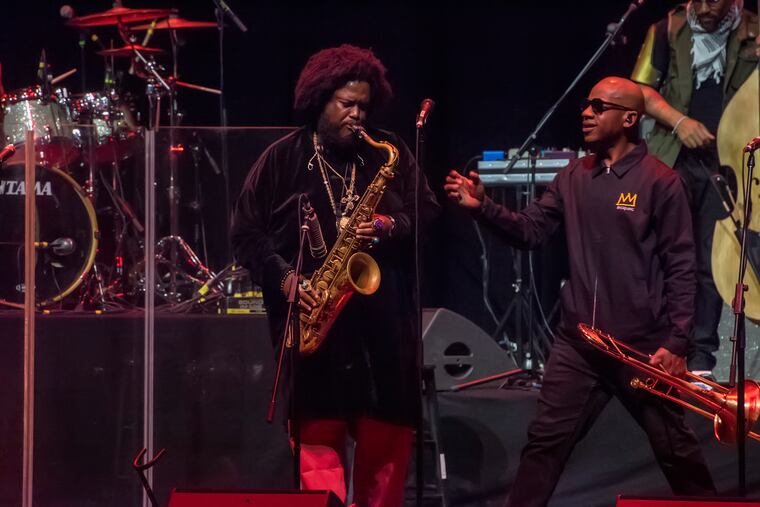
Since opening its doors in December, the refurbished Metropolitan Opera House in North Philadelphia has made good on its promise to serve a wide range of constituencies.
It has presented living legends in Bob Dylan and Patti Smith, teen goth stars like Billie Eilish, hip-hop heroes such as Meek Mill, and pop-R&B vocalists like John Legend, as well as jam bands, comedians, and boxing matches. Madonna is coming in December.
But one thing Oscar Hammerstein I’s rococo showplace hadn’t gotten around to yet was a marquee jazz show.
That changed on Sunday, when not one, but two, of the biggest names in the genre brought one of the prestige tours of the summer to town for a terrifically entertaining, classy evening on North Broad Street.
Virtuoso pianist, crossover trailblazer, and still fearless musical adventurer Herbie Hancock headlined a bill that packed a cross-generational punch thanks to 38-year-old sax man and bandleader Kamasi Washington.
Washington opened with a 70-minute set that felt condensed by his maximalist standards. The Los Angeles tenor player who burst upon the pop consciousness in 2015 with his bold triple LP The Epic fronted a six-piece band with two drummers.
That number expanded to seven when he brought out his father, Rickey Washington (“The man who taught me everything I know"), to play spirited soprano sax on “Oscalypso,” a song from Force For Good, the new album by Ryan Porter, who stood on Washington’s left and distinguished himself on trombone throughout the set.
Washington has made himself a powerful force in jazz by expanding the music’s reach to new audiences without compromising his vision. His spiritual, soul-searching songs place his horn at the center of ebbing and flowing journeys that draw from a wide range of musical sources without watering them down.
Jazz may be art music mostly appreciated by aficionados in small venues. But Washington has courted a different market, favoring pop and rock venues like the World Cafe Live, Union Transfer, and the former Electric Factory on his way to the Met.
And on Sunday, Washington brought that largely white young audience to commingle with the older African American fans who displayed a deep affection for Hancock.
At the end of weekend in which America was angered and grief-stricken by mass shootings in Texas and Ohio, both jazz men stressed unity without specifically mentioning the massacres.
>>READ MORE: Kamasi Washington: Your favorite rapper’s favorite jazz man
“Our differences are what make us cool,” Washington said. “We don’t have to look the same or think the same to love each other … Diversity amongst all people on this whole planet is not something to be tolerated. It’s something to be celebrated.”
“The Truth," from the 2017 EP Harmony of Difference followed, stating five different musical motifs before coalescing as one. It was met with a prolonged standing ovation.
Hancock took the stage with a staggeringly versatile band to his left. The brightest lights were guitarist Lionel Loueke and keyboard player, sax man, and singer Terrace Martin, who produced rapper Kendrick Lamar’s 2016 album To Pimp A Butterfly and who, Hancock promised, is producing his next one.
“How many kinds of people to do we have in America?” Hancock asked the crowd. The response was shouted back immediately. “One!” The pianist responded: “That’s right. Human beings.”
As effective as Washington had been in putting across an uncompromising musical vision, Hancock’s free-spirited explorations displayed a curiosity that made the younger man seem conservative.
The jazz man who made his name with Donald Byrd and Miles Davis in the 1960s before innovating with electronic music in the 1970s and 1980s opened with a loose-limbed jam of chunky funk, colored by by Hancock’s stellar, economical keyboard splashes. One minute Martin was playing a thrilling alto sax solo and going on a futuristic synthesizer excursion, the next Loueke, who hails from Benin, was taking lead vocal duties and the music was migrating to West Africa.
Hancock’s playing was robust and often beautiful throughout his 90-minute set. “You have to be a daredevil to play with these guys!” he enthused.
Taking a seat on the lip of the stage, Hancock boasted about his 50-year marriage, and made old-guy jokes about its secrets. “Two things: ‘Yes, dear.‘ And ‘Ask your mother.’”
But while it may seem like he’s been around forever, Hancock never seems set in his ways musically. On vocal interchanges with Martin, both performers sang into an electronic voice altering vocoder. Hits like the catchy “Cantaloupe Island” from 1964′s Empyrean Isles, were reshaped, with a steady hypnotic pulse a starting point rather than an end to itself.
Anchored by bassist James Genus and hard-driving drummer Vinnie Colaiuta, the band was also augmented by young flautist Elena Pinderhughes, whose playing and singing gave the middle of the set an airy delicacy.
She was back on the stage during the the crowd-pleasing moment that closed the show. Hancock picked up his keytar and was joined by Washington on the rugged funk of “Chameleon,” in which the legend’s fleet-fingered synth soloing meshed with the warm, inviting saxophone of the new standard bearer in a display of unity that was as enjoyable as it was reassuring.
