Lucinda Williams on being ‘the female Bob Dylan,’ hot chocolate and cheesesteaks, and how the ‘World’s Gone Wrong’
The Grammy winning Southern country, blues and rock songwriter is coming to Philly for two shows in support of her new album of topical songs.
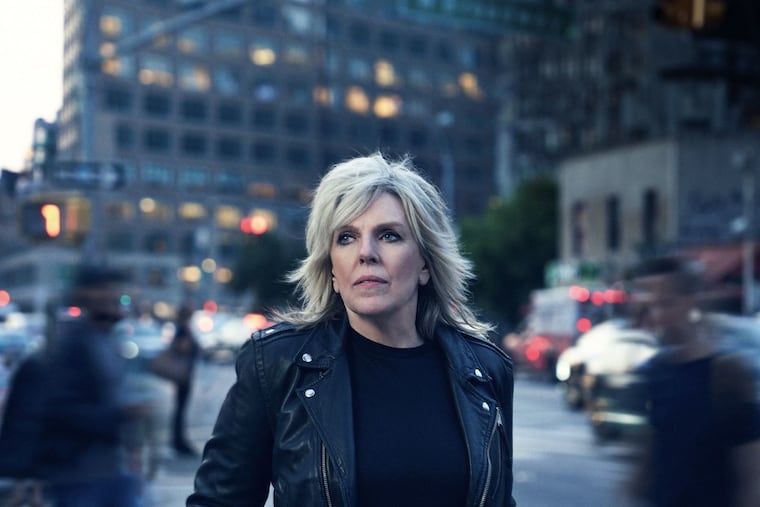
Lucinda Williams is on the phone from Los Angeles, where she lives with husband and manager Tom Overby.
That is, when they’re not in Nashville, where the couple also have a home. Or New York, where she celebrated the release of her politically charged album, World’s Gone Wrong, earlier this year at Lucinda’s, the Lower East Side country bar she co-owns. (And where she programmed the jukebox.)
“I feel like I always have one foot going out the door,” says the singer-guitarist who was an obvious choice as one of the 30 greatest living American songwriters on the New York Times, otherwise highly debatable rage bait, list this month. (Philly-centric objection number one: Where are Gamble & Huff?)
Williams has been habitually on the go reaching back to a childhood with her late father, poet Miller Williams, with whom she moved a dozen times before she was 18, living in college towns throughout the American South as well as Mexico City and Santiago, Chile.
Those travels gave names to evocative Williams songs like “Crescent City,” “Lake Charles,” and “Pineola.” Filled with longing and regret, joy and sadness, they map a Southern gothic upbringing with rough-cut elegance and literary flair. “A little bit of dirt, mixed with tears,” is how she put it on her 1998 classic Car Wheels on a Gravel Road.
The next stop on Williams’ ongoing road trip is Philadelphia, a city she has played numerous times over the years, with shows at the long gone Chestnut Cabaret, recent dates at the Scottish Rite Auditorium in Collingswood, and multiple stops at the Theatre of the Living Arts on South Street.
One night she remembers her band taking her for a cheesesteak, brought back to the car with a cup of hot chocolate. “And I have to tell people, that is the most amazing combination,” she says in her immediately identifiable Louisiana drawl. “It was like 3 in the morning, and the best thing I ever had in my life.” Where was this magical combo? She can’t recall.
Williams will play two shows in support of World’s Gone Wrong at Union Transfer on Monday and Tuesday, with a band including guitarists Doug Pettibone and Marc Ford, bass player David Sutton, and drummer Brady Blade. She hasn’t played guitar on stage since suffering a stroke in 2020.
“I always wanted to have a band,” says Williams, 73, whose first two albums, Ramblin’ On My Mind (1979) and Happy Woman Blues (1980) were recorded for the Smithsonian Folkways label. She gained wider renown in 1988 with Lucinda Williams, whose songs would be covered by Tom Petty, Mary Chapin Carpenter, and Emmylou Harris.
“But I was looked at as a country or folk singer — you know, a singer-songwriter — because I played acoustic guitar.” As explained in her 2023 memoir Don’t Tell Anybody the Secrets I Told You, she always aimed to be “a literary rock singer.” She cites Patti Smith and particularly Chrissie Hynde of the Pretenders as role models.
The artist of that ilk, who has shaped Williams immeasurably, is Bob Dylan, who released an album of his own called World Gone Wrong in 1993. “Of course, my favorite album for forever has been Highway 61 Revisited,” she says.
She met Dylan at Folk City in Greenwich Village in the 1970s, and last year, when doing dates together on Willie Nelson’s Outlaw Music Tour, she was summoned to speak with him.
Dylan expressed admiration for Williams’ version of “Hard Time Killin’ Floor Blues,” a song by Mississippi bluesman Skip James, who’s buried in Merion Memorial Park cemetery in Bala Cynwyd.
Gospel great Mavis Staples — who joins Williams on a cover of Bob Marley’s “So Much Trouble in the World” on World’s Gone Wrong — had told Williams that Dylan was aware a journalist had referred to Williams as “the female Bob Dylan.”
“I mentioned that to Bob,” Williams says. “And then this is the part that made my entire life: He looked at me and said, ‘Well, who else would it be?’”
Williams began to write the songs on World’s Gone Wrong, which includes a duet with Norah Jones on “We’ve Come Too Far to Turn Around,” during the first Trump administration.
“This just happened organically,” she says. “There was just stuff in the news that was insane every single day, on TV, or in the paper. It was pervasive. And I was in writing mode, so it was top of mind.”
Williams has been remarkably consistent and productive over the past 30 years, with career highlights like 2001’s Essence, which she thinks might be her best record. Underrated gems include the 2014 double album Down Where the Spirit Meets the Bone and 2018’s Vanished Gardens, with jazz saxophonist Charles Lloyd.
She writes “regularly, all the time. When the muse strikes, I’m always ready with a pen and paper, just in case. I look at it like baking cookies, almost. They’re in the oven, but they’re not ready yet.”
“Songs like ‘Drunken Angel’ and ‘Lake Charles’ [from Car Wheels], those took a long time.” Her supernatural masterpiece, “Change the Locks,” however, came quick. “That one just sort of fell out of me.”
She prefers “topical,” rather than “protest,” to describe World’s Gone Wrong songs like the title track, which brings to life a woman for whom “dark days are getting long, so she looks for comfort in a song.”
Addressing the state of the world, she was wary of sounding didactic.
Topical songs “are hard to write. It’s easy to get overly sentimental and preachy. Or like ‘Everybody hold hands and stand around in a circle.’ It’s harder to write something like [Dylan’s] ‘Masters of War’ that really stands the test of time.”
A blood clot in her brain caused her stroke in 2020. It’s had lasting effects, but Williams praises the care she received after being rushed to Nashville’s Vanderbilt Medical Center. “I was fortunate. They got me into physical therapy right away, and I think that made a big difference,” she says.
“At the risk of sounding not humble enough,” the health scare “made me realize I have an inner strength that maybe I didn’t know I had before.”
“I didn’t know if I was going to be able to stand up in front of a microphone. I might have to sit in a chair. But then I started to get strong enough to stand up and walk, and I was able to sing.”
“I was kind of scared. Kind of nervous about it. I wanted to make sure I did a good enough job. I didn’t want to let my stroke turn into a ‘feel sorry for me’ thing. So I just sort of barreled through. That surprised some people. That comes from my stubbornness, I guess.”
An Evening with Lucinda Williams and Her Band at Union Transfer, 1026 Spring Garden St., at 8 p.m. Monday and Tuesday. utphilly.com.
