Flyers assistant GM Brent Flahr talks Jett Luchenko’s big summer, the value of NCAA hockey, and the team’s intriguing college prospects
In the second part of a Q&A with the Flyers' assistant GM, Flahr gave assessments of some of the team's up-and-coming names.
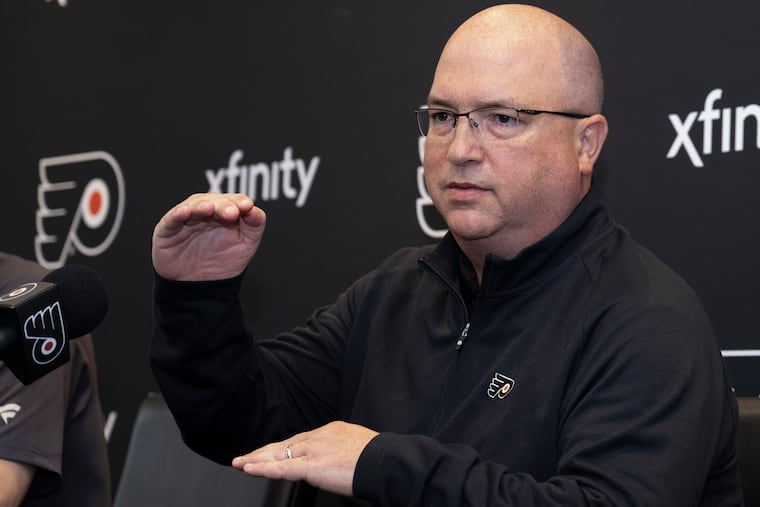
BUFFALO, N.Y. — In Part 2 of The Inquirer’s two-part interview with Flyers assistant general manager Brent Flahr, he gives some insight into the prospects already in the system.
This interview has been edited and condensed for clarity and was conducted on June 3.
Q: Was there anyone who set themselves apart, or surprised you this season?
A: I don’t think there were too many surprises. Obviously, Porter Martone’s finish — we thought he could play [but] we didn’t know he was going to have that level of impact, maybe. But other than that, Jack Berglund, maybe for fans who didn’t know him well, that’s just been the way he’s played the last couple of years. ... Heikki Ruohonen, at the World Juniors, that grouping there maybe stepped up. Overall, our kids have been good. ... So it’s exciting.
Q: Not everyone has the same opinion on Jett Luchenko and how things went this year. So, how do you think his season went?
A: I don’t think he’s happy with his points or whatever. Still, there’s a stretch there where — I don’t know whether it was pressure — just wasn’t on his game, as far as offensively. But even his B-game is still very good with his speed, defensively responsible, and I think he lost a little confidence, maybe on the offensive side of things. But he bounced back, had some really good games down the stretch; he’s already been a really good player for us in the past, within the system, and he’ll get it back and get it going. You know, he’s also missed most of last summer training-wise too, which set him back due to injury, so I think he’s got a big summer here, hopefully.
» READ MORE: Q&A: Brent Flahr on the Flyers’ draft strategy with the 21st pick, whether trading the pick is an option, and more
Q: Do you think getting that one playoff game gives him a little confidence moving forward?
A: I shouldn’t say lack of confidence, but he knows he’s a good player. I just think it should give him confidence that he knows that the coaching staff thinks that highly of him — and that wasn’t our decision, that [was] the coach doing that. But, no, I think he knows what he is, but he also knows what he’s going to have to do to crack the NHL and stay there full time.
Q: With the changing landscape, do you like that more and more players are going to college hockey?
A: It’s up to every player. I don’t think a lot of these kids understand how hard college hockey is, and how fast it is, and you’re playing against older players. Some kids are ready for that, and some kids aren’t, so it’ll take longer for them to adjust. ... So, yeah, it’s a new situation for us and the teams and agents; we’re all trying to figure this out as we go. But there’s some good programs out there that do a great job and get these kids stronger, and, obviously, the hockey is good.
Q: Several players in the Flyers system are playing college hockey now, and some are off to play college hockey, like Jack Nesbitt this September to Michigan and Nathan Quinn next year at Northeastern. How does that impact things on your end?
A: Well, I think it will impact the American League a little bit, as not every kid at 19 or a CHL player is coming right in. In some cases, it might be beneficial [as] some kids aren’t quite ready for the American League physically or mentally at 20, so maybe having an extra year or two to play NCAA, and then transition. So, there might be a buffer zone in there where we have to find players to fill up rosters and stuff, but that’s not a big deal. Whatever is the best development path for these guys is fine. And there’s still going to be CHL kids that are going to be committed to schools, but maybe they’re ready for the American League right away, and they’ll go that route, too. So we’ll see.
Q: Speaking of Quinn, what did you see from him this year and does it change your outlook on his projection?
A: Well, he was a skilled kid. He was already a good junior when we drafted him, but when you see him off the ice, you see him on the ice — he knows how to play. A longer path, because physically, he’s got a ways to go, but he knows how to play the game. He has the ability to generate offense and make players around him better. I saw him a number of times because they have a number of draft picks on his team, and obviously I follow him as well, but he had a really good year. I thought he had some really high-end stretches, so he’s put himself in a position where he’s a legitimate prospect, and he’s improved from a year ago. Kind of met or exceeded expectations, and now that’s just a stepping stone for him, though; he’s got to keep working, getting better, and that’s his plan.
Q: Porter Martone was brought up often by the prospects regarding him gaining strength and making himself NHL-ready at Michigan State. With that, how excited are you for Nesbitt to go to a college program and build up his strength?
A: Porter, when we drafted [him], was a little more dense physically than Jack. Even though they were the same draft year, they’re far apart as far as where they are physically. So, Jack, we’re really excited about as a prospect, as a player. He’s got some work to do, just with his body type, to put on the right type of weight, get stronger. ... He’s a good player, a good prospect, and it’s a great program for him to come in to play with top players, and the way they practice, the way they train, it’s really conducive for improving. So we’ll see the timeline — we don’t really have one — but he’s excited about going there.
» READ MORE: Flyers Q&A: Danny Brière on the NHL draft and the progression of Jett Luchanko
Q: Jack Murtagh, a 2025 pick, will be a sophomore in the fall at Boston University. How did you see his past season unfold?
A: I think he was a little frustrated, just with the role, and his ice time kind of fluctuated all over the place. But the games I was at, he was good. I think he began to earn it, which is good and healthy. ... But he’s going to have a much bigger role this year, and my expectation is he’s going to make a big jump statistically. He brings a lot of assets [like] his speed and his shot. ... He played a lot of different roles, which, when he was available in the second round, it’s kind of why we drafted him. So there’s pro potential, but he’s got some work to do: get stronger conditioning-wise and fast, but he’s in a good program for that to happen.
Q: Carter Amico was his teammate with the Terriers but left a few months in for Muskegon of the United States Hockey League. Where do you see things with him now?
A: I think it was the right decision to go because he played a lot of minutes. He missed so much time last year [due to injury], and to not play a lot of minutes regularly, I think it wasn’t great for him. ... The first couple games, he’s ... catching his breath playing that many minutes, and then he started to go, and he really got better. But he’s an intriguing guy because of his size and skating ability and range and physicality, and his puck game and puck touches have really improved. And then they had a long playoff run, too, which was awesome for him, and selfishly for us, too, just to get him those games, which he needed. He’s going back to BU next year, and should be a lot more ready and more confident, I think, and obviously they’ll be more confident using him.
Q: What about Heikki Ruohonen at Harvard?
A: Yeah, I thought [this] last year was great. I was able to see him play a couple times there in Harvard, not just the World Juniors, but he had a big role there. One thing about playing [at Harvard], he was the first power play a lot of nights, first penalty kill, played in all situations, big faceoffs. So that was really healthy, and I thought he just got better and better. His skating is coming, his pace, he’s really working on his body, and he’s in a good environment for that to happen. He’s obviously a bright kid, too, and very focused on his school. And with his World Juniors tournament, I thought he opened people’s eyes, too, for the type of player he could become, and I think the way he played there translates to what he’s going to be in the NHL, hopefully, too.
Q: Spencer Gill will be turning pro in 2026-27. He’s battled a few injuries the last couple years, so where do you see his projection now?
A: Well, thankfully his team had a pretty good playoff run, so he got a number of games. He’s been frustrated, but he’s put on a lot of weight in his downtime because of injuries. Now we’ve got to get him quicker, stronger for the pro game. But I thought his playoff run was really good and he should be ready to jump in and play at the American League level. It’s going to be an adjustment period for him, but he’s a smart player, he’s puck friendly, he’s big. I think once his pace of play comes, and learning the details of the pro game, he should be a fairly quick study.
Q: Luke Vlooswyk and Matthew Gard were traded out from Red Deer of the Western Hockey League this season. How do you assess their seasons?
A: Vlooswyk, who just finished [with a loss in the Memorial Cup Final], had a great season in Everett, and he was a big part of that team — and we interviewed one of his teammates there this morning. But there’s another kid [who’s] got the tall, lanky frame that’s going to take some time to put on weight, get stronger; his mobility hopefully can come with that. He’s long, he’s rangy, good defender, and his puck game is improved dramatically. They’ve got a really good program there. I thought he just kept getting better and better, and a lot of big minutes, and he’s going to go back there next year and then the plan is to go to college. ... He’s a longer-path guy, but he’s shown some interesting traits this year, and he’s certainly taken a step in the right direction.
Gardo, I think once he got to Seattle, he emerged. But he’s another guy who’s tall and lanky. He’s got some work to do to get stronger, quicker with the explosiveness. He’s got a long stride, he’s got a powerful stride, so we project him to be a good skater — it’s going to take him the time to get there. Obviously, his defensive details have always been solid, but the offensive game in Seattle is good. ... Big, exciting year for him, and he’s in the same category: go back and wants to play junior. He had options to go to college this year, but I think his agent and even his family thought playing one more year, getting stronger.
Q: Max Westergård is an intriguing prospect: on the smaller side, but showed a lot of skill and a lot of upside at World Juniors. What did you see from him this year?
A: He’s actually bigger than I thought when we initially drafted him, but what he brings is, he has a skill set ... [and] he has dynamic speed, and he’s sneaky strong. He has one-on-one ability; he has the ability to generate offense out of nothing because of his speed, and he can score. ... I think he’s in a good spot over there [in Sweden] to keep going. I know colleges are all over him, but he’s not going to college. I think he’s in a good spot, and hopefully earn his spot on Frölunda. We have a good relationship with them, so if he’s not having a bigger role than down to Allsvenskan, which is the second division, hopefully have a good role. But he’s determined to make it there, and they’re going to give him a chance, too.