Eric Tulsky grew up in Philly and wrote for Broad Street Hockey. Now, the Carolina GM is facing his hometown team.
Tulsky went to Penn Charter and got his Ph.D. in chemistry. But his interest in numbers soon led him to a position writing about the Flyers at Broad Street Hockey. Now, he faces them in the playoffs.
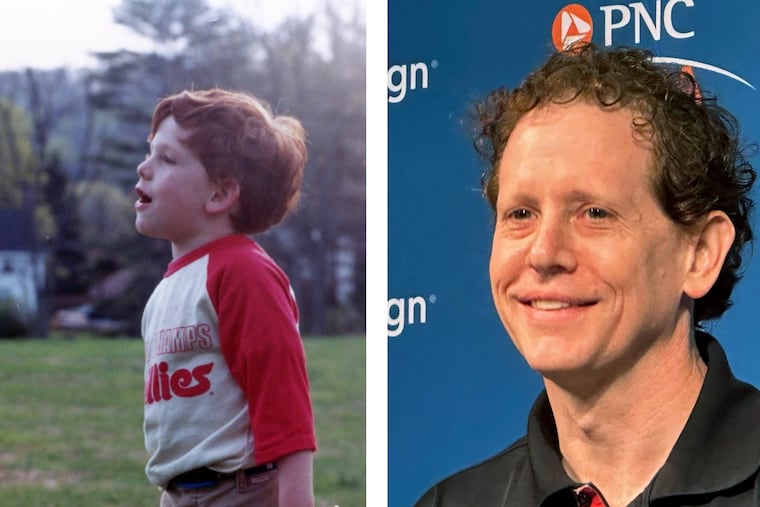
RALEIGH, N.C. ― Eric Tulsky was raised in West Philadelphia, at 44th and Baltimore. He went to Penn Charter and spent summer nights at the Vet (Section 244), where he cheered on Mike Schmidt and Steve Carlton.
His allegiances are a little different now. Tulsky, the general manager of the Carolina Hurricanes (and the son of former Inquirer reporter Rick Tulsky), is no longer a Flyers fan, writing for the blog Broad Street Hockey.
But he still loves the Eagles, Sixers, and Phillies. And every once in a while, when the executive is walking the concourse at the Lenovo Center in Raleigh, N.C., he slips into his native tongue.
“I do find myself saying, ‘Go Birds,’ to people from time to time,” Tulsky said. “If you’ve got an Eagles hat on, and you’re in our building, then, you know ... ‘Go Birds.’”
» READ MORE: Matvei Michkov is 5,100 miles away from his home in Russia. But in Philly, ‘life has become easier.’
He is likely to see more of them this week. On Saturday night, Tulsky’s hometown team lost 3-0 to his carefully crafted roster in Game 1 of the Eastern Conference’s second round in Raleigh.
On Monday, Philadelphia and Carolina will face off in Game 2. If Tulsky were simply a Philadelphia native, this would just be a funny coincidence.
But his ties to the Flyers go beyond that. The 50-year-old executive says he entered the field, in large part, because of his three years at Broad Street Hockey.
What began as an unpaid hobby — hanging out in the comments section under the username “Eric T” — became an introduction into the world of sports analytics.
And as he runs a perennial Stanley Cup contender, Tulsky isn’t sure where he’d be without it.
“If I had been reading Sports Illustrated, or the Sporting News, if those had been my only sources, I doubt I would have ever found the hockey stats community,” he said. “I think the whole thing would have been different.
“But I happened to stumble onto a blog that was paying attention to hockey stats early on, and I liked the people there, and got engaged with the community there.”
Chemistry by day, hockey by night
Tulsky’s path to the Hurricanes was unconventional.
He studied chemistry and physics as an undergrad at Harvard and pursued his Ph.D. at the University of California, Berkeley.
It wasn’t until the late 1990s that he really started to dive into the sport. Two of his lab mates were from Minnesota and talked about hockey constantly.
Before long, the three chemists were ducking labs to watch New Jersey Devils and Flyers games at nearby Kip’s Bar and Grill (this was back when Minnesota was in between pro hockey teams).
Tulsky’s heightened interest in the NHL happened to coincide with a golden era of Philadelphia hockey. The Flyers made the playoffs every year from 1995 to 2006, reaching the Stanley Cup final in 1997.
He was hooked. After Tulsky graduated from Berkeley, in 2002, he continued to follow the team, even from the West Coast.
The future GM took a job as a nanotechnologist at a biotech company in Eugene, Ore., which is when he stumbled across Broad Street Hockey.
He moved to the Bay Area a few years later, to work at a solar startup called Solexant.
Tulsky had a little more time on his hands, because his wife and son were temporarily in Oregon, getting the house ready for sale.
So, he did what any reasonable hockey fan would do with his newfound respite: He built his own software to extract NHL data and began writing detailed comments and posts on his favorite Flyers blog.
The software would comb through the NHL’s data for every game and input it into various formats. It helped provide more context around what fans were seeing on a given night.
“So you could say, when this shot was taken, which players were on the ice?” Tulsky recalled. “And was it five-on-five, or empty net, or power play, or what? That raw material, a detailed summary of what happened in the game, and who was on the ice when it happened, was sort of the fodder for the kind of analysis I was doing.”
The admins at Broad Street Hockey quickly realized that “Eric T” was not your average commenter. Geoff Detweiler, an editor at the blog from 2009-13, remembered being struck just by the tone of Tulsky’s posts.
“He would always chime in with something really intelligent, measured, and reasoned,” he said, “which, not to make light of it, but it definitely stood out in a Philadelphia comments section.”
Tulsky became a de facto translator for the blog’s audience, explaining in simple terms what the data was telling them. Broad Street Hockey, relative to other sites in the 2010s, was more interested in this side of the sport.
The future GM found that he was, too, and as he answered questions for his fellow commenters, he started coming up with new queries of his own.
“These were the early days in the field, when there was a lot that still needed to be fleshed out,” he said. “And so, pretty quickly, I found myself starting to want to answer some of those questions.”
Soon after he developed the software, Tulsky graduated from the comments section to Reddit-style blog posts. It was there that he caught the attention of the Broad Street Hockey founder, Travis Hughes, who asked if he’d like to join his staff.
“Staff” might be too generous a word. Broad Street Hockey had three regular writers before Tulsky; only one was paid. But the Philadelphia native loved the community, and enjoyed the research, so he decided to carve out some time.
This ended up being a life-altering choice, despite the fact that Tulsky still saw it as a hobby. As the sport began to slowly catch up analytically to the likes of baseball and basketball, the future GM found himself at the forefront.
“I was playing around with numbers on a spreadsheet for fun,” Detweiler said. “And that’s essentially where the state of hockey stats was. It was just taking counting stats and trying to figure out what is related.
“Eric was, I would say, one of the first dozen to take it beyond that.”
Tulsky’s articles were more predictive than reactive. Detweiler remembered one they collaborated on about Ilya Bryzgalov, not long after the goalie joined the Flyers.
Bryzgalov’s save percentage was lower than it once was. Rather than harping on the number, Tulsky put it into the context of the entire league.
He looked at other goalies, who had similar workloads, paying close attention to those playing on back-to-back nights.
His conclusion was that Bryzgalov was far from an anomaly, given how he was being used.
To Detweiler and Hughes, it was as if a mystery hockey savant had dropped out of thin air.
“That was the vibe,” Detweiler said. “It is crazy that this man is just in our comments section. I remember looking up his LinkedIn profile at one point. He had multiple patents registered with the U.S. Patent [and Trademark] Office.
“I had no idea what to expect. But I remember being like, ‘I have to see this guy’s resumé.’ And it was wild. Wild.”
From the comments section to the NHL
In 2012, Tulsky transitioned to a blog called NHL Numbers, which paid him $100 a month.
It was a small stipend, not nearly enough to live on, but the notion of being paid to write and think about hockey analytics was exciting, nonetheless.
Later that year, he and another writer, Derek Zona, came together to pitch a consulting service to NHL teams. The endeavor was unsuccessful, but it did give Tulsky something he didn’t have before: league contacts.
The future GM sent out a “round of spam” to as many executives as he could, in the hope that someone would bite. One team, the Nashville Predators, did, asking if he’d be interested in working as a consultant.
» READ MORE: Some wanted to change Trevor Zegras. The Flyers let ‘Z be Z.’ Now, he’s got his ‘swagger back.’
It was an unpaid position, but one that got his foot in the door. In 2013, a year in which he consulted for two NHL teams, Tulsky presented at the MIT Sloan Sports Analytics Conference, on the benefits of using zone entry data to evaluate a player’s performance.
In 2014, the Hurricanes brought him on as a paid part-time consultant, working 20-25 hours a week. The Philadelphian was still living in Berkeley, but was working in San Jose, which was about 90 minutes away.
He’d leave home at 6 a.m., stay in the lab for 9-10 hours, drive back, and do three to four more hours of analysis for the Hurricanes. It was a long year.
“I was stretched very thin,” Tulsky said. “There were a lot of days that I was up until 1 or 2 in the morning trying to get done the thing that I needed to have for the upcoming game. Then my alarm’s going off at 5:30 the next morning.
“So, I was really not sure I could keep doing that. It was a lot of fun, but it was a lot of work, too.”
After his contract expired in 2015, Carolina offered him a full-time job as a hockey analyst. Tulsky was promoted to manager of hockey analytics in 2017, to VP of hockey management and strategy in 2018, and to assistant GM in 2020.
In May of 2024, he was named interim GM after Don Waddell resigned, a role that became permanent a few months later. Tulsky had a formidable assignment ahead: The Hurricanes had long been contenders, but struggled to get over the hump in the playoffs.
And now, a decade after he wrote blog posts about Danny Brière and Sean Couturier, he is facing both of them in the second round.
This was not where the executive imagined his life going. But he’s happy it’s where it went.
“Incredibly grateful,” Tulsky said. “It is remarkable that I’ve ended up where I am in my life, and I am incredibly appreciative of everything that fit together to make that possible.”