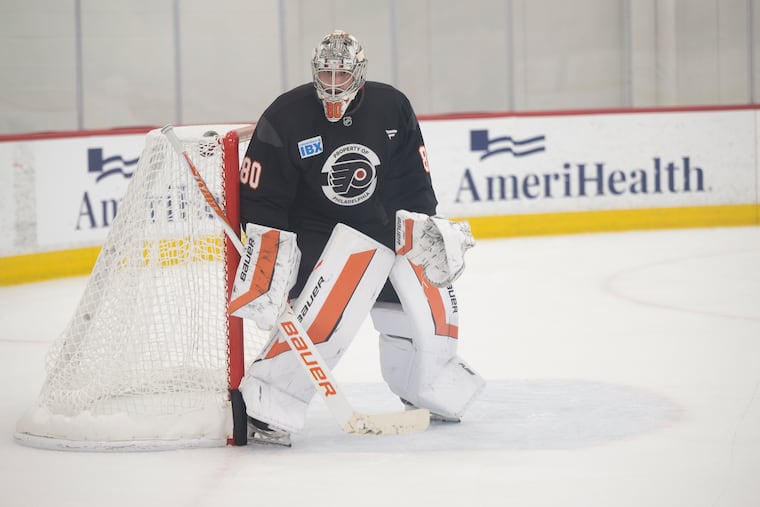
Matvei Michkov is 5,100 miles away from his home in Russia. But in Philly, ‘life has become easier.’
The 21-year-old's adjustment to North American culture, the English language, and the NHL is ongoing. But the Flyers winger is starting to feel more comfortable on and off the ice.

When Matvei Michkov walks into his Voorhees home, the first thing he smells is his mother’s cooking. It could be any dish on a given night; borscht soup, dumplings, or pasta and chicken, his favorite.
The 21-year-old winger doesn’t take it for granted. At every stop of his hockey career, his family had been by his side, from his earliest days in Perm, Russia, to his stints with Lokomotiv Yaroslavl, SKA St. Petersburg, and HC Sochi.
That changed in 2024, when he arrived in Philadelphia, young, unsure of his surroundings, and alone.
The Flyers had selected Michkov a year earlier with the seventh overall pick in the 2023 NHL draft, but it seemed like they’d have to wait before the highly touted prospect joined their roster.
» READ MORE: Some wanted to change Trevor Zegras. The Flyers let ‘Z be Z.’ Now, he’s got his ‘swagger back.’
Michkov, whose Flyers will open this year’s Stanley Cup playoffs in Pittsburgh on Saturday, was in the midst of a five-year contract with SKA St. Petersburg, but managed to terminate it two years early in June 2024. A month later, he left for the U.S., unaccompanied by his family.
He couldn’t speak or understand English and struggled with the cultural differences. Everyday tasks that were easy in Russia suddenly became hard.
Slava Kuznetsov, the team’s skating coach and translator, was on call 24 hours a day. A few times, Michkov would ring him from the gas station, asking how to refuel his car.
“Because he could not talk to [the attendants],” Kuznetsov said.
There were countless examples like this, and for a then-19-year-old, whom many hoped would save the dormant franchise, in one of the most intense sports cities in the world, it was a lot.
But since then, his outlook has improved. In August 2024, his mother, Maria, and his brother, Prohor, moved to South Jersey and rented a house a few doors down from Kuznetsov.
This year, the winger is starting to pick up more English and can communicate with teammates and coaches without a translator. He doesn’t need to rely on GPS to get around.
Life in America still feels foreign, but now, it is a little happier.
“It’s good to feel at home,” Michkov said of his life in South Jersey, through a translator. “The atmosphere is home.”
Dreaming of the NHL
Michkov was born and raised in Perm, a provincial city not far from the Ural Mountains in western Russia. During the Cold War, it became a hub for artillery production, mining, and oil refineries, but the city has been better known in recent years for its contemporary art and world-class ballet.
It wasn’t a hockey hotbed like Moscow or St. Petersburg, but by age 2½, Michkov was already on the ice. His father, Andrei, played in local leagues around the city and was eager to see his son supersede him.
“He liked to score,” Matvei said. “He was not the fastest, but he could snipe. He knew what he wanted to see out of me. He would say, ’Don’t look at me. Be your best.’”
At first, the winger dreamt of being a goalie, imitating the likes of former Flyer Sergei Bobrovsky. He’d sit on his knees, with a glove in his right hand and a rubber ball in his left, throwing it against a wall at home as if he was stopping a puck.
Andrei, a strict disciplinarian, worried about his son breaking a piece of furniture.
So Matvei decided to get creative.
“I’d go to the bathroom and practice there,” he said with a laugh. “Nobody could hear.”
Coaches felt Michkov was undersized for a goalie, and moved him to forward, where he rapidly found success. The family moved to Yaroslavl, 16 hours from Perm, so he could play with the well-known youth program at Lokomotiv Yaroslavl.
» READ MORE: Flyers rookie Matvei Michkov is the latest Philly sports savior. Can he match the hype?
In the 2019-20 season, he scored 70 goals and compiled 109 points in only 26 games for Yaroslavl’s under-16 team. He added 15 goals and 28 points in 10 games for the U16 Russian national team that year.
Andrei served as a round-the-clock hockey coach, making sure his son stayed focused on his ultimate aspiration of playing in the NHL. This constant supervision didn’t allow for much whimsy, and it occasionally frustrated the teenager.
Sometimes after school, Matvei would go to the grocery store with his friends to buy chips and soda. They’d eat and drink in the yard at their apartment complex until Andrei showed up.
“I’d see my father and I’d have to say goodbye and go to practice,” Matvei said. “I was not allowed to eat junk food. He was always asking me to eat good.”
He added: “Sometimes I was a little bit angry about how they always had their eye on me. But without the guidance of my father, I would not be what I am right now.”
With every passing year, Michkov’s star continued to brighten. In 2021-22, he made his Kontinental Hockey League debut at 16 with SKA St. Petersburg, one of the most respected teams in Russia’s top league.
In 2022-23, he was loaned to Sochi, where he played for two seasons, tallying 28 goals and 61 points in 74 games. By age 18, Michkov had already established himself as a smart player with elite puck-handling skills, who had broken records at every level.
Still, he pined to reach the NHL, and he seemed close to making that jump.
Months before the 2023 draft, the family was upended by a crisis. On April 2, Andrei was declared missing. On April 4, Russian media outlets reported that he was found dead just outside of Sochi.
Andrei was 51. In a statement, the Russian Hockey Federation said he “sadly passed away in unexplained circumstances.”
Eighty-five days later, Matvei was in Nashville to embark on the next stage of his career.
He was selected by the Flyers in the first round, and in a media availability afterward, paid tribute to his late father.
“From a young age, my dad put a lot of work into my game,” he told reporters. “He taught me a lot of ways of disguising my shot. A lot of credit with my goal-scoring goes to [him].”
Life in America
After securing his early release from SKA St. Petersburg, Michkov departed Russia on July 22, 2024. Flyers general manager Danny Brière and team president Keith Jones met the prospect at John F. Kennedy International Airport in New York and drove him to Voorhees.
Training camp was about two months away, but the Flyers felt it was important to give Michkov extra time to acclimate to a new country and a new league.
The KHL played on a shorter schedule, in rinks that could be a variety of dimensions, and with a less physical, more calculated style. But it wasn’t just that.
Michkov’s language barrier made almost everything challenging. The cultural adjustments did, too.
One disparity he noticed almost immediately was that more people smiled at him in America than in Russia. Initially, he assumed these strangers had nefarious intentions.
“In Russia, people are more serious,” he said. “If they have something to say, they say it to your face. Here, it could be that they’re smiling to your face and say differently behind your back.
“At the beginning, I was not really comfortable because everybody would smile. Even in the stores, the gas station. I was not used to it.”
The time difference made it difficult to stay in touch with family and friends at home. Kuznetsov, his wife, Yulia, and son, Max, became Michkov’s stateside support system.
He lived with them for his first month in America. Yulia would make home-cooked Russian meals every night. They’d follow dinner with a Russian sitcom — Zhuki — about the contrast between country and city folk.
“We watched them all,” Kuznetsov said.
The skating coach gave the prospect guided tours of the local grocery store, gas station, and other routine destinations. This grew to include some surprising stops.
One day, Michkov asked Kuznetsov where he bought his activewear.
“Lululemon,” the coach responded.
He could tell Michkov was hoping for a trip. Kuznetsov relented.
“OK,” he said. “Let’s go.”
When they walked in, the winger’s eyes lit up.
“Lululemon,” the coach said with a laugh. “His favorite place.”
Michkov felt much more at ease once Maria and Prohor arrived in August 2024. They briefly lived out of a hotel, and then moved to South Jersey.
Yulia and Slava would translate for Maria on occasion. They’d also help Prohor navigate the newfound experience of attending an American high school.
His previous school in Russia hadn’t used a bus to pick up students. So, Kuznetsov explained how it worked: Where the stop was, what time to be there, and, of course, the importance of not being late.
“Little things that we’re used to here, the [athletes and families] that come in, it’s a nightmare for them,” Kuznetsov said. “You miss the bus. How do you get to school?”
‘Steak, pasta, and Sprite’
On the ice, Michkov had a successful first year in 2024-25. He fell just shy of being a finalist for the Calder Trophy, given to the NHL’s rookie of the year, after leading rookies in goals (26) and tying for second in points (63).
Despite his accolades, he still struggled to communicate with teammates and coaches. Left winger Noah Cates noticed that they sometimes spoke too fast, or used slang, leaving the teenager with an “overwhelmed” look on his face.
Kuznetsov couldn’t be everywhere at once. So, Michkov started to fend for himself. This was especially true when the team was on the road.
For almost the entirety of his rookie season, he’d pick up the hotel phone and order the only meal he knew how to recite in English: “Steak, pasta, and Sprite.”
It wasn’t until this season that the winger started feeling more comfortable conversing with his teammates (and choosing other options on the room service menu).
Cates made a concerted effort to slow down when they were going over shifts on the whiteboard or the iPad. Kuznetsov called it “hockey language.”
The Minnesota native spoke no Russian. Michkov knew only minimal English.
But as they scribbled on the board, and paused and pointed at the video, both players found that they could understand each other.
“Obviously, he’s such a smart offensive player and thinks about the game a little bit differently,” Cates said. “It’s very unique, but it’s special. And, like I said, you’ve just got to find him, and know where he’s going.
“It’s just going to the board, slowing it down, communicating different things that we’re seeing or want to accomplish.”
Michkov says his Flyers teammates have become his de facto English teachers this year, placing a particular emphasis on the expletives.
In turn, Michkov has shared some of his native expressions with his comrades.
“I feel like if I know any Russian, it’s curse words,” Cates said. “Goes both ways.”
After a slow start, the winger has been on a tear since February’s Olympic break. Michkov’s 22 points — seven goals, 15 assists — in 26 games led the Flyers after the restart, while he racked up 18 points and a plus-11 rating over his past 16 contests to finish the regular season.
He’s also developed more of a rapport with his teammates.
“I’m going to be honest with you guys,” coach Rick Tocchet told reporters on Thursday. “Early this season, [he was] not a ‘loner,’ but he was kind of alone a lot.
“Now, he’s around the young guys, I think it’s a huge development for Mich. Even with the language barrier … I think he’s actually stepped up his English. But he’s more involved.”
A happier year
Not far from central Perm, along the banks of the Kama River, is a well-known art installation. It has become a modern symbol of the city, appearing on magnets and other souvenirs, and even in some Russian movies.
In four words, and 17 big, red, block letters, the landmark reads: "Schastye ne za gorami.“ Translated to English: ”Happiness is just around the corner."
When Michkov first arrived in Philadelphia, it might not have seemed so close. But it doesn’t feel that way anymore. He can now go to a gas station without giving Kuznetsov a call.
He can navigate a supermarket on his own and has broadened his palate beyond steak, pasta, and Sprite. When a stranger smiles, he’s started to smile back.
The simple things are simple again, even 5,100 miles from home.
“Life has become easier,” he said.

Flyers win series 4-2
Game 1: Flyers 3, Penguins 2 | Sielski: Kids stand tall
Game 2: Flyers 3, Penguins 0 | Sielski: Stealing Pens' will
Game 3: Flyers 5, Penguins 2 | Sielski: Shades of glory days
Game 4: Penguins 4, Flyers 2 | Sielski: New test awaits
Game 5: Penguins 3, Flyers 2 | Hayes: Now what?
Game 6: Flyers 1, Penguins 0 (OT) | Sielski: Exceeding expectations