Chris Pronger on his time in Philly, his impressions of the 2025-26 Flyers, and his new book: ‘Earned’
In his new book, "Earned: The True Cost of Greatness From One of Hockey’s Fiercest Competitors," Pronger recounts “a career defined by triumph, adversity, and transformation.”
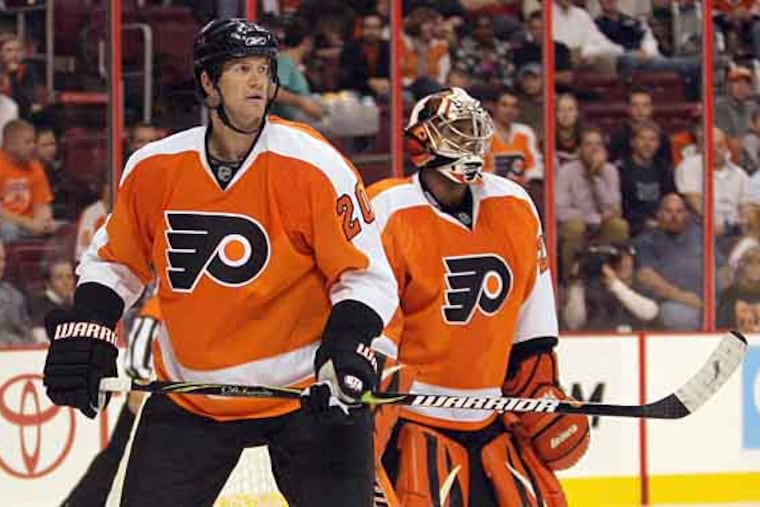
Across 18 NHL seasons, Hall of Famer Chris Pronger established himself as one of the best and most imposing defensemen ever to lace up a pair of skates.
From being traded for Brendan Shanahan as a 20-year-old to winning the Hart Trophy and the Stanley Cup to an up-and-down spell with the Flyers, and now a career in broadcasting, Pronger has lived a full hockey life. In his new book, Earned: The True Cost of Greatness From One of Hockey’s Fiercest Competitors, Pronger recounts “a career defined by triumph, adversity, and transformation,” while also providing his formula for pursuing greatness.
Ahead of the book’s release earlier this week, The Inquirer’s Jackie Spiegel sat down with Pronger, 51, to discuss a variety of topics in the latest installment of Flyers Extra, which can be found below. Here are some of the highlights from their conversation.
The interview has been edited for clarity and length.
Q: This book is a bit different as it is not just a traditional memoir but also a road map for life. Why was it so important to share your formula — Standards + Adversity + Ownership = Success — with people?
A: Those [pillars] seem very difficult in the moment, but when you think about standards, it’s setting non-negotiables that you uphold every single day. You think about discipline and habits. And then you think about ownership. Like, you have to be able to self-assess, you have to be able to look at yourself in the mirror and really say, “Am I holding up my end of the bargain? Am I doing what I said?” And also more importantly, am I looking at things and saying, “OK, I want to do this.” Well, then why aren’t you? What is holding you back? How dedicated are you? What are you willing to sacrifice? ... A lot of the book is really just about those pillars and kind of how that fits in with where you are in life.
Q: There was one line in the book that kind of stood out for me where you say, “Every setback isn’t a detour. It’s a training ground for the next level.” Explain what you mean by that.
A: I say all the time in my speeches that adversity is a gift. Like, we don’t lean into it enough. We always want to stay comfortable. We try to skirt pushing ourselves too hard or challenging ourselves too much. And I think if we can get comfortable really kind of pushing the envelope and going past that little barrier that we’ve set, the more often we’re going to challenge ourselves, the more comfortable we’re going to be in those moments, the better we’re going to perform.
» READ MORE: Chris Pronger weighs in on Matvei Michkov and a Flyers rebuild that’s been going on ‘for what seems like 12 years’
Q: You speak about “culture” in your book and how it wins championships. Culture is a big word that gets thrown around a lot in Philadelphia, especially during this rebuild. Why is it so important?
A: When you bring people into a locker room, how are they assimilating? ... What is the standard that’s been set? How is Porter Martone when he walks into the Flyers locker room, and he assimilates into the team, what is the expectation? What does he know about how we practice? How do we perform? How do we work out in the gym? ... And then as we continue to create that culture of accountability and that culture of belief in one another, the spirit of the room lifts and everybody starts having that belief in one another. That we’re all bought in. We’re all working towards a common goal.
Q: Speaking of the current Flyers, what do you make of Matvei Michkov’s sophomore season, especially as a former high pick who endured some initial adversity?
A: When you’re trying to develop a young player like him, who’s super talented, you don’t just get free rein to do whatever you want. We just finished talking about habits and standards and building a winning culture. You don’t just give, you’ve got to earn ice time. You have to earn the trust of the coach. ... Why aren’t they just playing him 25 minutes a night? ... By doing that, he’s going to create bad habits, and the next thing you know, you’re going to be like, what’s wrong with the kid? ...
He looks like he’s in much better shape. He will come into camp next year in much better shape. He is now learning how to play better defensive hockey. He’s learning what he needs to do. And I think all under the premise and the guise that you’re not going to stymie his offensive creativity and his offensive production; albeit initially it may feel like that because you’re trying to teach him the game and how to play the game properly.
Q: Talk about landing in Philly in 2009-10. How do you look back at your time now?
A: I was very excited. I wish it would have been a little bit earlier in my career. It was a perfect fit. Match made in heaven. ... Things happen for a reason, and unfortunately, I got hurt and had my career-ending injury, but it was a great two-and-a-half, three-year run. Had a great time in Philly, played with some amazing players, and unfortunately came up a little short in 2010, but I think overall my experience was tremendous here in Philadelphia and with the Flyers, and Mr. Snider was great to me.
Q: You often speak openly about your concussions and post-concussion syndrome and how it even impacts you today. Why was it important for you to speak out about everything you went through?
A: It was a pretty dark place there for about a year and a half. The game is kind of stolen from you, for lack of a better term, and you’re not quite ready to give it up and push back. Tried to play through it, and just couldn’t do it. And then you start coming to grips with the fact that you’re done. ... OK, now I’ve got to try to get healthy again. What does my quality of life look like? It took about a year and a half to retrain my eye. ...
» READ MORE: Porter Martone’s fast start with the Flyers was forged in Michigan State’s gym: ‘The best decision I ever made’
I kind of hit a point towards the latter part of my days here in Philly, at the end of that season of like, all right, I was just sitting around my house in the dark doing nothing and one day I was getting a little out of shape and I was eating like crap. I was eating junk food and eating and just not doing anything. And finally, I was like, “Yeah, all right. Today’s the day I stop. I’m done.” I just made a pact with myself. ... First couple weeks were a bit of a battle just dealing with the symptoms, but as soon as you get over that part of it, I got a little bit better, a little bit better, a little bit better and then next thing you know, you’re living a fairly healthy life, albeit a little bit differently.