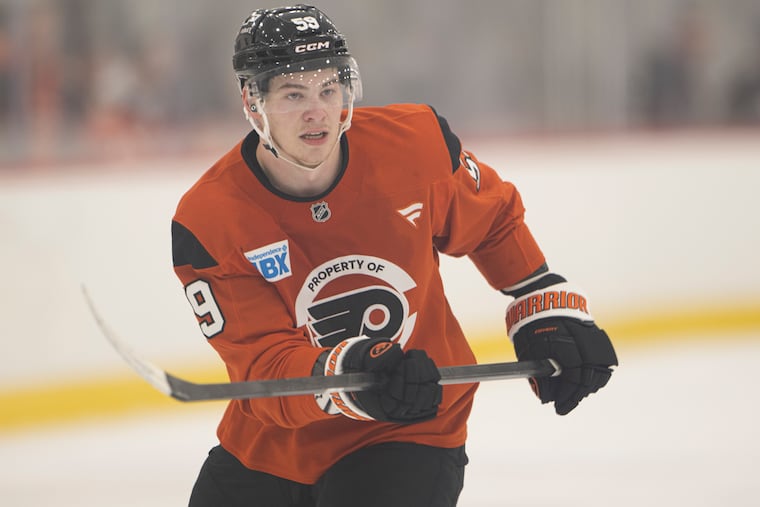
During the recent Olympic break, the Flyers called up a few youngsters to fill out their roster for a series of practices.
One of those players was top defensive prospect Oliver Bonk, who is finally settling in with Lehigh Valley after an upper-body injury cost him all of training camp and delayed the start of his pro career until mid-December. The Inquirer caught up with Bonk last Thursday for an interview to discuss his frustrating summer, his adaptation to the pro game in the minors, and much more.
Q: To start, what has this year been like for you?
A: Yeah, I mean, it’s been a learning year. Trying to, even after the rehab, trying to learn how to take care of my body better, and learning how to play pro hockey. Learning how to be a good player up there and not just being an average player up there. You want to be the best so you can make it back up [to the NHL]. So I think just learning all about that, how to be a pro, and kind of just learning as I go along.
Q:Are you someone who prefers to watch tape?
A: I like watching, especially after games. I like watching the clips. Some guys get focused on what they messed up and keep looking at that, but I just kind of let that go. Everyone’s going to make mistakes. It’s hockey, it’s not a perfect game. It’s never going to be. I’m not striving to be perfect every time I’m out there; just improving every time and making sure I’m making the right [reads] and then not making the same mistakes over again.
Q: What’s the transition been like for you to the pro game, especially after not playing until early December?
A: Yeah, it was a tough first 10 games, until I started kind of feeling like fully myself again. So it was definitely a learning curve there. But I think now, I’m kind of back to the way I want to play, and just improving my game every day and feeling good about myself. So it was tough at the start, but I think I’m on a good path right now.
Q: Is there anything you are particularly focused on improving?
A: There’s a lot. Every week, I kind of try to work on different things, whether it’s closing guys off with speed one week, or it’s hard passes, or it’s hand-eye coordination. Every week’s got something different, which is kind of different than in Junior. You mess around in practice and whatever; you shoot a couple of pucks, and you’re like, ‘Yeah, great.’ So I think it’s a lot different. It makes me excited to come to the rink every day, knowing that every week I’ve got something different planned, and something else to work on. So it’s good.
Q: You mentioned at development camp in July that you wanted to make the NHL team. How hard was it when the injury happened to reset how the year was going to go?
A: It’s tough. I thought I had a chance to make the team, and I believed that I could do it. But a setback, and now you’re starting the season off in the AHL — and still a very good league with very good players. So I think it’s just, it happened, and there’s really nothing you can do about it. But just like I said before, you can’t dwell on bad stuff that happens. It’s never going to help you. So I think just trying to get back up here, for me, has been the only objective, and just keep working at that every day.
Q: Two years ago, you had 67 points in 60 games. Last season, it was 40 in 52. Do you feel like your game has a good balance now?
A: I still try to work on both [sides of the puck] the most you can. After my draft year, I scored the 24 goals, and then the year after, it kind of slowed down. Our power play didn’t do as well, but we won the [Memorial] Cup, so I must have been doing something well. ... People will say whatever they want, and, ‘Oh, you can’t put up points,’ and whatever. But we won and that was the biggest thing for me that year. I didn’t score 20-whatever goals, but we ended up winning the Memorial Cup and the OHL, so I think obviously we must have been doing something right there.
Q: You have just over 20 games left this season, so what will be your focus?
A: I think it’s just playing the best I can for the team. Doing the most I can, give them the best effort every night to help us win. And play how I want to play, not just one side of the puck, but be a real 200-foot player that can be versatile and in any situation and stuff like that. So I think that’s the focus for me.
» READ MORE: Flyers top 20 prospects: Porter Martone is No. 1, but where do Alex Bump and Jett Luchanko rank?
During the recent Olympic break, the Flyers called up a few youngsters to fill out their roster for a series of practices.
One of those players was top defensive prospect Oliver Bonk, who is finally settling in with Lehigh Valley after an upper-body injury cost him all of training camp and delayed the start of his pro career until mid-December. The Inquirer caught up with Bonk last Thursday for an interview to discuss his frustrating summer, his adaptation to the pro game in the minors, and much more.
Q: To start, what has this year been like for you?
A: Yeah, I mean, it’s been a learning year. Trying to, even after the rehab, trying to learn how to take care of my body better, and learning how to play pro hockey. Learning how to be a good player up there and not just being an average player up there. You want to be the best so you can make it back up [to the NHL]. So I think just learning all about that, how to be a pro, and kind of just learning as I go along.
Q: Are you someone who prefers to watch tape?
A: I like watching, especially after games. I like watching the clips. Some guys get focused on what they messed up and keep looking at that, but I just kind of let that go. Everyone’s going to make mistakes. It’s hockey, it’s not a perfect game. It’s never going to be. I’m not striving to be perfect every time I’m out there; just improving every time and making sure I’m making the right [reads] and then not making the same mistakes over again.
Q: What’s the transition been like for you to the pro game, especially after not playing until December?
A: Yeah, it was a tough first 10 games, until I started kind of feeling like fully myself again. So it was definitely a learning curve there. But I think now, I’m kind of back to the way I want to play, and just improving my game every day and feeling good about myself. So it was tough at the start, but I think I’m on a good path right now.
» READ MORE: Is the Flyers' rebuild working? Here's a look at their moves over the last three years
Q: Is there anything you are particularly focused on improving?
A: There’s a lot. Every week, I kind of try to work on different things, whether it’s closing guys off with speed one week, or it’s hard passes, or it’s hand-eye coordination. Every week’s got something different, which is kind of different than in Junior. You mess around in practice; you shoot a couple of pucks, and you’re like, ‘Yeah, great.’ So I think it’s a lot different. It makes me excited to come to the rink every day, knowing that every week I’ve got something different planned, and something else to work on. So it’s good.
Q: Do you plan that out, or is it in consultation with someone like defense coach Nick Schultz?
A: No, it’s just kind of whatever I make up. I have a notebook of things that you do and things that need improving and you just go every week. You don’t want to change it every day, because you want to kind of have a steady look of how you’re improving. So last week, maybe hand-eye coordination, trying to bat down two-on-ones, and stuff like that. So you just focus on that for a week, and you kind of see how, by the end of the week, you’re more comfortable, you’re better doing it.
Q: You mentioned you keep a journal. After games, do you jot things down to track your development?
A: It’s more like, this week you work on this, this, this; three things you want to work on after practice, a couple of things before practice. You just bang that out during the week, and then next week, you can reset and see what you didn’t do well that week, and maybe improve on that.
Q: Do you talk to your father, former NHLer Radek Bonk, about what to work on to get ideas?
A: We talk about it, and we always talk pretty much every day. Like about practice and what he thought about the game and stuff like that. But I think most of it’s got to come from me. I definitely lean on him heavily ... he’s my dad, and he’s here to support me, but I got to kind of figure it out because he’s not coaching me anymore, and he’s not always here with me, so I kind of got to figure it out on my own what I got to improve on.
Q: You mentioned at development camp in July that your focus was on making the NHL team. How hard was it when the injury happened to reset how the year was going to go?
A: It’s tough. I thought I had a chance to make the team, and I believed that I could do it. But a setback, and now you’re starting the season off in the AHL — and still a very good league with very good players. So I think it’s just, it happened, and there’s really nothing you can do about it. But just like I said before, you can’t dwell on bad stuff that happens. It’s never going to help you. So I think just trying to get back up here, for me, has been the only objective, and just keep working at that every day.
Q: You said in September you gained 15 pounds of muscle, and then the other day you mentioned that you gained a little bit of weight when out with the injury. How hard was it to get back into game shape when you hadn’t played a game since June 1?
A: I mean, there’s shape, but then there’s game shape. Every hockey player knows that once you get on the ice, it’s so much harder. It’s so much different when you get on the ice. And even just, from being on the ice and practicing, doing your rehab skate is tough, but then playing is a whole different thing. I did a lot of conditioning when I was here, but I still had a bit of weight. And then once you start playing, the five pounds that I lost, and I started to just feel a bit quicker and a bit more explosive and a bit better. So it’s not like I’m losing, like 15, 10 pounds, it’s not like going like that; it’s just little increments. But I feel like I lost five pounds, and it really helps.
Q: When John Tortorella was here, he mentioned your pace of play as an issue. Do you feel like you’re learning to play with better pace in the AHL and getting reps at that speed?
A: Yeah. Our team, we try to play the same way as Philly and do the same stuff. We’re not as skilled, obviously, because we’re in the AHL, but I mean, we try to do the same stuff and play the same way and play a pace game, trying to score off the rush and do all that stuff. So I think it’s a big thing that [Phantoms coach John Snowden] has been on us too, like, move the puck up and try to just get up, get in the rush. Don’t just hold it, because then the forwards are crossing and it’s annoying for them. So yeah, it’s definitely been a big thing of focus for all the [defensemen] this year in Lehigh.
Q: Two years ago, you had 67 points in 60 games. Last season, it was 40 in 52. Do you feel like your game has a good balance now?
A: I still try to work on both [sides of the puck] the most you can. After my draft year, I scored the 24 goals, and then the year after, it kind of slowed down. Our power play didn’t do as well, but we won the [Memorial] Cup, so I must have been doing something well. ... People will say whatever they want, and, ‘Oh, you can’t put up points,’ and whatever. But we won and that was the biggest thing for me that year. I didn’t score 20-whatever goals, but we ended up winning the Memorial Cup and the OHL, so I think obviously we must have been doing something right there.
Q: You and Denver Barky know each other well from London. What’s it like watching him in the NHL now?
A: Well, it was great to see him in Lehigh, and I was excited to spend the season with him, and then he gets called up right away. So, there’s still guys at Lehigh, but [Ty] Murchison got hurt, and then [Hunter] McDonald got called up, so I’m like there’s no more young guys to hang out with. But, yeah, it’s great. It’s awesome seeing him here, and he’s playing unreal, and he’s a great player. But we miss him, definitely, in Lehigh, but it was great to see him here, and great to see how he’s learning and blossoming. It’s awesome.
» READ MORE: From trade bait to untouchables, here’s where the Flyers roster stands less than two weeks before the deadline
Q: You have just over 20 games left this season, so what will be your focus?
A: I think it’s just playing the best I can for the team. Doing the most I can, give them the best effort every night to help us win. And play how I want to play, not just one side of the puck, but be a real 200-foot player that can be versatile and in any situation and stuff like that. So I think that’s the focus for me.
Q: Flyers assistant coach Todd Reirden was saying he had some drills last week that were specifically designed to see where you and McDonald were at. How did those go?
A: Yeah, we went through it [last Thursday], and he had video clips of the practice yesterday. But he had a couple of ones testing how well we’re going to react to the speed here. He was giving the forwards all the speed that they wanted, and then coming down on us. So it was a test for us, but I think we both did pretty well. And yeah, it’s just another thing to learn. And stuff is so much quicker, even from here to the AHL. It’s more on the tape, quicker, better players. So I think it’s another thing to get used to and another thing to learn.