Analyzing where the Flyers’ penalty kill went wrong in Monday’s 5-1 loss to the Penguins
The Flyers were well beaten on Monday night, and it was their normally stout penalty kill that let them down most, surrendering three goals on four Pittsburgh power plays.
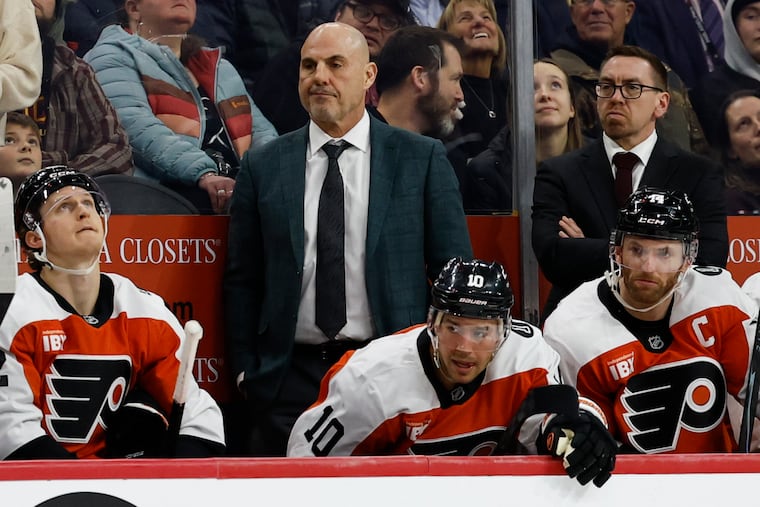
The Flyers entered Monday’s matchup with the Pittsburgh Penguins with the league’s fourth-best penalty kill. When the night was done, the Flyers were handed a 5-1 loss to snap a three-game winning streak, and their penalty kill slipped to ninth.
In some ways, it made sense. The Penguins started the day with the NHL’s No. 2 power play and an impressive 30.2% effectiveness. Even with that, no one expected them to score three times in four opportunities.
» READ MORE: Flyers activate Oliver Bonk from injured reserve, assign him to Lehigh Valley
The Penguins now have the NHL’s No. 1 power play at 33.3% — which is ridiculous when you think about it. But maybe not.
“Well, they’ve got a championship pedigree, right?” Flyers coach Rick Tocchet said. “They’re well-coached. They stuck to their game plan. They went north on us. First period, actually, we had some chances, [but] not much velocity on the shots. I don’t know, we weren’t assertive enough. And then obviously the PK, which has been good all year, struggled tonight.”
Tocchet knows the Penguins. He was an assistant coach on former Pittsburgh coach Mike Sullivan’s staff and won two Stanley Cups. And he ran the power play.
Yes, the Penguins’ power play boasts Sidney Crosby, who is 23rd in NHL history with 191 power-play goals and scored one on Monday night. And, yes, there’s Evgeni Malkin, who is four spots below Crosby and has 185.
But the Flyers coach also hasn’t liked his group’s penalty kill the last five games, noting the structure. It was exposed to the utmost degree at Xfinity Mobile Arena.
“We’ve been running around lately,” he said. “We’re an aggressive diamond ... and if you look at the goals, after the shot, two guys ran out of position, opens up the middle. Twice. Those are killers.”
The diamond pattern is just that, a diamond shape. It allows there to be a defender, usually a defenseman, in front of the goalie with the other defenseman as one of the points on the side of the diamond picking up someone in the circle, aka on the flank. There is one forward opposite that defenseman and another at the top of the diamond shape.
The aggressiveness comes with the unit moving together as one of the penalty killers puts pressure on the opposition’s power play. Does it leave open the middle of the ice and the person in the bumper? Sometimes, but an active stick and closing lanes are critical to this type of penalty kill.
“If you give them the flanker shots, you can live with it,” Tocchet said. “I think the [Bryan] Rust flanker, [Travis Sanheim’s] got to get out there. That’s his flex. He was backed in too much.
“He flexes out; his job is to take the weak side away so [Dan Vladař] can see it. Things like that. But that’s just, maybe that’s guys being tired, mentally tired. I don’t know.”
The Flyers’ penalty kill has been a strong suit for a while. Over the first 24 games, the Flyers had killed off 100% of the penalties they faced in 14 games, had allowed just one power-play goal in nine other games, and, before Monday night, had allowed two goals on the man advantage just once all season, against the Montreal Canadiens in a wild 5-4 shootout win in early November.
“All year, PK has been great for us,” captain Sean Couturier said. “Tonight we didn’t have it. They picked us apart. It happens. We’ve got to fix it and get back on track next game.”
The structure has fallen by the wayside a bit. The New York Islanders had the second-worst power play entering Friday’s game, and Anders Lee could stand in front of the net and deflect a point shot in. Against the New Jersey Devils, Timo Meier was allowed to crash the net down the middle and clean up a loose puck.
» READ MORE: Travis Konecny is playing with ‘more conviction,’ according to Rick Tocchet. Are the goals about to come?
On Monday night, Crosby buried the puck from just above the slot “because we cheated on one of them,” Tocchet said. Penguins defenseman Erik Karlsson carried the puck from the left to the right and down the boards, causing the Flyers to overcommit. It opened the ice for Rust, who sent a backhand pass to Crosby coming down the middle — and Crosby isn’t going to miss from there.
The Penguins added a third power-play tally after Malkin put a shot on goal, Kris Letang retrieved the rebound along the boards, and set up Tommy Novak for the shot past Vladař. The Flyers were out of their structure.
Initially, when Malkin shot the puck from the point, they collapsed into an I formation, meaning everyone straight down the middle. When the puck went to the boards, Owen Tippett went to him, which is fine, but Noah Juulsen and Nick Seeler were too low to step into Novak or play a possible pass to Ville Koivunen, who was sitting wide-open across the crease.
“They snap it around, and they get a lot of shots from the middle, and that’s what we’re trying to get our guys to do,” Tocchet said. “It’s actually a good learning lesson ... get that shot in the middle.”