Kombucha for your face: A Phoenixville fermenter transforms her bubbly brew into skincare products
“What if [skincare] could be like a beautiful, artisanal loaf of sourdough?” asks Baba’s Brew founder Olga Sorzano.
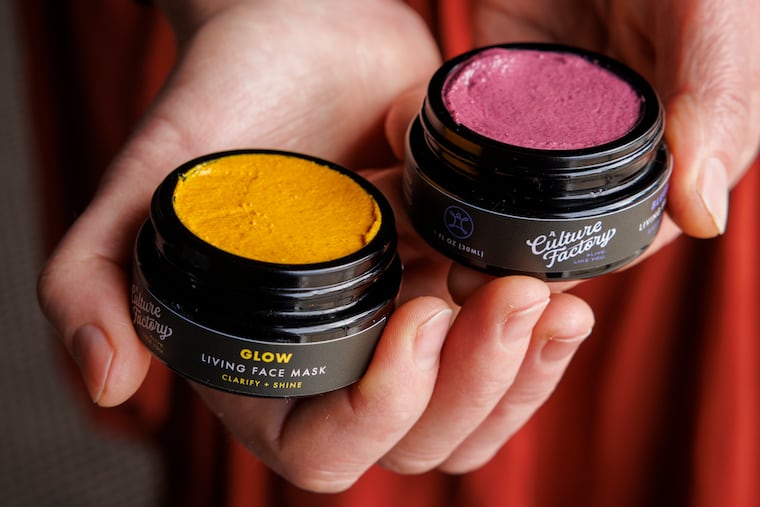
While you may be familiar with kombucha’s benefits for your gut, one brewer is determined to show that the beverage and its byproducts can also make for excellent skincare.
Phoenixville-based Olga Sorzano, 49, the owner and brewer behind decade-old Baba’s Brew as well as a chef and culinary instructor, has an expansive, multifaceted career — but all her varied interests are united by one thing: fermentation. Her newest venture is A Culture Factory, a line of kombucha-infused skincare products that ranges from toners and masks to scrubs and serums.
“Our skin is alive. Most skincare is like Wonder Bread, designed for shelf-stability, but what if it could be like a beautiful, artisanal loaf of sourdough, which is living and nourishing? It feeds you with a living culture,” said Sorzano.
“As a chef, I want to feed you. And I have a chef’s approach to the skin as well. My great-grandmother and grandmother didn’t have all these [store-bought] solutions. They had lard and they would put it on their elbows. And kombucha vinegar on their skin. If they had berries leftover from making jam, they’d mix it with yogurt for a face mask.”
Sorzano‘s kombucha company generates large amounts of scoby, or the mother culture used as a kombucha starter. “It’s loaded with all these enzymes and I was thinking, how awesome to use some surplus scoby and turn it into face masks.”
Many ingredients from Baba’s Brew — like turmeric, which Sorzano also ferments — make it into A Culture Factory’s products, too, along with tallow from Breakaway Farms in Mount Joy, which Sorzano renders, refines, and blends with green coffee oil for a bright yellow eye butter.
Paying tribute to Baba
“Baba” means grandmother in Russian. Sorzano’s kombucha company, in both its branding and its recipes, is an homage to her great-grandmother, who raised Sorzano in the town of Barnaul, Siberia (close to the Mongolian border) when she was very young.
“I would say, ‘Baba, my belly hurts,’ and she would say, ‘Have some kombucha.’ Or I would say, “My leg hurts,’ and she would also say, ‘Have some kombucha,’ ” said Sorzano with a laugh. She grew up thinking kombucha was everywhere, that everyone had access to it, and that it was a balm for all ills.
If Sorzano’s Baba made kombucha that over-fermented, “she would put it on her skin as a toner.” This was a beauty tip that has followed Sorzano her entire life, brewing as an idea for years until finally blooming into a business concept.
Fermentation, and the patience it demands, has long been a part of Sorzano’s family. To survive the long, bitter winters, the women in Sorzano’s family fermented everything they grew in their garden. “When I tell people about my childhood, they think I grew up in the 1700s,” she joked. “We foraged, we would go on mushroom hunts, we’d have a big cabbage day where several families would get together, chop cabbage, and preserve it for the winter.”
Baba’s Brew uses organic, fair-trade tea and sugar as the base for its kombuchas, but otherwise all its ingredients are local, like plums from Frecon Farms, blueberries from Hamilton, N.J., and honey from Swarmbustin’ Honey. They also brew many one-off, seasonal kombuchas, with ingredients like black currants, which frequently show up on Sorzano’s doorstep, brought by small farmers.
Sorzano came to the U.S. in 2000 as an exchange student with Future Farmers of America after receiving a doctorate in veterinary medicine in Moscow. She worked on a dairy farm in Nebraska for a year, milking cows and doing other farm work, then moved to Florida, met her husband, and when he was offered a job in Philly, moved to the area. She enrolled at the Restaurant School at Walnut Hill College and applied her veterinary school-informed chemistry knowledge to cooking.
“I found cooking very easy, because to me, everything is about chemical reactions,” she said. Cooking eventually led to her opening Baba’s Brew, the spark of which was born at a fermentation festival, where she realized there was a community of people in the U.S. fermenting single ingredients, just as her Baba had. In a sense, she found her own culture, through cultures.
A Culture Factory skincare launched this month and shares its name with the tasting room where Sorzano hosts private events and teaches cooking and fermentation classes (such as making your own kimchi or mastering basic cooking skills). “It’s where I bring people in and teach them to cook but focus on techniques like how to season or layer flavors,” said Sorzano.
Like the notions of producing fermentation “mothers” and the actual mothers in Sorzano’s family who treated every ailment with kombucha, Sorzano’s life has been threaded with yet another motif: the squirrel. She constantly “squirrels” ingredients away to ferment them.
The logo for Baba’s Brew is a squirrel because “Baba’s nickname was Belka [the Russian word for ”squirrel"]. And when we moved into this brewery, we had a squirrel infestation and we had to call animal control to remove them from the attic. And when we moved to our farmhouse, we had a flying squirrel infestation. I safely captured and released all 18 of them,” said Sorzano, proudly.
The tasting room is adjacent to the now-squirrel-free brewery in which Baba’s Brew produces 4,000 liters of kombucha per week. There, along with Baba’s Brew’s eight kombuchas on tap, you can now purchase Sorzano’s handmade skincare products, as carefully and locally sourced as the fruit that goes into her kombuchas.

Want to get Inquirer Chester County straight to your inbox every week? Sign up here for our guide to the news, stories, and events shaping life in your community.