Inside the Neon Clown Dream Lounge, a Kensington bar that takes clowning seriously
Roughly once a month, a group of clowns will sit at the bar in full costume and imbibe. “They’re appreciative of the space,” the bar’s manager said. “There’s not a lot of clown bars in Philadelphia.”
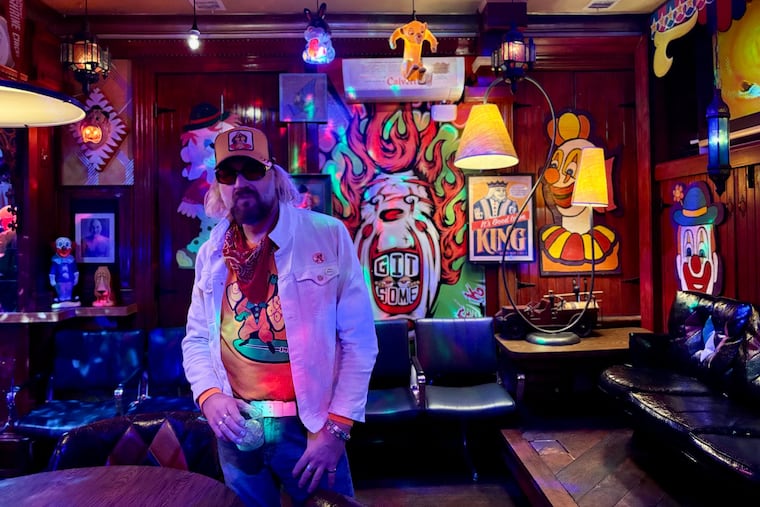
If you’re looking to clown around, look no further: Philadelphia’s quirkiest bar is a cross between a retro living room, an amusement park’s dumpster, and a clown collector’s dream.
Located above Kensington bar Kung Fu Necktie at 1248 N. Front St., the Neon Clown Dream Lounge has roughly 120 salvaged works of clown art competing for attention across the walls, the counters, and even the ceilings.
And yet, the bars’ owner — a man who would only refer to himself as Chicken (real name James Herman) — said the Neon Clown is not a shrine to the professional red-nosed jokers, despite its name and decor. Rather, Philly’s clown lounge is an ode to a few of Chicken’s favorite things: art deco furnishings, upcycled industrial trash, and a touch of clownery.
Chicken’s clown fascination began in the 1990s when he was building his career as an artist and gallerist inspired by Bernard Buffet, a French expressionist painter whose work often depicted downtrodden and almost skeletal clowns. Since then, the painted jokesters have flitted in and out of Chicken’s life. They became subjects of his own art and a bit for his band, Plaque Marks, which performs in full clown suits.
“How can you cancel a clown?” Chicken, 64, said while knocking back his first of several tequila and ouzo cocktails over a recent interview. “There’s no prospect of offending anybody with a clown ... Some people love them and some people dislike them, but there’s still a level of whimsy.”
The second-story space served as Kung Fu Necktie’s no-frills music venue until 2018, when Chicken said a Department of Licenses and Inspections officer ordered the second floor to close. The closure — coupled with the pandemic — gave the Kung Fu Necktie owner what he called the “perfect” opportunity to make something useful out of the salvaged wares he’d been collecting for decades from abandoned churches, condemned buildings, and going-out-of-business sales at theme parks.
When the Neon Clown Lounge opened in September 2024, it “was like a relief valve,” Chicken said. “I’ve had some of this s— for 30 years.”
@rochestermeetsphilly Neon Clown Dream Lounge, you were first up. Any suggestions for cool bars/bars that decorate for Halloween in Philly is appreciated ✨ #NeonClownDreamLounge #PhillyBars #BarsInPhilly #Philly #Philadelphia ♬ original sound - Rayven | Philly Creator
The clown bar was an apartment before it was anything else. The living room was replaced by the bar’s main seating area, where a leather couch and a row of vintage seating from one of LaGuardia Airport’s lounges sit beneath a cluster of clown masks Chicken retrofitted into ambient light fixtures. The parlor was knocked out in favor of a stage paneled with leftover wood from a now-demolished house on Front Street; the room is outfitted with a disco light that spins above couches fit for a conversation pit.
The rest of the space is peppered with clown portraits and figurines both large and small, including a trio of eerily childlike wooden cutouts Chicken purchased from Obnoxious Antiques, a warehouse that mines amusement parks for treasure in Burlington, New Jersey.
There’s no criteria for what makes a good piece of clownery, Chicken said, other than that it captures the aura of the 1970s. The decade was a golden age for clowns in popular culture, not long after Barnum & Bailey opened the first clown college to train people to emulate characters like Bozo and Ronald McDonald.
“I could’ve put out a bunch of crap you can buy at the dollar store,” said Chicken. “We want stuff that’s one-of-one and authentic. Something that is of the era, not replicated.”
A space for clowns, tended by the ‘clown neutral’
Bar manager Evan Madden — who self-identifies as “clown neutral” — said he tries to imbue the drinks program with the energy of a clown. Both, after all, are very serious about doing what some consider unserious work.
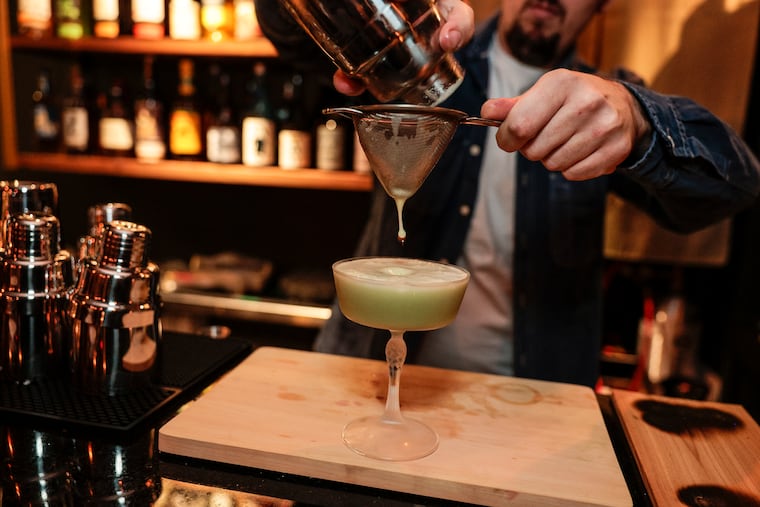
The Neon Clown Dream Lounge never has a cover, and the only food on offer are $2 hot dogs. The drink menu has 12 cocktails with names that conjure up images of killer clowns and carnival food, like “Endless Nightmare,” “Witching Hour,” or “Tropical Hot Dog Too.”
The Endless Nightmare is the lounge’s house margarita and uses Espolón tequila that Madden says spends just under a week marinating in a pineapple-lime mixture; on good weeks, the bar goes through six to eight 25-ounce bottles of the mix. The Witching Hour comes across as a spiked coffee, combining cold brew with rum, amaretto, mint extract, and a shot of dry Curacao for a citrus-y aftertaste. Tropical Hot Dog Too mixes smoky mezcal with a vermouth that spends hours steeping in a mixture of chilies, limes, and grapefruit liqueur.
Roughly once a month, Madden said, a group of clowns will sit at the bar in full costume and imbibe. “They’re appreciative of the space,” he continued. “There’s not a lot of clown bars in Philadelphia.”
Or anywhere, really. Outside of Philadelphia, the clown lounge’s only competition in the United States is Creepy’s in Portland, Ore., which has animatronic dolls and pinball, but only a fraction of Chicken’s clowns.
Still, not everyone is a fan, said Chicken: When the bar first opened, one customer left a review saying there weren’t enough clowns. Tough nuts, Chicken said with another cocktail in hand.
The clown lounge is “like a sanctuary ... a safe zone,” Chicken said. “We want to make the space feel open and comfortable.”